Showing posts with label Dialysis Patients' Quality of Life. Show all posts

Sunday, August 23, 2020

Surgical innovation promises better dialysis outcomes
Surgical innovation promises better dialysis outcomes
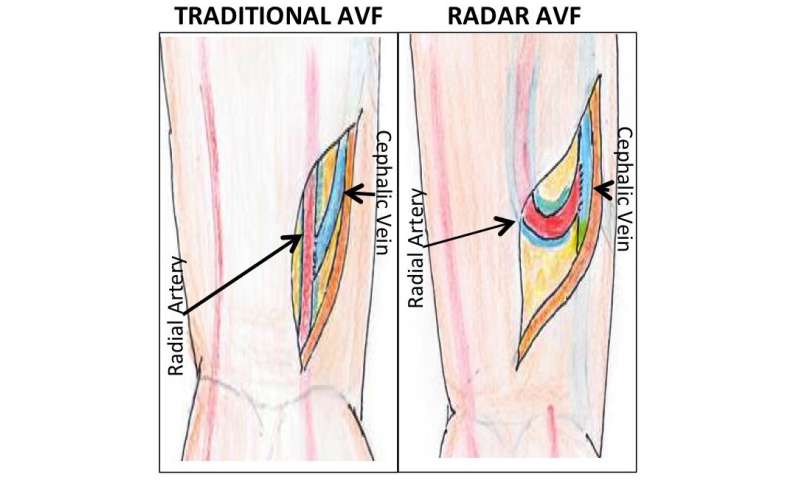
An illustration comparing the traditional approach to creating an arteriovenous fistulae in the arm to the scientists’ RADAR method. Credit: H. Bai et al., Science Translational Medicine (2020)

A new technique developed by a Yale-led research team improves blood flow in surgically made blood vessels used in dialysis, enables them to last longer, and results in fewer complications than the standard technique.

23 august 2020--The findings, based on work with hundreds of patients and supported by animal studies, appear in the Aug. 19 issue of Science Translational Medicine

Of more than 661,000 Americans with kidney failure, according to the National Institute of Diabetes and Digestive and Kidney Diseases, 468,000 are on dialysis, a method of filtering waste from the blood when the kidneys are damaged or fail. But the standard way of accessing a patient's blood flow has shortcomings the new technique overcomes.

Typically, vascular surgeons fashion a vein-to-artery arteriovenous fistula (AVF)—a larger, stronger blood vessel—by dividing a vein in the patient's wrist and joining it to the artery. This enhances blood flow and vein access for the two needles that route a patient's blood through the dialysis machine and back into the body. 

Yet the method, standard procedure for the last 50 years, has "the worst results of any procedure we do," said Yale School of Medicine's Dr. Alan Dardik, professor of surgery (vascular) and of cellular and molecular physiology, and senior author of the study.

Sixty percent of fistulas fail to mature, and only 50% are still usable a year later. For women, success rates are even lower, with just 40% of fistulas still usable at one year. 
Surgical innovation promises better dialysis outcomes
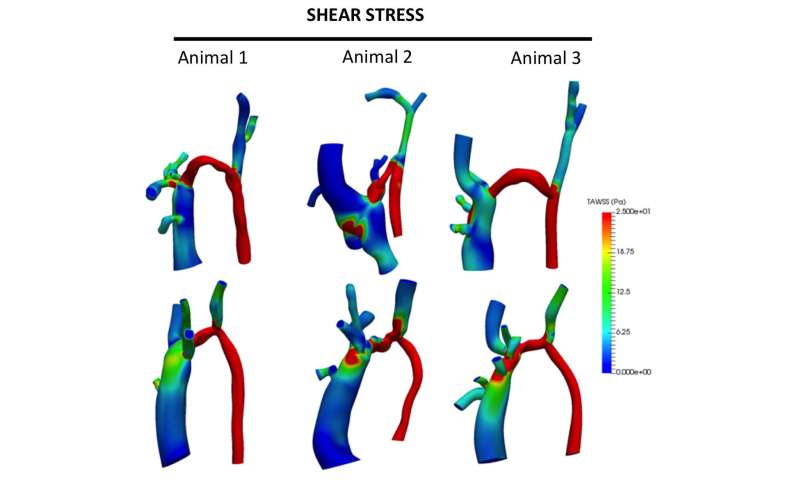
Shear stress on vessels (colored regions) was lower in key spots in the new RADAR configuration (bottom row) than in the conventional vein-to-artery configuration (top row) in male rats. Credit: H. Bai et al., Science Translational Medicine (2020)

For the many cases in which the fistula can't be maintained, Dardik said, patients need an artificial graft, which has an even lower success rate.

"Eventually these patients can only receive dialysis with a catheter," he said, a procedure that carries increased risk of infection and death. Patients receiving dialysis by catheter have a 1.6 to 2.5 times higher mortality rate than those receiving dialysis by fistulas.

In the new surgical technique, known as radial artery deviation and reimplantation, or RADAR, surgeons essentially reverse the procedure, bringing the artery over to the vein. They also use a tourniquet instead of clamps to temporarily stop blood flow while operating. This requires less handling of the artery and vein than the traditional method and results in better blood flow and a more robust fistula.

"It works a heck of a lot better," said Dardik. 

Building on a 2016 pilot study of RADAR's effectiveness involving 53 patients, the new study examined 201 patients who had the novel artery-to-vein surgery and compared them with 73 who had the traditional vein-to-artery surgery.

At one year, 72.2% of the RADAR patients had viable fistulas, compared with 48.1% of traditional fistula patients. At three years, fistulas remained viable in 62.1% of RADAR patients versus 37.6% of patients with traditional fistulas.

Notably, the new procedure was just as successful for female patients as male patients. 

The researchers confirmed their findings in animal (rat) studies in which they created both artery-to-vein fistulas and vein-to-artery fistulas, and examined the differences. The results closely mirrored those for the human patients.

The animal studies also made clear why the new technique was more effective. Using CAT scans and ultrasound, researchers observed crucial differences in hemodynamics between the two surgical techniques. "The pattern of blood flow in the RADAR technique was better than the usual pattern of flow with the conventional technique," Dardik said.

Given the significant need for dialysis, Dardik said, the new technique offers a clear opportunity for improving patient outcomes through more robust fistulas and fewer procedures to maintain access and the related complications.

"Surgeons always want the best for their patients," he said, "and the RADAR procedure lets surgeons do their best."


More information: Hualong Bai et al. Artery to vein configuration of arteriovenous fistula improves hemodynamics to increase maturation and patency, Science Translational Medicine (2020). DOI: 10.1126/scitranslmed.aax7613
Journal information: Science Translational Medicine 

Provided by Yale University 

Tuesday, October 23, 2007

New Option for Hemoglobin Control May Improve Dialysis Patients' Quality of Life

Laurie Barclay, MD

October 22, 2007 — A new option for hemoglobin control can be administered much less frequently than the current treatment, thereby possibly improving dialysis patients' quality of life, according to an open-label, randomized noninferiority trial (MAXIMA) reported in the October 20 issue of The Lancet.
"Conventional treatment with epoetin to manage anaemia in chronic kidney disease needs frequent administrations, changes of dose, and close monitoring of haemoglobin concentrations," write Nathan W Levin, MD, from the Renal Research Institute in New York City, and colleagues from the MAXIMA study. "We aimed to compare the effectiveness of methoxy polyethylene glycol-epoetin beta, given intravenously at 2-week or 4-week intervals, with epoetin treatment one to three times per week for haemoglobin control in haemodialysis patients."
The investigators screened 1115 adult patients with stable chronic renal anemia who were receiving intravenous maintenance epoetin and dialysis treatment at 96 centers. In an open-label, parallel-group, noninferiority trial, baseline hemoglobin concentration and eligibility were determined during a 4-week run-in period.
Two dosing intervals of methoxy polyethylene glycol-epoetin beta were compared with standard epoetin treatment: 223 patients were randomly assigned to receive methoxy polyethylene glycol-epoetin beta every 2 weeks, 224 to receive it every 4 weeks, and 226 to receive standard epoetin treatment, with the initial dose based on the average epoetin dose given during the week before the switch. The main outcome measure was change in hemoglobin concentration from baseline to the evaluation period, with analysis both by intention to treat and per protocol.
Of the 673 randomized patients, 133 were excluded from the per protocol analysis for inadequate iron status, fewer than 5 hemoglobin measurements during the evaluation period, or the need for red blood cell transfusions.
For patients who had switched to receiving intravenous methoxy polyethylene glycol-epoetin beta every 2 weeks (–0.71 g/L; 95% confidence interval [CI], –2.20 to 0.77) or every 4 weeks (–0.25 g/L; 95% CI, –1.79 to 1.29), the mean change from baseline hemoglobin was noninferior to the mean change for patients who continued epoetin treatment (–0.75 g/L; 95% CI, –2.26 to 0.75; P < .0001 for both comparisons).
The incidence of adverse events or serious adverse events was similar between groups for the 666 patients who received at least 1 dose of study drug (P = .30 and P = .40, respectively).
Study limitations include open-label design, potential assessment biases, and lack of blinded evaluation of clinical endpoints.
"This long-acting erythropoiesis-stimulating agent is as safe as conventional epoetin treatment, and can maintain anaemia management in haemodialysis patients when given intravenously at 4-week dosing intervals," the authors write. "Since our findings show that haemoglobin can be controlled in all dialysis patients with methoxy polyethylene glycol-epoetin beta given every 4 weeks, we advise that this drug should be introduced as an option to epoetin for simplified anaemia management."
F. Hoffmann-La Roche employs 2 of the authors. Three other authors report various financial arrangements with Roche Pharmaceuticals.
Lancet. 2007;370:1415–1421.