Showing posts with label Dysphagia. Show all posts

Sunday, November 03, 2019

The first test to detect dysphagia in patients with cognitive problems
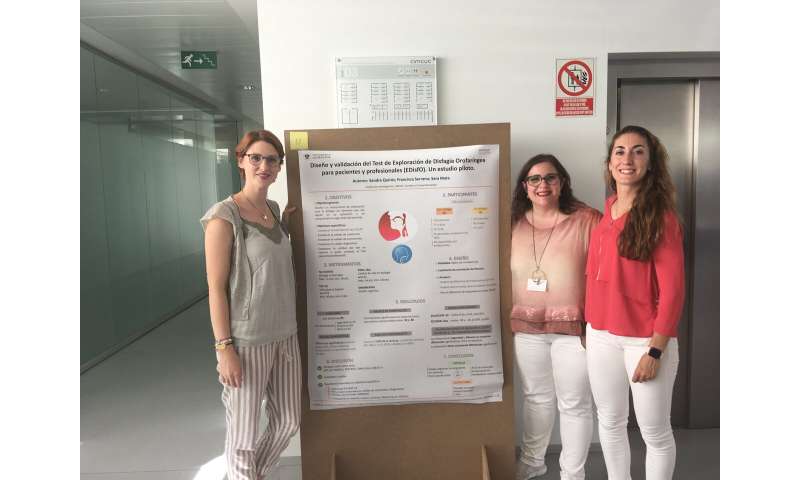
Scientists design first test to detect dysphagia in patients with cognitive problems
The UGR researchers who conducted this study. Credit: University of Granada
Researchers from the Mind, Brain and Behaviour Research Centre (CIMCYC) of the University of Granada (UGR) have designed a test to detect dysphagia, a disorder that prevents people from swallowing when eating. It affects 8 percent of the world's population.
03 nov 2019--Dysphagia is prevalent among older people in particular (30 percent to 40 percent of the elderly people admitted to hospitals or care homes) and patients with neurological or neurodegenerative disorders and diseases such as Alzheimer's, Parkinson's or multiple sclerosis, amyotrophic lateral sclerosis, cerebral palsy or strokes.
This difficulty in swallowing is due to the fact that the process of passing food or liquids from the mouth to the stomach requires more time and effort for these patients. Many die from aspiration pneumonia as a result of dysphagia. Yet dysphagia remains underdiagnosed because many of these patients suffer from cognitive disorders and cannot respond to functional evaluation processes.
To address this, the UGR researchers have designed and validated an early detection test for oropharyngeal dysphagia—called EdisfO—for patients with preserved cognitive status (that is, with no cognitive problems) that has also proven valid in patients with impaired cognitive status. This is the first time an assessment measure has been designed that successfully addresses this need.
The overarching aim of this research is to position the EdisfO as a widely-used tool that facilitates the diagnosis of possible dysphagia—a quick, safe, and effective test to screen for this disorder. It is currently being adapted and validated among the Turkish population, thanks to collaboration with Hacettepe University.
More information: Sandra Quirós et al. Design and Validation of the Oropharyngeal Dysphagia Screening Test for Patients and Professionals: A Preliminary Study, Dysphagia (2019). DOI: 10.1007/s00455-019-09999-4
Provided by University of Granada 

Sunday, August 25, 2019

Certain dietary supplements tied to dysphagia, choking in seniors

Certain dietary supplements tied to dysphagia, choking in seniors

Most reports of swallowing problems caused by dietary supplements involve seniors taking multivitamins or calcium supplements, according to a research letter published online Aug. 20 in the Annals of Internal Medicine.
25 aug 2019--Cecile Punzalan, M.D., from the U.S. Food and Drug Administration in College Park, Maryland, and colleagues used data from the FDA Center for Food Safety and Applied Nutrition Adverse Event Reporting System (2006 through 2015) to understand dietary supplement-associated adverse events caused by pill size.
The researchers found that of the 20,791 reported adverse events, in 19.1 percent of the cases, the patients indicated swallowing problems. Woman predominately filed these adverse swallowing reports (85.6 percent), which represented one-quarter of all adverse reports made by women. Of the roughly two-thirds of reports of swallowing problems that included age data, more than three-quarters (76.8 percent) involved adults aged 65 years or older. One in seven reports of swallowing problems cited serious adverse events, including three deaths due to supplement-induced airway obstruction or aspiration. Most reports of swallowing difficulty involved multivitamins (72.9 percent), followed by calcium supplements (17.3 percent). Ten dietary supplements were tied to more than three-quarters (76.4 percent) of swallowing problems and had a weighted mean pill length, width, and height of 19.3 mm, 9.8 mm, and 7.8 mm, respectively. Four in 10 reports of swallowing problems involved a single multivitamin product marketed to older women.
"These data identify a specific harm—choking—that may be preventable, particularly in older adults who regularly consume dietary supplements," the authors write.

More information: Abstract/Full Text (subscription or payment may be required)
Journal information: Annals of Internal Medicine 
Copyright © 2019 HealthDay. All rights reserved.

Wednesday, August 18, 2010

Dysphagia found to increase length of hospital stay and mortality risk

Underdiagnosed swallowing condition causes complications in hospitalized patients

18 aug 2010--Researchers from Mount Sinai School of Medicine have found that hospitalized patients with dysphagia, or difficulty swallowing, averaged a 40 percent longer hospital stay than patients without the condition. They also had a generally poorer prognosis. The research is published in the August issue of Archives of Otolaryngology–Head & Neck Surgery, one of the JAMA/Archives journals.

The researchers evaluated more than 77 million hospital admissions during 2005-2006, 271,983 of which were associated with dysphagia, as indicated by the National Hospital Discharge Survey (NHDS). The median number of days in the hospital for patients with dysphagia was 4.04, compared to 2.40 days for patients without dysphagia. Mortality increased significantly in patients with dysphagia and disk disorders or heart disease, and those undergoing rehabilitation had a greater than 13-fold increased risk of mortality. Patients ages 75 and older were twice as likely to have dysphagia.

"Our study shows that dysphagia has a significant impact on length of stay and prognostic indicators," said Kenneth W. Altman, MD, PhD, Associate Professor of Otolaryngology, lead author on the study. "Early identification of dysphagia and therapeutic intervention are critical to preventing further complications in these patients and reducing length of stay. These data indicate the necessity for health care providers to prevent or diagnose this condition early to reduce complications."

The impact of dysphagia on hospital resources was also substantial. Patients with dysphagia are often at risk of aspirating, which often requires antibiotic use and intubation. The increased mortality risk associated with the condition also increases end-of-life costs. Using a measurement tool previously developed for community-acquired pneumonia, the researchers estimated the cost of dysphagia at nearly $550 million over the two year period.

"With our country moving into a value-based health care system, we will truly feel the impact of the costs associated with dysphagia," said Dr. Altman. "As such, it's important to develop strategies to prevent and treat this debilitating condition to reduce those costs."

Dysphagia is present with a number of serious conditions, which may contribute to mortality risk. The most common conditions associated with dysphagia were stroke, aspiration pneumonia, urinary tract infection, esophageal disease, fluid or electrolyte disorder, and congestive heart failure. Patients with these conditions are especially susceptible to aspiration. The authors emphasize that dysphagia is severely underreported, due to minor cases not being documented, or clinicians seeing it as a side effect of another condition rather than a condition itself.

"Hospitals should implement assessment tools to identify dysphagia in high risk patients, including the elderly, stroke and rehabilitation patients, and patients with malnutrition, neurodegenerative disease, pneumonia, or heart disease," said Dr. Altman. "At Mount Sinai, we are making every effort to identify these patients early to prevent further complications."

Monday, April 12, 2010

Diffuse Idiopathic Skeletal Hyperostosis Causes Dysphagia In Older Patients


12 april 2010--Diffuse idiopathic skeletal hyperostosis (DISH) is a common but often unrecognized systemic disorder observed mainly in elderly people. All papers related to DISH demonstrate a consistent and marked increase of the disease with advancing age. Various local structural lesions such as oropharyngeal tumors, vascular pathologies, retropharyngeal abscesses, and anterior cervical osteophytes may lead to mechanical esophageal dysphagia.

A research article published in the World Journal of Gastroenterology addresses this issue. A research team led by Dr. Berrin Karadag reported a case of a geriatric patient with diffuse idiopathic skeletal hyperostosis.

This study concluded that DISH should be considered an important, although rare, cause of dysphagia among older adults. However, it should not be accepted as the cause of dysphagia until all other causes have been ruled out.

Reference: Karadag B, Cat H, Aksoy S, Ozulu B, Ozturk AO, Oguz S, Altuntas Y. A geriatric patient with diffuse idiopathic skeletal hyperostosis. World J Gastroenterol 2010; 16(13): 1673-1675.

Source:
Ye-Ru Wang
World Journal of Gastroenterology