Showing posts with label Healthy Aging. Show all posts

Saturday, November 05, 2022


Healthy aging requires an understanding of personality types

SFU research: Healthy aging requires an understanding of personality types
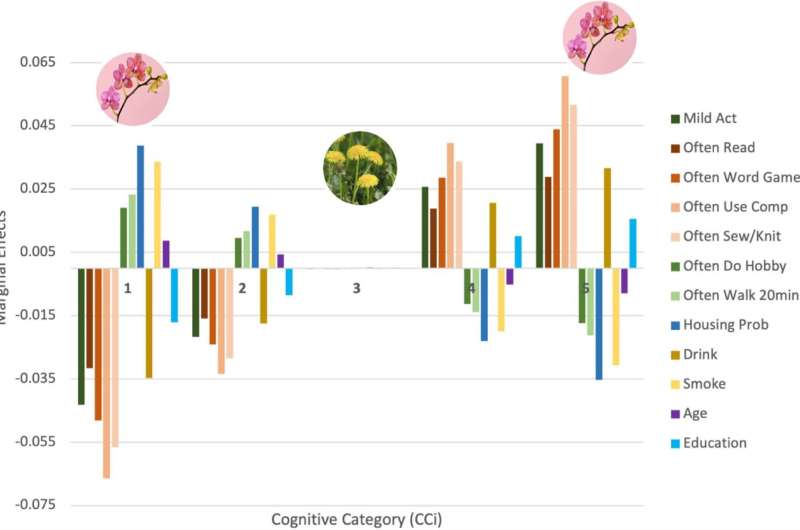
Relationship between lifestyle factors and different cognitive categories. The figure is color coded based on similarity of covariate. In dark blue are the factors related to financial strain, in shades of orange are the factors that require greater levels of concentration, in shades of green are the factors that relate to physical exercise, in purple and light blue is age and level of education, and in shades of yellow is smoking and drinking. Credit: Frontiers in Aging Neuroscience (2022). DOI: 10.3389/fnagi.2022.98626

New research shows that older adults may be better supported as they age when their personalities are considered—for example, are they more like orchids or dandelions?

05 nov 2022--Researchers from Simon Fraser University's Circle Innovation examined the potential effects of lifestyle activities on the cognitive health of more than 3,500 adults aged 60+, and found that personality–using psychology's orchid-dandelion metaphor—can be a factor in how well supportive programs work.

Their results, published this month in the journal Frontiers in Aging Neuroscience, make a case for policy-makers to consider designing programs tailored to personality types rather than a one-size-fits-all approach.

"These discoveries offer new possibilities to support aging adults and provide substantial evidence for new social prescribing programs," says Circle Innovation CEO and scientific director Sylvain Moreno. "Understanding how personality differences affect an aging population can help decision-makers provide older adults with solutions that fit their individual needs."

People who may be considered "orchid adults" thrive best under ideal circumstances, since they are more sensitive and biologically reactive, while "dandelion adults" are thought to be resilient and can easily adapt to any environment.

That means orchid individuals could require more nurturing solutions, researchers say. "These older adults are more fragile, like the delicate flower they represent, and hence prone to overreact to ongoing health and housing problems, disturbing news about the economy or global pandemics," says SFU Ph.D. student and study researcher Emma Rodrigues. "On the other hand, dandelion retirees are relatively less environment-sensitive and also more resilient to deterioration in poor environmental conditions."

"The lesson here is that we should stop pigeonholing aging adults into one group of our population. These results demonstrate how aging trajectories can differ depending on whether a person is influenced by the environment."

According to researchers, understanding how modifiable lifestyle factors may maintain or promote cognitive health can lead to a healthier aging population.

More information: Emma A. Rodrigues et al, Does cognitive aging follow an orchid and dandelion phenomenon?, Frontiers in Aging Neuroscience (2022). DOI: 10.3389/fnagi.2022.986262www.frontiersin.org/articles/1 … agi.2022.986262/full
Provided by Simon Fraser University 

Sunday, September 26, 2021


Four keys to healthy aging

exercise
Credit: Unsplash/CC0 Public Domain

The "secrets" to healthy aging are anything but secret. They're the conventional medical recommendations most people will hear from their doctor at a typical checkup: exercise, eat a healthy diet and keep up-to-date with your doctors' visits and vaccinations.

26 sep 2021--Each year, more evidence emerges to help us determine what that healthy diet should look like and how much exercise is enough to age better and live longer.

"You need to do more exercise than you think," says Dr. Jorge Camilo Mora, director of geriatric medical education at the Herbert Wertheim College of Medicine.

Thirty minutes of exercise five days a week has traditionally been the recommendation for adults. But Mora said many people don't realize their daily walks are probably not enough.

"Exercise has to be more intense than a walk," he said. "Ideally, it would combine flexibility, strength, and balance."

A moderate-intensity, brisk 30-minute walk five days a week, plus a muscle-strengthening workout twice a week meets the Centers for Disease Control's recommendations, for example.

For diet, Mora recommends moving toward more plant-based meals. That is, getting more of your daily nutrition from fruits and vegetables and less of it from meat.

Adopting a plant-based diet is associated with a reduced risk of type 2 diabetes, cancer, heart disease and Alzheimer's disease, according to a 2020 article published in the Journal of the American College of Nutrition.

Mora notes that people who live in "Blue Zones," the parts of the world where people live longest, tend to eat diets rich in plant-based foods. These people have a much higher-than-average number of centenarians—people who live to 100 years or more. Why not borrow a bit of their wisdom and incorporate more vegetarian meals into your diet?

As we observe Healthy Aging Month this September, here are Mora's tips:

  • Exercise! At least 150 minutes per week of moderate-intensity activity. Try to find activities that will also work on your strength and flexibility.
  • Eat more plant-based foods rich in antioxidants and vitamins.
  • Get your COVID-19 booster shot around 6 months after your completed dose. Not only are older adults more susceptible to the novel coronavirus, but their immune response to the vaccine is less than in younger people.
  • Get social! Social isolation is a risk factor similar to smoking in older adults. Mora's advice? Join a group exercise class—You'll meet your exercise goals AND keep up your social life.

More information: Hana Kahleova et al, Plant-Based Diets for Healthy Aging, Journal of the American College of Nutrition (2020). DOI: 10.1080/07315724.2020.1790442
Provided by Florida International University

Friday, March 02, 2018

More isn't always better when it comes to health care, older Americans say

More isn't always better when it comes to health care, older Americans say
New results from the National Poll on Healthy Aging look at what people over 50 say about perceived overuse of health care. 
Doctors and older patients may disagree more often than either of them suspects about whether a particular medical test or medicine is truly necessary, according to findings from a new poll of Americans over age 50.

02 mar 2018--Improving communication about that mismatch of opinions, the poll suggests, might reduce the use of unneeded scans, screenings, medications and procedures - and health care costs as well.
Only 14 percent of people over age 50 believe that more is usually better when it comes to health care, according to the new findings from the National Poll on Healthy Aging.
But one in four say their health providers often order tests or prescribe drugs that they don't think they really need. One in six said it had happened in the last year—but about half of them followed through with the test or filled the prescription anyway.
On the flip side, about 1 in 10 of those polled said their doctor or other health provider had told them that a test or medication they'd asked for wasn't needed. Most of them said the provider explained why, but 40 percent didn't completely understand the explanation.
The poll was conducted in a nationally representative sample of 2,007 Americans between the ages of 50 and 80 by the University of Michigan Institute for Healthcare Policy and Innovation. It was sponsored by AARP and Michigan Medicine, U-M's academic medical center.
"The new findings suggest patients and providers need to work together more to prevent overuse of health care services that provide the least value to patients," says U-M's Jeffrey Kullgren, M.D., M.S., M.P.H., who designed the poll and analyzed its results.
"Patients should speak up when they aren't sure if a test or medication recommended to them is needed," he says. "And providers need to communicate about how a particular service will - or will not - affect the patient's health, both when they're recommending it and when a patient has requested it."
Overuse from the patient perspective
Kullgren, an assistant professor of internal medicine and a member of IHPI, has studied overuse and appropriate use of many types of health care. But, he says, most studies have been done from the point of view of providers or health care systems. That has led many to focus on patient demand, and resistance to being denied a service they expect or have asked for, as major drivers of overuse and cost.
The new poll data give the perspective of those who use the most health care in America - older adults. In all, 54 percent of those polled said that in general, they believe that health providers often recommend tests, medications or procedures that patients don't really need.
This means doctors and other clinicians may have more leeway than they might realize to hold back on recommending services that hold little or no value for a particular type of patient - or to help patients understand why a service they're asking for probably won't help them.
"These survey results show us that more attention needs to be focused on improving communication between patients and doctors," says Alison Bryant, Ph.D., senior vice president of research for AARP. "Encouraging patients and doctors to routinely discuss the need for recommended procedures and medications should help prevent unnecessary treatments and cut health care costs."
To help providers and patients accomplish this, Kullgren points to the "Choosing Wisely" website created by medical professional groups as a central source of information about which tests and treatments hold low value for certain patients. It provides specific examples, based on medical research, and gives explanations using language that both patients and providers can understand.
"Using such information during a clinic visit, and providing it to a patient after recommending a service or turning down a request, could go a long way toward reducing overuse," says Preeti Malani, M.D., director of the National Poll on Healthy Aging and a professor of internal medicine at the U-M Medical School who specializes in infectious diseases and geriatrics.
And when a provider recommends a medical service but the patient isn't sure it is needed, better communication could increase use of services that provide the most value, she adds.
In the poll, 50 percent of the patients who had been told they needed an x-ray, blood test or other test, but weren't sure they needed it, went on to have it anyway. Among those who had received a medication recommendation that they didn't think they needed, 41 percent still filled the prescription.
If the provider had recommended those tests or medicines based on evidence that they held high value for that particular patient, then it's concerning if some patients didn't follow through. But past research has shown that providers sometimes order tests or prescribe medications without being aware of the latest evidence about who gets the most benefit from them, and who doesn't. They may even order them to avoid patient dissatisfaction or legal liability.
The poll results are based on answers from a nationally representative sample of 2,007 people ages 50 to 80. The poll respondents answered a wide range of questions online. Questions were written, and data interpreted and compiled, by the IHPI team. Laptops and Internet access were provided to poll respondents who did not already have it.

More information: A full report of the findings and methodology is available at http://www.healthyagingpoll.org.


Provided by University of Michigan

Wednesday, February 03, 2010

Exercise Linked To Healthier Aging: Four New Studies


03 feb 2010--Four new studies published in a leading journal this week link exercise with healthy aging, either through reduced risk or slower progression of several age-related conditions or through improvements in overall health in older age, and detail associations between physical activity and cognitive function, bone density and overall health.

All four studies, and an accompanying editorial commentary appear in the 25 January issue of the Archives of Internal Medicine.

In the accompanying editorial, Drs Jeff Williamson and Marco Pahor, of the University of Florida, point out that previous studies have linked exercise to beneficial effects on a range of conditions and diseases, including obesity, diabetes, heart disease, cancer, lung disease, arthritis, falls and fractures, that can hamper older people's ability to get on with their day to day tasks and lead indendepent lives.

They write:

"Regular physical activity has also been associated with greater longevity as well as reduced risk of physical disability and dependence, the most important health outcome, even more than death, for most older people."

And now, they suggest, these four new studies advance the field and help us better understand the "full range of important aging-related outcomes for which exercise has a clinically relevant impact".

Exercise in Middle Age Linked to Better Health in Later Life

In the first of the four studies, Dr Qi Sun, of the Harvard School of Public Health, Brigham and Women's Hospital and Harvard Medical School, Boston, and colleagues looked at health data from 13,535 participants taking part in the Nurses' Health Study.

They found that among women aged 70 and over, those who engaged in regular physical activity in their middle age were more likely to show signs of better overall health.

The women completed questionnaires about their physical activity in 1986, when their average age was 60.

When the researchers looked at data on health outcomes in those women that survived to age 70 and over from 1995 to 2001, they found that those who had reported higher levels physical activity in their middle age were less likely to have undergone heart surgery, have chronic diseases, or any physical, cognitive or mental impairments.

The researchers wrote that they also found:

"Increasing energy expenditure from walking was associated with a similar elevation in odds of successful survival."

They concluded that as the US population is a rapidly aging one and nearly 25 per cent of Americans do not pursue leisure time activities:

"Our findings appear to support federal guidelines regarding physical activity to promote health among older people and further emphasize the potential of activity to enhance overall health and well-being with aging."

They said people might be more motivated to pursue physical activities if they thought it would increase their chance of being fit and well in old age rather than just extending their lifespan.

Resistance Training Linked to Improved Cognitive Skills in Older Women

In the second of the four studies, Dr Teresa Liu-Ambrose, of Vancouver Coastal Health Research Institute and University of British Columbia, Vancouver, Canada, and colleagues, enrolled 155 women aged 65 to 75 and randomly assigned them to one of three groups that undertook to follow a particular exercise pattern for a year.

One group of 54 participants did resistance training once a week, another group of 52 did it twice a week, and a third group of 49, the control group, didn't do resistance training: they took part in twice-weekly sessions of balance and tone training.

The results showed that after following their exercise program for a year, compared to those in the balance and tone group, the women in both resistance training groups improved their performance on the Stroop test, a cognitive test of selective attention and conflict resolution.

Liu-Ambrose and colleagues also wrote that:

"Task performance improved by 12.6 per cent and 10.9 per cent in the once-weekly and twice-weekly resistance training groups, respectively; it deteriorated by 0.5 per cent in the balance and tone group."

The women in the resistance training groups also improved muscular function.

The authors concluded that:

"This has important clinical implications because cognitive impairment is a major health problem that currently lacks a clearly effective pharmaceutical therapy and because resistance training is not widely adopted by seniors."

"The doses of resistance training we used in this study fall within those recommended by the 2008 Physical Activity Guidelines for seniors," they added.

Exercise May Be Linked to Reduced Cognitive Impairment in Older Adults

In the third of the four studies linking exercise to healthier aging, Dr Thorleif Etgen of the Technische Universität München, Munich, and Klinikum Traunstein, Germany, and colleagues who followed a group of older adults for two years, found that moderate or high physical activity appeared to be linked with a lower risk of developing cognitive impairment.

The participants, who were older than 55 years, enrolled in a community-based prospective cohort study in southern Bavaria, Germany between 2001 and 2003 and were followed for 2 years. They gave data about their physical activity level and underwent tests of cognitive function (the 6-item Cognitive Impairment Test). The main outcome measure was the level of cognitive impairment after the 2 years of follow up.

The results showed that at the start of the study, 418 (10.7 per cent) of the participants had cognitive impairment, leaving 3,485 unimpaired.

After 2 years, 207 (5.9 per cent) of the unimpaired participants developed cognitive impairment.

When they analysed the data on these additional 207, the researchers found that compared with those who did no physical activity, those who reported moderate (exercising less than 3 times a week) or high (3 times a week or more) levels of physical activity at the start of the study (baseline) "showed a significantly reduced risk of incident cognitive impairment after 2 years".

"The incidence of new cognitive impairment among participants with no, moderate and high activity at baseline was 13.9 per cent, 6.7 per cent and 5.1 per cent, respectively," they wrote.

The researchers concluded that further studies should be done to assess how much and what types of exercise might prevent or delay cognitive impairment and to what extent.

Exercise Linked to Denser Bones and Lower Risk of Falls in Older Women

For the fourth study, which ran from May 2005 to July 2008, Dr Wolfgang Kemmler and colleagues at Freidrich-Alexander University of Erlangen- Nuremberg, Erlangen, Germany, recruited and randomly assigned 246 women aged 65 and over either to to follow an exercise program (the exercise group) or a wellness program (the control group) for 18 months.

They found that compared to the control group, the women in the exercise group appeared to have denser bones and a reduced risk of falls, but not a reduced risk of cardiovascular disease.

The exercise group followed a multipurpose 4 days per week exercise program that emphasized exercise intensity, while the controls followed a general wellness program that focused on wellbeing with a low intensity and low frequency program.

The main outcome measures were bone mineral density (BMD), number of falls, risk of coronary heart disease (the Framingham CHD Risk Calculator, which takes into account cholesterol level, blood pressure and presence of diabetes), and health care costs.

The results showed that among the 227 women who completed the study, the 115 in the exercise group had higher bone mineral density in the spine and hip and a 66 per cent reduced rate of falls.

Also, women in the control group were twice as likely to have fractures due to falls compared to those in the exercise group (12 versus 6), but the 10-year risk of cardiovascular disease went down in both groups with no difference between them.

There were no significant differences in direct health care costs per participant between the two groups.

The researchers concluded that:

"Compared with a general wellness program, our 18-month exercise program significantly improved BMD and fall risk, but not predicted CHD risk, in elderly women. This benefit occurred at no increase in direct costs."

"Because this training regimen can be easily adopted by other institutions and health care providers, a broad implementation of this program is feasible," they wrote.

"Physical Activity at Midlife in Relation to Successful Survival in Women at Age 70 Years or Older."
Qi Sun; Mary K. Townsend; Olivia I. Okereke; Oscar H. Franco; Frank B. Hu; Francine Grodstein.
Arch Intern Med. 2010;170[2]:194 -201, published online 25 January 2010.

"Resistance Training and Executive Functions: a 12-Month Randomized Controlled Trial."
Teresa Liu-Ambrose; Lindsay S. Nagamatsu; Peter Graf; B. Lynn Beattie; Maureen C. Ashe; Todd C. Handy.
Arch Intern Med. 2010;170[2]:170 -178, published online 25 January 2010.

"Physical Activity and Incident Cognitive Impairment in Elderly Persons: the INVADE Study."
Thorleif Etgen; Dirk Sander; Ulrich Huntgeburth; Holger Poppert; Hans Forstl; Horst Bickel.
Arch Intern Med. 2010;170[2]:186 -193, published online 25 January 2010.

"Exercise Effects on Bone Mineral Density, Falls, Coronary Risk Factors, and Health Care Costs in Older Women: the Randomized Controlled Senior Fitness and Prevention (SEFIP) Study."
Wolfgang Kemmler; Simon von Stengel; Klaus Engelke; Lothar Haberle; Willi A. Kalender.
Arch Intern Med. 2010;170[2]:179 -185, published online 25 January 2010.

Source: JAMA/Archives.
Thursday, April 05, 2007

100-Year-Olds' Secret: Stay Aware

The secret to a long life is to stay busy, get plenty of exercise and don’t drink too much. Then again, don’t drink too little.-- Hermann Smith-Johannson, 103-year-old cross-country skier, quoted in The New York Times, March 20, 1979.
April 3, 2007 -- The key to long life is a vivid interest in the world around you, a survey of 100-year-olds suggests.
That means people born when Teddy Roosevelt was president are watching music videos, ordering at Starbucks, and even listening to iPods, according to the poll from Evercare, a division of UnitedHealth Group focused on the health care needs of Americans aged 50 and older.
"We are finding older Americans are staying engaged and staying on top of what is going on in the world," Sherri Snelling, director of caregiving services at Evercare, tells WebMD.
Evercare's second annual telephone poll of 100 people aged 99 and older isn't a scientific study -- it's a snapshot of the attitudes of American 100-year-olds. Eighty-seven percent of survey respondents were white; 70% still lived at home; 95% were 100 or older; and 70% were women.