Showing posts with label Transcranial Magnetic Stimulation. Show all posts

Sunday, May 16, 2021


What is repetitive transcranial magnetic stimulation and how does it actually work?
What is repetitive transcranial magnetic stimulation and how does it actually work?
Credit: www.shutterstock.com

A line in this week's federal budget allocating A$288.5 million to repetitive transcranial magnetic stimulation (rTMS) therapy might pass most people by.

16 may 2021--This is a brain stimulation technique that's been used to treat conditions such as depression for almost ten years in Australia, but which has not been funded through Medicare and so has had very limited availability.

Soon, it will be available on the Medicare Benefits Schedule for people with depression that hasn't responded to other treatments, funding I've led applications for since 2012, and treatment I provide.

While we know rTMS can work, and is generally safe, we're not entirely sure how it works. Here's what the evidence says so far.

What is it?

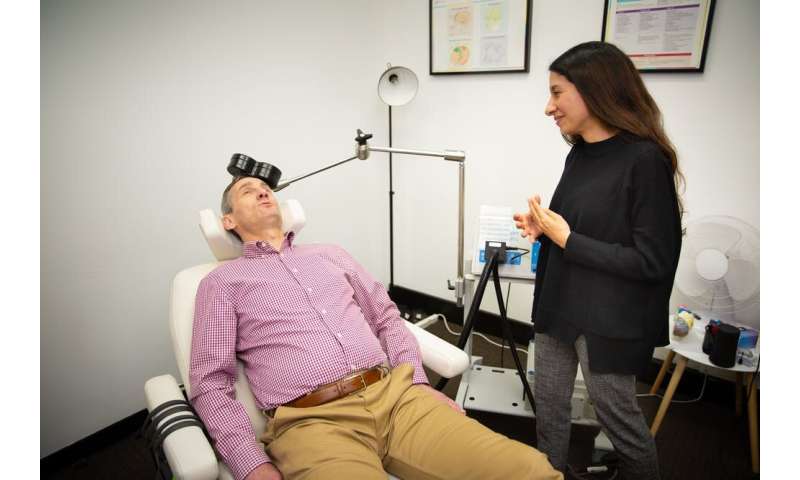
In rTMS, a machine produces and applies a highly targeted, pulsed magnetic field to a specific area of the brain, towards the front, known as the prefrontal cortex. This is an area we believe isn't working normally in people with depression.

During treatment, an electrical current passes through an electromagnetic coil held near the scalp to stimulate the nerve cells.

The person sits in a comfortable chair, awake and alert during treatment. It's quite different from electroconvulsive therapy (ECT, the modern version of shock treatment). Unlike ECT, rTMS does not involve producing a seizure and does not require the person to be asleep and under an anesthetic.

How does it work?

We know repeated rTMS stimulation, over the course of weeks, increases nerve activity in the area under the coil. It also changes the strength of connections between different areas of the brain. This is thought to help restore the normal interaction between brain regions, although these ideas are still theoretical and definitely not proven.

Antidepressant medications may act in similar ways, but less directly. The chemicals they affect can influence brain function quite widely: tuning activity or connectivity in brain circuits up or down. rTMS probably does this more directly. By directly making nerve cells fire we can directly change their activity levels. These more direct actions could possibly explain why rTMS may work in some people who have not responded to medication.

Trials show rTMS treatments result in a gradual improvement in depression. A person's mood will slowly lift, usually over the course of several weeks, they will become more interested in things, sleep better, be more motivated and have more energy.

In people who respond, depression can go away for several months up to many years. If depression returns, most people will get better again with further treatment.
What is repetitive transcranial magnetic stimulation and how does it actually work?
People are awake and alert during rTMS treatment. Author provided

Does it work? Is it safe?

Evidence collected over the past 25 years and collated shows rTMS is a safe and effective treatment for people with treatment-resistant depression. These are the 30-40% of people diagnosed with depression who have tried antidepressant medications, usually two or more, and haven't seen any or sufficient relief. They have persistent, ongoing depression with major effects on their ability to function, work and lead normal family lives.

The treatment is usually well-tolerated. Although some people experience a strong tapping sensation on the scalp, scalp pain during treatment, or a headache afterwards.

Some 25 years of research have failed to identify any long-term negative consequences. People are much more likely to experience significant side-effects with  than with rTMS.

Studies have also compared the effectiveness of rTMS with other treatments, such as different medications. This study, written by authors from the pharmaceutical industry, only reports the benefits of medications in the study abstract but rTMS was clearly the superior intervention on outcomes across the full analysis.

Finally, research including more than 5,000 people having the treatment shows it provides meaningful and valuable clinical benefits in the real world, outside clinical trials.

This treatment isn't perfect

Like many medical treatments, rTMS is not perfect. We are trying to develop ways to improve outcomes by better individualizing the treatment. For example, we are trying to better understand the exact spot to target in the brain and how to match the frequency of stimulation to an individual person's pattern of  activity.

We're also trying to get around one of the biggest issues: its relative inefficiency.

A course of rTMS typically involves going to a clinic for a 30-minute treatment session, five days a week, for up to six weeks, which is time-consuming and requires a significant commitment. We are working to make the application less time-consuming and potentially shorten the duration of therapy.

One of the most significant implications of the government funding of rTMS therapy through Medicare is that it will become more widely available, including in outer suburban and rural areas.

The funding will take some months to be implemented but once available will be accessible by a referral from a GP or psychiatrist.


Provided by The Conversation 

Sunday, October 19, 2008

FDA Okays Transcranial Magnetic Stimulation to Treat Depression

By Peggy Peck
ROCKVILLE, Md., 20 oct 2008-- The FDA has approved a transcranial magnetic stimulation system (NeuroStar TMS) for treatment of major depressive disorder in adult patients for whom traditional therapies have failed.
The device delivers focused, MRI-strength magnetic pulses to the brain. The procedure, typically administered daily for four to six weeks, takes about 40 minutes and is done on an outpatient basis.
In a six-week, randomized, placebo-controlled trial of 164 patients with unipolar, non-psychotic, major depressive disorder the device was associated with a statistically significant improvement in symptoms (P<0.0006) compared with controls.
All of the patients in the study had failed to find relief with at least one prior depression therapy.
Compared with patients treated with a sham device, twice as many patients treated with the active device had an improvement of at least 50% in symptoms.
They also achieved statistically significant improvements on the Hamilton Depression Rating scale measurements of factor scores for core depression symptoms, anxiety symptoms, somatization, and psychomotor retardation.
Patients had none of the systemic side effects often reported in depression therapy trials, such as weight gain, sexual dysfunction, sedation, nausea, or dry mouth. There were no reported adverse effects on concentration or memory, and no seizures.
The most common device-related adverse event was scalp pain or discomfort at the treatment area during active treatment, but this effect declined after the first week of treatment.
The FDA said the device was contraindicated in patients with implanted metallic devices or non-removable metallic objects in or around the head.
Moreover, the stimulator has not been studied as a first-line treatment and its efficacy has not been established in patients who failed to achieve benefit from antidepressant therapy when the drugs were dosed at levels less than minimal effective dose or duration.
The device maker, Neuronetics of Malvern, Pa., said that initially NeuroStar TMS Therapy "will only be available in a limited number of treatment centers around the country."

Tuesday, November 27, 2007

Penn research shows transcranial magnetic stimulation effective in treating major depression

PHILADELPHIA – Researchers at the University of Pennsylvania School of Medicine and other study sites have found that transcranial magnetic stimulation (TMS) – a non-invasive technique that excites neurons in the brain via magnetic pulses passed through the scalp – is a safe and effective, non-drug treatment with minimal side effects for patients with major depression who have tried other treatment options without benefit.
This study – the largest to-date studying TMS as a standalone treatment for major depression – appears in the December 1st issue of Biological Psychiatry.
“TMS provides a well-tolerated treatment option to patients whose depression is otherwise treatment resistant,” says John P. O’Reardon, MD, Associate Professor of Psychiatry at Penn, and lead study author. “Since TMS is administered via the scalp and therefore goes directly to the brain, it allows the patient to avoid bodily side effects such as weight gain, sedation and/or sexual function.”
The study was conducted at 23 sites in the U.S., Australia, and Canada, and involved 301 medication-free patients with major depression who had not benefited from prior treatment. The patients were randomized to active or sham TMS for 4-6 weeks. Response and remission rates with active TMS were approximately twice those of sham. Additionally, there were no unexpected, serious side effects, and less than 5% of patients discontinued their TMS due to side effects. This is about three times better tolerated and safer than standard medications, which have about a 15% discontinuation rate due to side effects.
Dr. O’Reardon further comments, “As indicated by recent large scale, government-sponsored, studies of existing treatment options for major depression conducted by the National Institute of Health (the STAR-D reports), there is a great need to develop new, effective treatments for patients, especially those not benefiting from first line interventions. The results of this study indicate that TMS offers new hope to patients in this regard.”

Thursday, November 22, 2007

Transcranial Magnetic Stimulation Repels Severe Depression


PHILADELPHIA, Nov. 21 -- Transcranial magnetic stimulation significantly reduces acute symptoms of major depression and offers an alternative to conventional therapy, investigators in a multicenter trial have concluded.Patients treated with transcranial magnetic stimulation had almost a twofold higher remission rate at six weeks compared with patients who received sham therapy in the randomized study, John P. O'Reardon, M.D., of the University of Pennsylvania, and colleagues reported in the Dec. 1 issue of Biological Psychiatry.As many as 40% of patients with major depression do not get adequate improvement in symptoms with medication and psychotherapy, the investigators noted. Depression may progress into treatment-resistant illness for which transcranial magnetic stimulation could be useful.
Action Points
Explain to interested patients that transcranial magnetic stimulation may improve depression in patients who have not responded to antidepressant medication.
Emphasize that TMS has not yet been approved for treatment of any psychiatric disorder.
Transcranial magnetic stimulation involves discharge of a time-varying current from an insulated coil placed on the scalp surface. The discharge generates a brief dynamic magnetic field that induces current flow when reaching a conductive medium, such as neural tissue. The current offers the potential to modulate neural circuitry in a therapeutic fashion.
Symptom improvement achieved with the modality was evident as early as four weeks, and it was associated with minimal side effects. The benefits persisted during a taper phase of the study.
"It is worth noting that active transcranial magnetic stimulation subjects continuing through the end of the acute phase and into the taper phase of the study showed persistent and perhaps accumulating benefit in comparison to their continuing counterparts in the sham transcranial magnetic stimulation group," the authors concluded.
Several single-center controlled studies have supported the hypothesis that transcranial magnetic stimulation has antidepressant effects when delivered to the left or right dorsolateral prefrontal cortex. Dr. O'Reardon and colleagues continued the investigation of that hypothesis with a double-blind, multicenter study of 301 medication-free patients with major depression that had been resistant to prior therapy (average of 1.6 prior therapies).

Philip G. Janicak, M.D.Rush University Medical Center, Chicago
The patients were randomized to active or sham transcranial magnetic stimulation administered five times a week for four to six weeks. The primary outcome was the improvement in symptom score at week four on the Montgomery-Asberg Depression Rating Scale (MADRS). Secondary endpoints were change in score on the 17- and 24-item Hamilton Depression Rating Scale (HAMD) and response and remission rates as determined by the MADRS and HAMD.
After correcting for baseline differences in depression severity, investigators found that active transcranial magnetic stimulation significantly improved the mean MADRS score at week four compared with sham treatments (P=0.038). A trend toward more improvement was still evident at six weeks (P=0.052). HAMD-17 and HAMD-24 scores demonstrated significant improvement with active treatment (P=0.006 and P=0.012) at four weeks and at six weeks (P=0.005 and P=0.015).
Response rates at four weeks and six weeks showed significant improvement with active versus sham transcranial magnetic stimulation for the MADRS (P0.05, P0.01), HAMD-17 (P0.05 at both time points), and HAMD-24 (P0.05 for both). Remission rates were significantly higher at six weeks with active treatment (P0.05) and for the HAMD-24 (P0.05).
Putting the transcranial magnetic stimulation results in perspective, Dr. O'Reardon and colleagues noted that the large open-label STAR*D trial of antidepressant medication showed a progressive reduction in the remission rate over time (Am J Psychiatry 2006; 163: 28-40). In contrast, the TMS remission rate by the HAMD-17 increased from 15.5% at six weeks to 22.6% after nine weeks and completion of the taper phase of the study.
"Given that controlled trials generally report somewhat lower clinical response and remission rates than are seen in open-label experience, the results reported here compare favorably to those seen in similarly treatment-resistant patients in the STAR*D reports," the authors noted.
Active transcranial magnetic stimulation was well tolerated, and the most common adverse event was transient scalp discomfort or pain. Fewer than 5% of patients dropped out over adverse events.
Dr. O'Reardon reported receiving grant support from Bristol-Myers Squibb, Cyberonics, Lilly, Magstim, Neuronetics, Pfizer, and Sanofi, consulting with Lilly and Neuronetics, and participating on speakers bureaus for BMS, Cyberonics, and Lilly. The study was supported by Neuronetics.Primary source: Biological PsychiatrySource reference: O'Reardon JP, et al "Efficacy and safety of transcranial magnetic stimulation in the acute treatment of major depression: a multisite randomized controlled trial" Biol Psychiatry 2007; DOI: 10.1016/j.biopsych.2007.01.018.