Showing posts with label aging views. Show all posts

Saturday, November 05, 2022


Men age faster than women, but the younger generation is closing the gap

Men age faster than women, but the younger generation is closing the gap
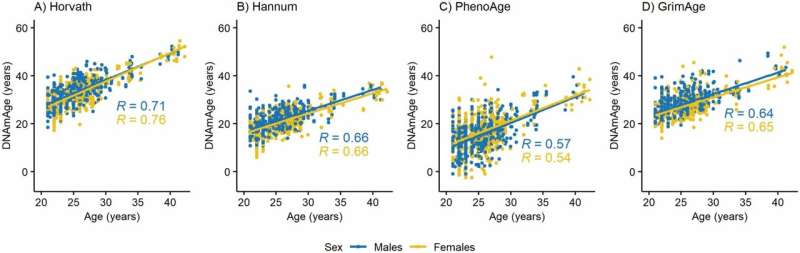
Association between chronological age and DNA methylation age (DNAmAge) estimates obtained by (A) Horvath’s clock, (B) Hannum’s clock, (C) PhenoAge, and (D) GrimAge estimators in younger (21- to 42-year-old) twins. R = Pearson’s correlation coefficient. Credit: The Journals of Gerontology: Series A (2021). DOI: 10.1093/gerona/glab337

In the Western world, life expectancy rapidly increased in the twentieth century, but women still have longer life expectancy than men. In Finland, women live on average five years longer than men. The gap between the sexes was greatest in the 1970s, when life expectancy at birth was almost 10 years higher for women than for men. However, in recent decades, this gap has gradually narrowed. The difference between the sexes can also be seen in biological aging, as revealed by a study recently published in The Journals of Gerontology: Series A.

05 nov 2022--The study investigated whether there are differences in biological aging between men and women and whether the potential differences can be explained by lifestyle-related factors. These differences were investigated in young and older adults.

Several epigenetic clocks were used as measures of biological aging. Epigenetic clocks enable studying lifespan-related factors during an individual's lifetime. They provide an estimate for biological age in years using DNA methylation levels determined from a blood sample.

"We found that men are biologically older than women of the same chronological age, and the difference is considerably larger in older participants," says Anna Kankaanpää, doctoral researcher at the Gerontology Research Center and the Faculty of Sport and Health Sciences.

More frequent smoking among men explained the sex gap in aging in older but not in young adult twins. In addition, men's larger body size explained a small part of the sex gap in both age groups.

"We observed a sex difference in aging pace, which was not explained by lifestyle-related factors," says Kankaanpää.

"In our study, we also used a quite rare study design and compared aging pace among opposite-sex twin pairs. A similar difference was also observed among these pairs of twins. The male sibling was about one year biologically older than his female co-twin. These pairs have grown in the same environment and share half of their genes. The difference may be explained, for example, by sex differences in genetic factors and the beneficial effects of the female sex hormone estrogen on health," Kankaanpää says.

The results help to understand lifestyle behaviors and sex differences related to biological aging and life expectancy. The results suggest that the decline in smoking among men partly explains why the sex gap in life expectancy has narrowed in recent decades.

The research was carried out in collaboration with the University of Jyväskylä and the University of Helsinki. The subjects were younger (21 to 42 years) and older (50 to 76 years) adult twins from the Finnish Twin Cohort. Lifestyle-related factors including education, body mass index, smoking, alcohol use and physical activity, were measured using questionnaires.

More information: Anna Kankaanpää et al, Do Epigenetic Clocks Provide Explanations for Sex Differences in Life Span? A Cross-Sectional Twin Study, The Journals of Gerontology: Series A (2021). DOI: 10.1093/gerona/glab337
Provided by University of Jyväskylä 

Sunday, February 20, 2022


When people's attitudes about aging improve, better health may follow

When people’s attitudes about aging improve, better health may follow
Credit: Jixiao Huang on Unsplash

Making people feel better about how they're aging could lead to concrete improvements in health and well-being down the line, new University of British Columbia (UBC) research suggests.

20 feb 2022--The researchers tracked changes in how participants felt about their own aging over a four-year period, then looked for measurable changes in health and well-being after another four years had passed. Participants whose attitudes had improved over the first four years were more likely to see measurable health improvements four years later.

"Prior research has looked at how psychological risk factors like depression and stress might adversely influence health and well-being outcomes, but we are interested in factors that might positively influence health and well-being outcomes," said Julia Nakamura, a graduate student in UBC's department of psychology and first author of the study. "With further research, our findings suggest that interventions to increase aging satisfaction might improve the health and well-being of our rapidly growing older adult population."

Health and well-being are gaining favor over pure economic indicators as ways to measure progress in a society. Governments and intergovernmental organizations have recognized that using gross domestic product as the primary measure of success can lead to policies that devalue environmental, psychological and social health. Increasingly, they are looking for more holistic ways to measure societal well-being.

In this study, more than 13,000 adults over age 50 contributed data through the Health and Retirement Study in the U.S. between 2008 and 2018. The research team, supervised by UBC assistant professor Dr. Eric Kim and biostatistician Dr. Tyler VanderWeele of Harvard University, analyzed participants' data at three separate intervals, four years apart.

At the first interval, the researchers recorded initial measures of health and well-being. They also captured aging satisfaction through participants' responses to statements such as:

  • Things keep getting worse as I get older.
  • I am as happy now as I was when I was younger.
  • The older I get, the more useless I feel.

At the second interval, they assessed aging satisfaction again.

At the third and final interval, they measured how health and well-being measures had changed four years after the second measurement of aging satisfaction.

Of the 35 outcomes they measured, 27 had improved in association with improved aging satisfaction four years earlier.

Conversely, decreases in aging satisfaction from the first to second interval were associated with worsening health and well-being outcomes by the third interval.

The order in which these measurements were taken is important. You might expect people in better health to have more positive attitudes about aging than those with health problems, but this analysis showed that increases in aging satisfaction clearly preceded improvements in health and well-being.

"Interventions that make people feel better about aging could potentially produce concrete benefits," said Nakamura. "Those interventions could come at both the individual level and the broader, societal level. At the societal level, combating ageism and reducing harmful stereotypes about aging are potential paths to improving individual aging satisfaction. If a person thinks aging is destined to be a negative experience, that might become a self-fulfilling prophecy."

More information: Julia S. Nakamura et al, Associations Between Satisfaction With Aging and Health and Well-being Outcomes Among Older US Adults, JAMA Network Open (2022). DOI: 10.1001/jamanetworkopen.2021.47797
Provided by University of British Columbia 

Sunday, July 03, 2011

Researcher challenges myth of elderly independence

Researcher challenges myth of elderly independence


Luke, a 76-year-old immigrant from the Caribbean, is part of a study examining the quality of life of seniors living alone.

03 july 2011-- Forty percent of San Franciscans over the age of 75 live alone and nearly one third of them live in poverty. "Luke," age 76, is one of them, living in an single-room-occupancy (SRO) hotel in the Tenderloin and desperately wanting a one-bedroom apartment of his own.

Elena Portacolone, a PhD candidate in Medical Sociology in the UCSF School of Nursing, has dedicated hours to interviewing Luke among other elderly residents, as part of her ethnographic fieldwork to learn more about this often neglected – but growing – segment of society.

For her dissertation project, titled “Precariousness among older adults living alone in San Francisco: An ethnography,” Portacolone delivered food as Meals on Wheels volunteer and spent time with 47 San Franciscans over age 75 living alone with different ethno-racial backgrounds, speaking different languages, and representing diverse sexual orientations.

Portacolone discovered that there are many reasons the San Francisco elderly live alone – some by choice, others by accident, and some by necessity because of rules such as those of low rent apartments with conditions that they live alone. But for many of them, living alone is not a sign of greater independence, but of having limited options.

This is what she calls the “myth of independence.” Many older Americans consider living alone and remaining independent in their retirement years as a triumph. But the reality is often isolation, depression and unmet needs. “The reluctance to ask for help often goes hand in hand with the pursuit of independent living,” said Portacolone. “Not depending on others and being free to make their own decisions often comes at a great expense.”

Portacolone is part of UCSF’s doctoral program in sociology, which is housed in the Department of Social and Behavioral Sciences (SBS), one of four departments of instruction and research in the School of Nursing. The substantive focus of the program is in the sociology of health, illness, biomedicine and health care systems. Portacolone credits the program with expanding her research into new territory. “Sharon Kaufman, a professor of medical anthropology in the Institute for Health & Aging was always pushing me to go beyond my boundaries and not focus on just independence and what’s beneath,” she said.

Aging in America

As the first round of baby boomers hit 65 years old this year, an unprecedented number of Americans will be confronted with concerns about health, financial security and other issues in the next ten years. According to AARP, between Jan. 1 and Dec. 31, 2011, more than 7,000 people will turn 65 years old every single day. And as many of them will strive to remain independent and not rely on or be a burden to others, for some it will result in a compromised quality of life and care.

Portacolone was first interested in studying alternatives to nursing homes. But as she started her research she realized seniors were living alone and not sharing their problems with anyone. “They are living with credit card debt, depression and isolation,” she said. “So I started moving my focus to the bigger phenomena of living alone in older age.”

Her subject Luke lives in a single room occupancy hotel in the Tenderloin, where space is so compressed there is barely room for a single bed. When Portacolone interviews him, she sits in the only chair as Luke perches on the bed, his polished black shoes hovering in the air. The rest of the room is filled by a fan blowing hot air, a TV surmounted by a DVD player, a small table, books on the floor, DVDs and CDs amassed over the ironing board, bags with clothes on the floor, the tower of a small fridge topped by a microwave topped by an electric grill, and an old rice cooker sitting on the floor beside.

“Something that really struck me when I was interviewing all these people was the idea of the ground falling out from beneath your feet,” said Portacolone. “Resources that were available in the past are not available any longer, and services these people thought they were easy to find are not affordable.

Portacolone’s subjects live in a precarious state where “a lot of friends have died or are institutionalized and family members don’t know the struggles of living alone because the informants don’t want to be a burden to the families,” she said.

Luke, more than anything, wants to move into a one-bedroom apartment and his physician and social worker put together an application for him to access public housing, but it was rejected. He relies on his social worker to help him navigate the system.

"At the end of the day, when I come home, and I open my door, I want to be able to come to my living room. And then go into my kitchen, and start to prepare dinner for myself. And after dinner is ready, I want to be able to bring it to a dining table and sit down and have a wonderful dinner," Luke said describing the life he wants beyond his single room.

“Even though Luke would qualify for public services because of his low income, there are only five one-bedroom apartments in section 8 housing in San Francisco and the public housing authority closed the list for vouchers eight years ago,” said Portacolone. “A very good social worker makes a very big difference but it’s hard because social workers are overloaded with clients and the system is hard to navigate for them too. It’s challenging for everyone.”

Portacolone hopes her research will inspire more people to study the elderly and devote resources to this often neglected group. "It's time to talk about this," she said. "People need to understand the challenges these seniors struggle with every day and they need to be recognized."

Provided by University of California - San Diego
Tuesday, August 25, 2009

Keeping Toddlers From Developing Negative Age Stereotypes By Visiting Nana

It's easy to list the negative stereotypes attributed to the elderly: they are considered forgetful, hard-of-hearing, absent-minded and confused.

25 aug 2009--What's unsettling is that those stereotypes can be present in children as young as two or three.

Research conducted by the University of Alberta's Sheree Kwong See, a psychology researcher, has identified that those stereotypes exist in some children at that age, which could adversely affect them when they are older.

"We've been able to show really early on that kids, when they're just starting to talk, have established beliefs about older people," said Kwong See. "We're seeing what we could call ageism by about age three."

In a recent study to be published in the journal Educational Gerontology, Kwong See and fellow researcher Elena Nicoladis measured the reactions of young children after being quizzed on vocabulary words by either an older or younger adult. Results showed that children who had less exposure to older adults had a stronger language bias against the older person in the experiment than those who had more exposure to older people.

"If you are interacting with 'nana' more frequently, you'll start to see that she's a pretty good teacher of words even though she's old," said Kwong See. "When you have little contact dominant negative cultural stereotypes emerge. You think an older person isn't as alert or in-the-know as a young person and maybe is not as good a teacher."

However, before making frantic trips to grandmother's house to curb the bias, Kwong See cautions that this is not the sole factor from which these biases can develop.

"They're getting negative images of aging from cartoons, from their story books, from watching how other people interact with seniors," she said. "But, they're also starting to pick up some of the positive images as well if they get lots of good interactions."

The long-term implications for these biases can be damaging in their interaction with and treatment of the elderly throughout their lives and in their own self concept as they age..

"Eventually those same children, once they know those stereotypes, may find that the stereotypes become a self-fulfilling prophecy," said Kwong See. "They will become their stereotypes as they grow older."

Source:
Jamie Hanlon
University of Alberta

Saturday, February 28, 2009

Views on Old Age May Become Reality Later

"If people hold more negative views of aging, they may be less likely to walk the extra block or engage in healthy behaviors as they get older," explained study author Becca Levy, an associate professor of epidemiology and psychology at Yale School of Public Health.

The findings don't confirm that negative assumptions about aging in young people directly cause them to develop cardiovascular problems later. But there's clearly a link, Levy said, and the association held up even when researchers adjusted their statistics to take into account the influence of other factors such as depression.

Levy and colleagues have been studying the stereotypes older people have about aging, trying to gauge how they affect their health. "This is our first study to look at younger adults and the age stereotypes they express, and follow them over time," said Levy.

The researchers looked at an aging study that tracked 386 people aged 18 to 49, beginning in 1968. Only 81 people in the group were women; 305 were men.

The participants took surveys that asked them if they believed various statements about the elderly, such as "old people are helpless."

The researchers then tried to find links between their responses and their likelihood of suffering from a heart attack, heart failure, angina, stroke or "mini-strokes" by 2007.

The findings were published in the March issue of Psychological Science.

After adjusting their figures to account for the influence of other factors, the researchers found that 25 percent of those who believed negative age "stereotypes" had experienced heart problems in the 30 years after answering the initial questions. By comparison, the figure was 13 percent in those who believed positive stereotypes about aging.

Previous research has suggested that people exposed to negative stereotypes have more difficult tolerating stress, Levy said. "I think negative stereotypes have components that are more stress-inducing."

It's also possible that genetics play a role, said S. Jay Olshansky, a professor at the School of Public Health at the University of Illinois at Chicago.

"Perhaps younger people with positive views of aging have them, because they are healthier or because they have older relatives who are healthier," Olshansky said. "In either case, the outcome would not be a product of the 'belief,' but rather, the fact that they inherited a genetic potential for a healthier old age that they see and experience in themselves or see in their older relatives."

It's unlikely that simply thinking "happy thoughts" about aging will make people live happily ever after, he said. "Health begets health -- when you see healthy older relatives, you are likely to develop a positive view of aging."