Daytime napping is common among older adults. The longitudinal relationship between daytime napping and cognitive aging, however, is unknown. A new cohort study by investigators from Brigham and Women's Hospital found a bidirectional link between the two: excessive daytime napping predicted an increased future risk of Alzheimer's dementia, and a diagnosis of Alzheimer's dementia sped up the increase in daytime napping during aging. The team's results are published in Alzheimer's & Dementia: The Journal of the Alzheimer's Association.
01 may 2022--"Daytime sleep behaviors of older adults are oftentimes ignored, and a consensus for daytime napping inclinical practiceandhealth careis still lacking," said Peng Li, Ph.D., of the Medical Biodynamics Program in the Brigham's Division of Sleep and Circadian Disorders. "Our results not only suggest that excessive daytime napping may signal an elevated risk of Alzheimer'sdementia, but they also show that faster yearly increase in daytime napping may be a sign of deteriorating or unfavored clinical progression of the disease. Our study calls for a closer attention to 24-hour sleep patterns—not onlynighttime sleepbut also daytime sleep—for health monitoring in older adults."
There are conflicting results regarding the effects of daytime napping on cognition in older adults. Whereas some studies have shown that daytime napping has benefits on acute cognitive performance, mood, and alertness, other studies have highlighted the adverse outcomes on cognitive performance. Nevertheless, researchers at the Brigham recognized that all prior studies on Alzheimer's disease assessed napping within a participant only once, and most of them were subjective and questionnaire based. Therefore, they sought to conduct a longitudinal, objective assessment of naps to determine the link between daytime napping and Alzheimer's dementia.
The current study tested two hypotheses: (1) Participants nap longer and/or more frequently with aging and the changes are even faster with the progression of Alzheimer's dementia; and (2) participants with excessive daytime napping are at an increased risk of developing Alzheimer's dementia.
The study was a collaborative work with Rush Alzheimer's Disease Center and University of California, San Francisco. The team conducted its study using data from the on-going Rush Memory and Aging Project (MAP), a prospective, cohort study. Over 1,000 individuals, with an average age of 81, were provided Actical, a watch-like device, to wear on their non-dominant wrist for up to 14 days. The team identified sleep episodes using a previously validated sleep scoring algorithm that considers wrist activity counts. After napping episodes were identified, the nap duration and frequency were calculated.
Through the novel cohort study, researchers learned that nap duration and nap frequency were positively correlated with age and found a bi-directional, longitudinal relationship between daytime sleep and Alzheimer's dementia. Independent of knownrisk factorsfor dementia, including age and nighttime sleep duration and fragmentation, longer and more frequent daytime naps were a risk factor for developing Alzheimer's dementia in cognitively normal older men and women. Besides, annual increases in napping duration and frequency were accelerated as the disease progressed, especially after the clinical manifestation of Alzheimer's dementia. Ultimately, the authors describe the relationship between daytime napping and cognition to be a "vicious cycle."
"The vicious cycle we observed between daytime sleep and Alzheimer's disease offers a basis for better understanding the role of sleep in the development and progression of Alzheimer's disease in older adults," said Li.
The authors acknowledge three primary study limitations. First, although actigraphy has been widely used in sleep field studies and validated, researchers recognize that polysomnography is the gold standard for sleep scoring. Second, the participants studied were older, and, therefore, the findings may not be easily translated to younger cohorts. Third, future studies should test whether a direct intervention in daytime napping can lower the risk of Alzheimer's dementia or cognitive decline.
"Our hope is to draw more attention to daytime sleep patterns and the importance of patients noting if their sleep schedule is changing over time," said co-senior author Kun Hu, Ph.D., of the Medical Biodynamics Program in the Brigham's Division of Sleep and Circadian Disorders. "Sleep changes are critical in shaping the internal changes in the brain related to the circadian clocks, cognitive decline and the risk of dementia."
More information: Daytime napping and Alzheimer's dementia: A potential bidirectional relationship, Alzheimer's & Dementia: The Journal of the Alzheimer's Association, alz-journals.onlinelibrary.wil … ll/10.1002/alz.12636
Saturday, June 12, 2021
Study identifies how COVID-19 linked to Alzheimer's disease-like cognitive impairment
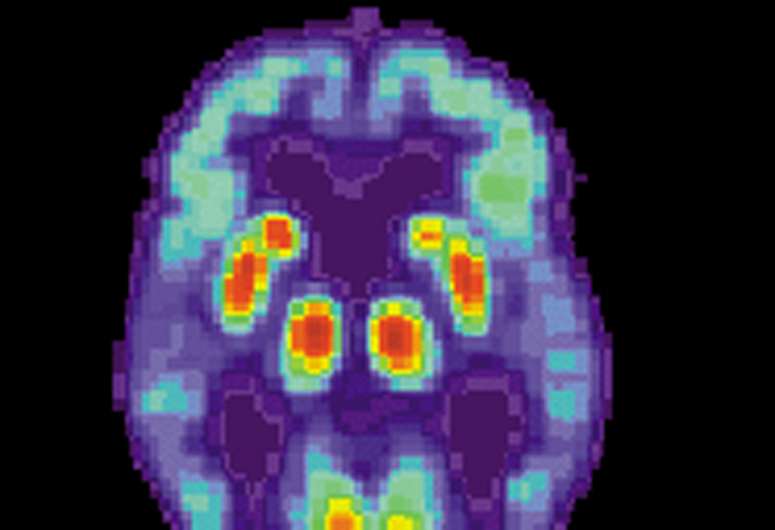
PET scan of a human brain with Alzheimer's disease. Credit: public domain
A new Cleveland Clinic-led study has identified mechanisms by which COVID-19 can lead to Alzheimer's disease-like dementia. The findings, published in Alzheimer's Research & Therapy, indicate an overlap between COVID-19 and brain changes common in Alzheimer's, and may help inform risk management and therapeutic strategies for COVID-19-associated cognitive impairment.
12 junho 2021--Reports of neurological complications in COVID-19 patients and "long-hauler" patients whose symptoms persist after the infection clears are becoming more common, suggesting that SARS-CoV-2 (the virus that causes COVID-19) may have lasting effects onbrain function. However, it is not yet well understood how the virus leads to neurological issues.
"While some studies suggest that SARS-CoV-2 infects brain cells directly, others found no evidence of the virus in the brain," says Feixiong Cheng, Ph.D., assistant staff in Cleveland Clinic's Genomic Medicine Institute and lead author on the study. "Identifying how COVID-19 and neurological problems are linked will be critical for developing effective preventive and therapeutic strategies to address the surge in neurocognitive impairments that we expect to see in the near future."
In the study, the researchers harnessed artificial intelligence using existing datasets of patients with Alzheimer's and COVID-19. They measured the proximity between SARS-CoV-2 host genes/proteins and those associated with several neurological diseases where closer proximity suggests related or shared disease pathways. The researchers also analyzed the genetic factors that enabled SARS-COV-2 to infect brain tissues and cells.
While researchers found little evidence that the virus targets the brain directly, they discovered close network relationships between the virus and genes/proteins associated with several neurological diseases, most notably Alzheimer's, pointing to pathways by which COVID-19 could lead to AD-like dementia. To explore this further, they investigated potential associations between COVID-19 and neuroinflammation and brain microvascular injury, which are both hallmarks of Alzheimer's.
"We discovered that SARS-CoV-2 infection significantly altered Alzheimer's markers implicated in brain inflammation and that certain viral entry factors are highly expressed in cells in the blood-brain barrier," explained Dr. Cheng. "These findings indicate that the virus may impact several genes or pathways involved in neuroinflammation and brain microvascular injury, which could lead to Alzheimer's disease-like cognitive impairment."
The researchers also found that individuals with the allele APOE E4/E4, the greatest genetic risk factor for Alzheimer's, had decreased expression of antiviral defense genes, which could make these patients more susceptible to COVID-19.
"Ultimately, we hope to have paved the way for research that leads to testable and measurable biomarkers that can identify patients at the highest risk for neurological complications with COVID-19," said Dr. Cheng.
Dr. Cheng and his team are now working to identify actionable biomarkers and new therapeutic targets for COVID-19-associated neurological issues in COVID long-haulers using cutting-edge network medicine and artificial intelligence technologies.
More information: Yadi Zhou et al, Network medicine links SARS-CoV-2/COVID-19 infection to brain microvascular injury and neuroinflammation in dementia-like cognitive impairment, Alzheimer's Research & Therapy (2021). DOI: 10.1186/s13195-021-00850-3
Provided by Cleveland Clinic
Thursday, January 23, 2020
A third of people would want to know they have Alzheimer's 15 years before symptoms
Over a third of people would want to know they had Alzheimer's disease 15 years before symptoms show, according to new findings from Alzheimer's Research UK.
23 jan 2020--The UK's leading dementia research charity published a report, Detecting and diagnosing Alzheimer's disease, revealing the public's attitudes toward early detection and diagnosis of Alzheimer's, the most common cause of dementia. The report calls for action to improve communication about dementia, support research efforts into earlier diagnosis and prepare the NHS for future treatments.
The report reveals that the public has a strong appetite to find out if they would develop Alzheimer's disease, although most want tests to be accurate and to give certainty about disease progression.
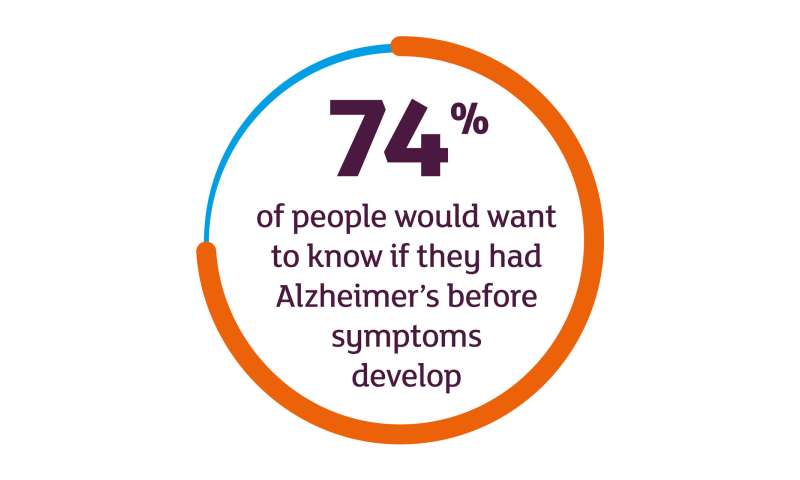
Despite there currently being no treatments to slow, stop or prevent Alzheimer's, 74 percent of UK adults would want to know they had the disease before symptoms appear. Upon further questioning, 33 percent said they would want to know two years before, while 38 percent would want to know 15 years before.
Currently Alzheimer's is diagnosed when symptoms such as memory loss appear, but the disease can begin damaging the brain years and perhaps decades before this point. Research suggests that being able to pick up these changes earlier has the potential to transform how and when we treat the disease.
Research in this area is progressing at pace and new diagnostic tools, such as blood tests, are on the horizon—while pharmaceutical company Biogen will soon file for FDA approval for the drug aducanumab, designed to be given in the early stages of Alzheimer's.
Alzheimer's Research UK, along with pharmaceutical company MSD, set out to get a clearer picture of people's attitudes in an effort to understand potential barriers that could hold back research and delay future treatments.
Other key findings from focus groups and a Populus survey of 2,106 people include:
At least 75 percent of people would be willing to undertake cognitive tests, brain imaging, blood tests and eye tests if they could help identify their risk of Alzheimer's.
Most people (84 percent) would be willing have an eye test if it could reveal their risk of developing dementia and least (40 percent) would be willing to have cerebrospinal fluid sampling.
But the results also highlighted a lack of understanding about the progression of Alzheimer's. Over half of UK adults (51 percent) surveyed didn't know or disagreed with the statement, "Alzheimer's begins decades before symptoms emerge."
The report highlights the important role doctors play in talking to people about early diagnosis and helping to shape public understanding of the different tests that are available now, or that research might deliver in the near future. It also makes recommendations on how the NHS can better inform the public about this topic, including recommending language guidance on how to talk about early detection and diagnosis.
Prof Jonathan Schott, Chief Medical Officer at Alzheimer's Research UK and Clinical Neurologist at the UCL Queen Square Institute of Neurology, said:
"For many people dementia, which is most commonly caused by Alzheimer's disease, is the most feared health condition. This can make it hard to start the important conversation about why we might want to start diagnosing Alzheimer's early.
"But this challenge is one we must overcome. Research suggests that our best shot at bringing about life-changing treatments and transforming the outlook for people with dementia may start by picking up diseases like Alzheimer's very early, and perhaps even before symptoms start. These efforts are particularly timely in light of recent preliminary but encouraging results from clinical trials of new treatments in people with early stage Alzheimer's.
"It's vital that we begin discussions with the public about why and how we can start to make an earlier diagnosis of Alzheimer's. This report suggests that the public is ready for this discussion—and that clinicians have a vital role to play."
Ian Wilson, Chief Executive at Alzheimer's Research UK, said:
"Right now, we face the frightening reality that one in three people born today will develop dementia in their lifetime, unless we find new preventions and treatments. To achieve this feat, we must be diagnosing diseases like Alzheimer's much earlier than we can today. This is a major focus for Alzheimer's Research UK and we're investing millions of pounds in research to make breakthroughs in this area.
"While we are making rapid progress, it's essential that we also act now to prepare both the public and the NHS for when these groundbreaking tests become available. That's why our report includes recommendations for how the NHS can support early diagnosis, and we're urging the Department of Health and Social Care to look now at what changes need to be made to the diagnostic pathway to support access to current and future dementia treatments. With life-changing drugs on the horizon, we don't have time to lose."
AB42 Cells - infected with amyloid beta prions. Credit: Prusiner lab / UCSF Institute for Neurodegenerative Diseases
Two proteins central to the pathology of Alzheimer's disease act as prions—misshapen proteins that spread through tissue like an infection by forcing normal proteins to adopt the same misfolded shape—according to new UC San Francisco research.
05 may 2019--Using novel laboratory tests, the researchers were able to detect and measure specific, self-propagatingprionforms of the proteins amyloid beta (A-β) and tau in postmortembraintissue of 75 Alzheimer's patients. In a striking finding, higher levels of these prions in human brain samples were strongly associated with early-onset forms of the disease and younger age at death.
Alzheimer's disease is currently defined based on the presence of toxic protein aggregations in the brain known as amyloid plaques and tau tangles, accompanied by cognitive decline and dementia. But attempts to treat the disease by clearing out these inert proteins have been unsuccessful. The new evidence that active A-β and tau prions could be driving the disease—published May 1, 2019 in Science Translational Medicine—could lead researchers to explore new therapies that focus on prions directly.
"I believe this shows beyond a shadow of a doubt that amyloid beta and tau are both prions, and that Alzheimer's disease is a double-prion disorder in which these two rogue proteins together destroy the brain," said Stanley Prusiner, MD, the study's senior author and director of the UCSF Institute for Neurodegenerative Diseases, part of the UCSF Weill Institute for Neurosciences. "The fact that prion levels also appear linked to patient longevity should change how we think about the way forward for developing treatments for the disease. We need a sea change in Alzheimer's disease research, and that is what this paper does. This paper might catalyze a major change in AD research."
What are Prions?
Prions are misfolded versions of a protein that can spread like an infection by forcing normal copies of that protein into the same self-propagating, misfolded shape. The original prion protein, PrP, was identified by Prusiner in the 1980s as the cause of Creutzfeldt Jakob Disease (CJD) and spongiform bovine encephalopathy, also known as Mad Cow Disease, which spread through consumption of meat and bone meal tainted with PrP prions. This was the first time a disease had been shown to infect people not by an infestation of an organism such as a bacterium or a virus, but through an infectious protein, and Prusiner received a Nobel Prize for that discovery in 1997.
Prusiner and colleagues have long suspected that PrP was not the only protein capable of acting as a self-propagating prion, and that distinct types of prion could be responsible for other neurodegenerative diseases caused by the progressive toxic buildup of misfolded proteins. For example, Alzheimer's disease is defined by A-β plaques and tau tangles that gradually spread destruction through the brain. Over the past decade, laboratory studies at UCSF and elsewhere have begun to show that amyloid plaques and tau tangles from diseased brains can infect healthy brain tissue much like PrP, but considerably more slowly.
The scientists’ new cellular assays could assess the presence of prion-like amyloid beta (top row), alpha-synuclein (middle row), or tau proteins (bottom row) in human kidney cells, as indicated by the bright orange spots. Credit: A. Aoyagi et al., Science Translational Medicine (2019)
Many scientists have been reluctant to accept that A-β and tau are self-propagating prions—instead referring to their spread as "prion-like"—because unlike PrP prions, they were not thought to be infectious except in highly controlled laboratory studies. However, recent reports have documented rare cases of patients treated with growth hormone derived from human brain tissue, or given transplants of the brain's protective dura mater, who went on to develop A-β plaques in middle age, long before they should be seen in anyone without a genetic disorder. Prusiner contends that these findings argue that both Aß and tau are prions even though they propagate more slowly than highly aggressive PrP prions.
In response to these debates, Prusiner likes to quote from a 1969 lecture by neuroscientist Bernard Katz: "There is a type of scientist who, if given the choice, would rather use his colleague's toothbrush than his terminology!"
Laboratory Bioassays Reveal Aß and Tau Prions in Human Postmortem Brain Samples
In the new study, the researchers combined two recently developed laboratory tests to rapidly measure prions in human tissue samples: a new A-β detection system developed in the Prusiner lab and a tau prion assay previously developed by Marc Diamond, Ph.D., a former UCSF faculty member who is now director of the Center for Alzheimer's and Neurodegenerative Diseases at UT Southwestern Medical Center.
Unlike earlier animal models that could take months to reveal the slow spread of A-β and/or tau prions, these cell-based assays measure infectious prion levels in just three days, enabling the researchers to effectively quantify for the first time the levels of both tau and A-β prions in processed extracts from post-mortem brain samples. In the new study, they applied the technique to autopsied brain tissue from over 100 individuals who had died of Alzheimer's disease and other forms of neurodegeneration, which was collected from repositories in the United States, Europe, and Australia.
In assays comparing the samples from Alzheimer's patients with those who died of other diseases, prion activity corresponded exactly with the distinctive protein pathology that has been established in each disease: in 75 Alzheimer's disease brains, both A-β and tau prion activity was elevated; in 11 samples from patients with cerebral amyloid angiopathy (CAA), only A-β prions were seen; and in 10 tau-linked frontotemporal lobar degeneration (FTLD) samples, only tau prions were detected. Another recently developed bioassay for alpha-synuclein prions only found these infectious particles in the seven samples from patients with the synuclein-linked degenerative disorder multiple system atrophy (MSA).
"These assays are a game-changer," said co-author and protein chemist William DeGrado, Ph.D., a professor of pharmaceutical chemistry and member of the UCSF Cardiovascular Research Institute, who contributed to the design and analysis of the current study. "Previously Alzheimer's research has been stuck looking at collateral damage in the form of misfolded, dead proteins that form plaques and tangles. Now it turns out that it is prion activity that correlates with disease, rather than the amount of plaques and tangles at the time of autopsy. So if we are going to succeed in developing effective therapies and diagnostics, we need to target the active prion forms, rather than the large amount of protein in plaques and tangles."
A-β and Tau Prion Activity Linked to Alzheimer's Patients' Longevity
The most remarkable finding of the new study may be the discovery that the self-propagating prion forms of tau and A-β are most infectious in the brains of Alzheimer's patients who died at a young age from inherited, genetically driven forms of the disease, but much less prevalent in patients who died at a more advanced age.
In particular, when compared to measurements of overall tau buildup—which is known to increase with age in Alzheimer's brains—the researchers found a remarkable exponential decline in the relative abundance of the prion forms of tau with age. When the researchers plotted their data, they saw an extremely strong correlation between tau prions and patients' age at death: relative to overall tau levels, the quantity of tau prions in the brain of a patient who died at age 40 were on average 32 times higher than in a patient who died at 90.
"I still remember where I was sitting and what time of day it was when I first saw this data over a year ago," said co-author and leading neurodegeneration researcher William Seeley, MD, a professor of neurology at the UCSF Memory and Aging Center who directs the UCSF Neurodegenerative Disease Brain Bank, which provided tissue used in the study. "I've very rarely, if ever, seen this kind of correlation in human biological data. Now the job is to find out what the correlation means."
The research raises a number of questions that will need to be addressed by future studies, including whether differences in prion infectivity could explain the long-standing mystery of why Alzheimer's progresses at such different rates in different patients. Other open questions resulting from the research include whether higher prion levels in brain samples from younger patients are linked to the early onset of the disease or how quickly it progressed, and whether lower prion levels in older brains reflect less "infective" prion variants or instead some ability of these patients' brains to dispose of misfolded proteins.
The evidence that prion forms of A-β and tau play a specific role in Alzheimer's disease—one that cannot be captured by simply counting amyloid plaques and tau tangles in patient brains—also raises questions on current approaches to Alzheimer's diagnosis, clinical trial design, and drug discovery, say the authors, who hope their novel assays will spur renewed interest in developing therapies to target the now-measurable prion proteins.
"We have recently seen many seemingly promising Alzheimer's therapies fail in clinical trials, leading some to speculate that we have been targeting the wrong proteins," said Carlo Condello, Ph.D., one of the study's lead authors. "But what if we just haven't been designing drugs against the distinctive prion forms of these proteins that actually cause disease? Now that we can effectively measure the prion forms of A-β and tau, there's hope that we can develop drugs that either prevent them from forming or spreading, or help the brain clear them before they cause damage."
More information: A. Aoyagi el al., "Aβ and tau prion-like activities decline with longevity in the Alzheimer's disease human brain," Science Translational Medicine (2019). stm.sciencemag.org/lookup/doi/ … scitranslmed.aat8462
Provided by University of California, San Francisco
Thursday, December 05, 2013
44 million now suffer from dementia worldwide, study finds
The number of people suffering from dementia has risen 22 percent in the past three years, with 44 million people living with the disease worldwide, according to a study released Thursday.
The report from Alzheimer Disease International predicts that the number of people suffering from the disease will triple worldwide to 135 million by 2050.
According to the new figures, 16 million people in western Europe will be living with the condition by 2050.
Marc Wortmann, executive director at Alzheimer Disease International, said: "It's a global epidemic and it is only getting worse—if we look into the future the numbers of elderly people will rise dramatically.
"It's vital that the World Health Organisation makes dementia a priority, so the world is ready to face this condition."
The study was released ahead of a G8 summit on dementia being held in London next week.
Britain's Department of Health called dementia "a growing worldwide challenge".
"We are leading a global fightback by bringing the G8 countries together to tackle dementia as a global issue for the first time," said a spokesman.
"The G8 summit next week will provide a unique opportunity to make real progress much faster, and re-double international efforts to find effective treatments and cures."
British actress Carey Mulligan urged G8 health ministers increase funding for dementia research.
"Since my own grandmother, Nans, was diagnosed with Alzheimer's, I have experienced at first hand just how terribly painful and frightening dementia can be for both the person diagnosed and their family," she wrote in a letter published in Thursday's Times.
"On behalf of all those who have dementia today, and the future generations who might still be spared, I would urge the G8 to deliver."