Showing posts with label alzheimer drugs. Show all posts

Friday, June 09, 2023


Alzheimer's drug development pipeline: Promising therapies, pharma investment drive momentum in clinical trials
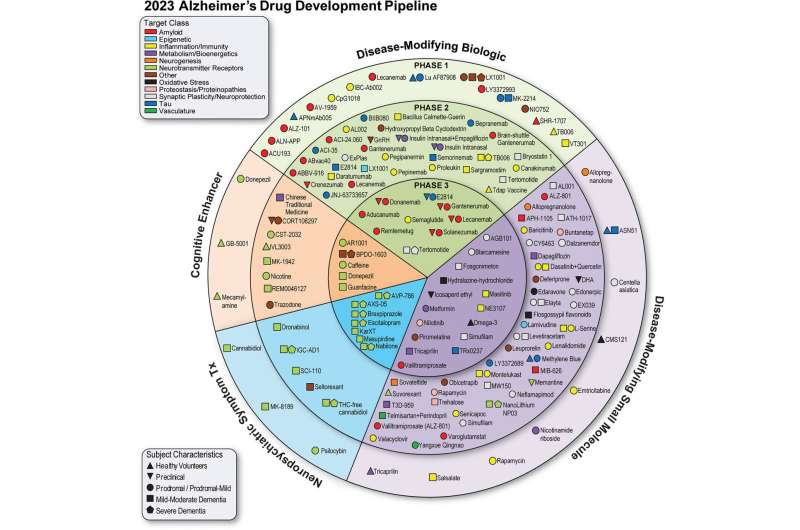
Alzheimer's drug development pipeline: promising therapies, pharma investment drive momentum in clinical trials
Agents in clinical trials for treatment of Alzheimer's disease in 2023 (from ClinicalTrials.gov as of the index date of January 1, 2023). The inner ring shows Phase 3 agents; the middle ring comprises Phase 2 agents; the outer ring presents Phase 1 therapies; agents in green areas are biologics; agents in purple are disease-modifying small molecules; agents in orange areas are symptomatic agents addressing cognitive enhancement or behavioral and neuropsychiatric symptoms; the shape of the icon shows the population of the trial; the icon color shows the CADRO-based class of the agent (“Other” category includes CADRO classes that have three or fewer agents in trials). CADRO, Common Alzheimer's Disease Research Ontology; Tx, treatment. Credit: J Cummings; M de la Flor, PhD, Illustrator

More than 6 million Americans are living with Alzheimer's disease, a staggering number that's expected to double within the next 30 years.

08 Jun 2023--But there are signs of optimism in the fight against Alzheimer's, with two new therapies approved by the FDA since 2021. Both drugs—Aduhelm (aducanumab) in 2021 and Leqembi (lecanemab) earlier this year—were approved to treat early-stage symptoms of the disease. They're the first-ever disease-modifying therapies (DMTs) to earn the green light for use against Alzheimer's, and they signal a new era of hope for millions who've been affected by the disease.

There could be more on the way.

According to the "Alzheimer's Disease Drug Development Pipeline: 2023," there are currently 187 clinical trials in the Alzheimer's drug development pipeline—the most ever on record. This momentum is driven in part by greater investment from the pharma industry and a bump in biologic therapies—particularly monoclonal antibodies—that were central to the success of both recent FDA-approved drugs.

The annual pipeline report, published May 25 in Alzheimer's & Dementia: Translational Research and Clinical Interventions, is led by Dr. Jeffrey Cummings, a leading Alzheimer's clinician-scientist and research professor in UNLV's School of Integrated Health Sciences. The goal of the annual report, Dr. Cummings says, is to spot trends in clinical trial design and outcome measures, and also investigate the types of agents and biological targets that are being pursued.

"Our database has gotten stronger and our ability to draw analysis from the pipeline is ever better," said Cummings, who first began the annual pipeline project in 2016. "We can derive lessons from both positive and negative trials that will inform and accelerate the development or new treatments."

Pipeline highlights

Researchers pulled data from all current phase 1, 2, and 3 clinical drug trials for Alzheimer's Disease and Mild Cognitive Impairment, as of Jan. 1, 2023. The team tracked all therapies in the pipeline, the types of agents used, and how far along each is in the drug development process. They also analyzed the agencies and industries funding clinical trials, and assessed the number of participants in current trials. Among the highlights:

  • 187 current trials, which consist of 141 unique treatments—just off last year's record of 143 unique treatments
  • 58 new drugs have entered the pipeline in the past year
  • DMTs are the most common agents used in trials: 111 agents, or 79%, of the total number of drugs in the pipeline
  • 28% of candidate therapies are repurposed from other diseases
  • 57,465 participants are needed for all currently active trials

"We are at an inflection point in the Alzheimer's field. The recent landmark FDA approvals we've seen for both disease-modifying and symptomatic treatments, as well as the diversification of the pipeline of potential new Alzheimer's therapies, provide hope to those impacted by this devastating disease," said Maria C. Carrillo, Ph.D., Alzheimer's Association chief science officer. "Yet, Medicare stubbornly continues to block access for people who could benefit."

Biologics gaining momentum

Cummings notes that the use of biologic therapies—particularly monoclonal antibodies—has become increasingly popular. Among DMTs, related trials have risen more than 10% over the past year (44% of drugs in the pipeline). These therapies are mainly given by IV infusion, as opposed to small molecule therapies (56% of DMTs in the pipeline) that can be taken orally.

"The recent approval of two anti-amyloid monoclonal antibodies specifically for Alzheimer's is certainly influencing the pipeline, but these are complex therapies," Cummings said. "We're in a steep learning period for how we incorporate these advances into care. They require intense resources and regular MRI scans during the initial phase, which can lead to unprecedented demands on health care systems."

In addition to the growth of biological therapies aimed at amyloid and tau—two hallmark signs of Alzheimer's disease in the brain—Cummings anticipates more investment in small molecules aimed at amyloid. The use of biomarkers has also become more prevalent in clinical trials, particularly in DMT trials, and their foundational role in drug development has been shown to increase probability of success throughout the pipeline.

Pharma investment growing

After a recent decline, the pharma industry has also started to become more of a player in clinical trials. Of all the trials in development, 108 (58%) are industry sponsored, up nearly 8% over the past year. Public-private partnerships accounted for 9% of trials, and 32% were funded by academic medical centers—a group that includes the NIH, universities, advocacy groups, and related organizations.

"We see many more phase 1 biologics than agents in any other therapeutic class, which again reflects an increased enthusiasm of pharma for biological agents such as monoclonal antibodies," said Cummings. "Overall, the recession has impacted biotech investment, but I expect to see the Alzheimer's investment arena rebound with the economy, which will drive investment compared to previous years when the capital becomes available."

Recruitment struggles slowing progress

Recruitment continues to be a challenge for phase 2 and 3 clinical trials, with the average recruitment time for various trials stretching more than 100 weeks, or as many as 200-plus weeks for certain trials. The timing for phase 1 trials is only slightly better.

Though Cummings expects a bump in interest following recent FDA-approved therapies and the related marketing that will follow, recruitment—both in the number and diversity of participants—remains an area that's delaying the pipeline and stalling therapies that could otherwise progress more quickly toward approval.

"We need to find a way to expand trial populations, as this remains a major challenge when surveying the pipeline," Cummings said. "These drugs are expensive, and access will be limited if there is not Medicare funding for them. The availability of approved and funded treatments may decrease interest in participating in clinical trials."

Study authors include Cummings, Kate Zhong, and Garam Lee from the UNLV Chambers-Grundy Center for Transformative Neuroscience and the UNLV Department of Brain Health; Yadi Zhou from the Cleveland Clinic; and Jorge Fonseca and Feixiong Cheng from Case Western Reserve University.

More information: Jeffrey Cummings et al, Alzheimer's disease drug development pipeline: 2023, Alzheimer's & Dementia: Translational Research & Clinical Interventions (2023). DOI: 10.1002/trc2.12385

Provided by University of Nevada, Las Vegas

Monday, October 02, 2017

Study ranks safety, effectiveness of cognitive enhancers for Alzheimer's


Study ranks safety, effectiveness of cognitive enhancers for Alzheimer's
Dr. Andrea Tricco.
A new study ranking the safety and effectiveness of four drugs taken to enhance concentration, memory, alertness and moods, found that donepezil was most likely to effectively improve cognition in patients with Alzheimer's dementia.

02 oct 2017--However, patients who took donepezil were more likely to experience side effects including nausea, vomiting and diarrhea than those who received a placebo, according to the study, published online today in the Journal of the American Geriatrics Society.
In 2015, 46 million people worldwide had Alzheimer's disease, according to the study. In 2013, 146,593 people aged 65 and older in Ontario alone used cognitive enhancers, according to a 2016 Ontario Drug Policy Research report.
"Alzheimer's dementia is the most common form of dementia in North America, and most people who have moderate to severe Alzheimer's will be on these medications," said Dr. Andrea Tricco, a scientist in the Li Ka Shing Knowledge Institute of St. Michael's Hospital and lead author of the study. "This analysis will give both patients and clinicians a full picture of how each of these drugs will likely affect their cognition, as well as their overall health."
Although there have been previous reviews of the safety and effectiveness of cognitive enhancers in treating Alzheimer's dementia, the authors said this was the first to rank their comparative safety and effectiveness.
The study used network meta-analysis, an advanced statistical analysis technique, to systematically review existing evidence from 142 clinical trials of four common cognitive enhancers administered alone or in combination published between 1996 and 2015. The number of patients in each study ranged from 13 to 2,045, and the review evaluated a total of 33,889 patients.
The researchers compared the safety and effectiveness of any combination of donepezil, rivastigmine, galantamine or memantine in treating moderate to severe Alzheimer's dementia based on the results of the clinical trials that examined a number of patient outcomes, including cognition, function behaviour, global status, mortality, serious adverse events, falls, bradycardia, headache, diarrhea, vomiting and nausea. Donepezil was likely the most effective medication for Alzheimer's dementia across all effectiveness outcomes, including cognition, behavior and overall health, according to the study.
Donepezil was also the only cognitive enhancer that reached the minimal clinically important threshold—meaning effects on outcomes were observed clinically, as well as statistically—on the Alzheimer's Disease Assessment cognition scale, making it the likely first choice for those patients and clinicians considering these medications, the authors said.
Although no significant risk of serious harm, falls or reduced heart rate was associated with any of the medications in the study, the data was limited on these specific outcomes.
Previous research by the authors found that cognitive enhancers do not improve cognition or function in people with mild cognitive impairment, and these patients experience significantly more nausea, diarrhea, vomiting and headaches.
The findings of the current study will help guide patients and clinicians who are making decisions about the best course of treatment for Alzheimer's dementia, said Dr. Tricco.
"The more information we are able to gather about how each of these medications can affect a patient's cognition and health, the more likely we are to be able to improve their health outcomes," she said.


Provided by St. Michael's Hospital

Thursday, January 23, 2014

Alzheimer's drugs fail, but lessons are learned

Disappointing Alzheimer's trial yields new ideas
DAD (Disability Assessment for Dementia) scores worsened on average during the 78-week trial, with "bapi" (dotted blue line) showing no improvement over placebo. This data is from the trial with APOE allele carriers. Credit: Salloway et. al.

Dr. Stephen Salloway pulls no punches in describing the results of two clinical trials of the Alzheimer's drug bapineuzumab that he helped to lead. The antibody failed to produce cognitive improvement for volunteers compared to a placebo, he and colleagues report Jan. 23 in the New England Journal of Medicine.
23 jan 2014--"It is very disappointing, especially to the terrific and dedicated patients and their famililes," said Salloway, professor of neurology and psychiatry in the Warren Alpert Medical School of Brown University, director of neurology and the Memory and Aging Program at Butler Hospital, and lead author of the study. "So much effort went into this trial. Alzheimer's is a difficult and complex disease, and we are moving forward."
As much as the negative findings stung the patient, medical, and investor communities when they first became public in 2012, Salloway said that in the intervening time, researchers have come to understand several important lessons that they are moving aggressively to apply to a next round of research.
"We don't have the luxury of time," Salloway said. "There is an urgency that doesn't allow us to wait."
Antibody drugs like bapineuzumab—"bapi"—bind to and trigger clearance of amyloid beta proteins that form harmful plaques in the brains of Alzheimer's patients. (The antibody solanezumab, which was also tested in trials with similarly disappointing results published this week in NEJM, binds  proteins in the blood, helping pull amyloid out of the brain.)
Important lessons of the bapi trials, Salloway said, are to test the drugs only with people who are building up the amyloid beta plaques the drugs address, to give drugs in doses that safely produce greater amyloid lowering, and to combine disease modifying treatments that might be complementary.
Drug combinations rather than single drugs, Salloway noted, have proven to be the answer not only for some forms of cancer, but also for converting other previously incurable problems, such as HIV, into manageable long-term conditions.
Another lesson may be to test these treatments at an earlier stage when amyloid plaques are mounting but before symptoms of cognitive decline have set in.
Salloway and a multicenter team of colleagues conducted two randomized, controlled, double-blinded trials, sponsored by bapi's manufacturers Janssen Alzheimer Immunotherapy and Pfizer. One trial tested the drug in 1,121 carriers of the APOE gene allele that is associated with a higher risk of Alzheimer's disease. The other evaluated it in 1,331 people without the allele. All participants were between 50 and 88 years old and had MRI scans and cognitive test scores indicating "probable" Alzheimer's disease.
Participants received the drug intraveneously every 13 weeks for 78 weeks. At each session they took cognitive tests. Subsets of participants also provided brain scans and fluid samples for various biomarkers, such as levels of amyloid beta plaques and tau protein associated with degeneration of brain cells. Early on researchers stopped administering the highest of three doses because of high levels of amyloid-related "fluid shifts" on MRI, most likely due to changes in amyloid in small arteries.
When researchers tallied the main measures of performance on cognitive tests, it became clear that bapi did nothing significant either for APOE carriers or noncarriers compared to placebo. In each group, cognitive decline continued unabated.
The researchers did find a benefit in two secondary measures: By week 71 they saw that bapi produced a significant reduction in phospho-tau concentration in the spinal fluid of APOE carriers, a indicator of neurodegeneration. In carriers who got the placebo, phospho-tau continued to rise. PET scans also showed less amyloid buildup in carriers who received the drug.
Looking for a breakthrough
"The biggest disappointment from this trial, was that if we had shown benefit with a drug like bapi, it would give people hope that Alzheimer's is a treatable disease, that we can slow it down," Salloway said.
That much needed breakthrough could come from new trials that apply the lessons researchers learned. It is likely that many of the participants, for example, had some form of dementia other than Alzheimer's disease, Salloway said. A future trial should only include those with amyloid buildup confirmed by a PET scan and spinal fluid testing.
"We were surprised to find that overall 20 percent of participants in both the bapi and solanezumab trials did not meet the threshold for amyloid buildup," Salloway said. "That proportion was higher for ApoE4 noncarriers."
Also amyloid plays a more critical role early in the development of the disease, he said. Trials that administer the medication earlier could produce greater effects.
It would make sense, he said, to pair drugs like bapi with drugs such as a beta secretase inhibitor that maximize amyloid lowering. The safety of such a combination, or combination with drugs that address the tangles of tau proteins also found in Alzheimer's, is not known, Salloway said, but needs to be carefully tested.
"Without taking strategic risks, we aren't going to make the progress we need to move forward," he said.
Testing drug combinations, however, may require pharmaceutical companies to pool resources and share data. He acknowledged that's something competitors are usually reluctant to do. These partnerships are forming in the pre-competitive arena, he said, but need to be expanded into clinical trials.
"For the level of suffering with this disease and for our economy, we have to break down barriers and come up with innovative approaches."
Provided by Brown University