Showing posts with label alzheimer risk. Show all posts

Wednesday, May 10, 2023


Study provides evidence that breathing exercises may reduce Alzheimer's risk

senior citizen
Credit: Unsplash/CC0 Public Domain

The exercise was simple: inhale for a count of five, then exhale for a count of five. Do that for 20 minutes, twice a day, for four weeks.

10 may 2023--These brief breathing sessions had significant impacts: Volunteers' heart rate variability increased during each exercise period and the levels of amyloid-beta peptides circulating in their blood decreased over the four weeks of the experiment.

That's the finding of a new study from USC Leonard Davis School of Gerontology Professor Mara Mather. Published last month in the journal Scientific Reports, the study may be the first to discover a way that adults, both young and old, can reduce their amyloid beta levels: via breathing exercises that lower the levels in our blood of these peptides associated with Alzheimer's disease.

That's because the way we breathe affects our heart rate, which in turn affects our nervous system and the way our brain produces proteins and clears them away. While we are awake and active, we typically use our sympathetic nervous system. This is sometimes known as the "fight or flight" system but we also use it to exercise, to focus attention, and even to help create long-lasting memories. While the sympathetic nervous system is activated, there isn't much variation in the time between each heartbeat. In contrast, when the parasympathetic system is activated, heart rates increase during inhaling and decrease during exhaling.

When we're young—or older, but very fit—our body slides easily between the sympathetic nervous system and its partner, the parasympathetic nervous system. Sometimes known as the "rest and digest" part of our system, the parasympathetic nervous system allows us to calm down, digest food easily, and sleep soundly. When these kinds of activities occur, the variation between heartbeats is greater.

But as we age, scientists are learning, our ability to access our parasympathetic nervous system—and thus, our heart rate variation—decreases dramatically.

A 2020 study using smart watches found that heart rate variability drops on average 80 percent between twenty and sixty years old. This finding could partially explain why we struggle to sleep deeply as we age.

"We know the sympathetic and parasympathetic systems influence the production and clearance of Alzheimer's related peptides and proteins," said Mather, who directs the Emotion & Cognition Lab at the Leonard Davis School of Gerontology. "Nevertheless, there's been very little research on how these physiological changes in aging might be contributing to the factors that make it conducive for someone to develop Alzheimer's disease or not."

Mather and fellow researchers from USC, UC Irvine and UCLA asked participants to do biofeedback exercises twice a day, for 20 minutes at a time. All the participants clipped a heart monitor onto their ear; that monitor was connected to a laptop the researchers provided.

Half the group was instructed to think of calm things, like a beach scene or a walk in a park, or to listen to calm music. Meanwhile, they were instructed to keep an eye on their heart rate as displayed on the laptop screen, making sure the heart rate line stayed as steady as possible while they meditated.

The other group was told to pace their breathing in rhythm with a pacer on the laptop screen—when the square rose, they inhaled, and when the square dropped, they exhaled. They also monitored their heart rates, which tended to rise in peaks as they inhaled and dip down to baseline as they exhaled. Their goal was to increase the breathing-induced oscillations in their heart rate.
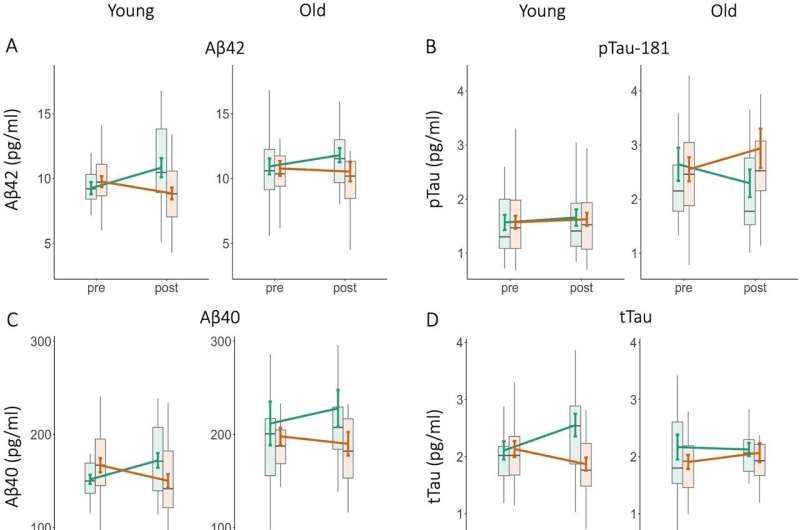
Study provides evidence that breathing exercises may reduce Alzheimer’s risk
Intervention effect on Aβ and tau levels. Orange represents Osc+ and green represents Osc−. The upper and lower box boundaries indicate the 75th and 25th percentiles respectively. The gray horizontal bar inside each box shows a median value for the box, and the colored vertical line describes the mean and standard error. The outliers are included for the summary statistics but are not shown in the figure. Credit: Scientific Reports (2023). DOI: 10.1038/s41598-023-30167-0

The researchers took blood samples before the participants began the experiment and again, after four weeks of biofeedback training. Then the researchers examined the plasma of participants from both groups, looking for amyloid beta peptides.

In particular, the researchers looked at two peptides, amyloid beta 40 and 42.

Accumulation of amyloid beta in the brain due to increased production and/or decreased clearance is believed to trigger the Alzheimer's disease process. In healthy adults who do not yet have signs of amyloid accumulation in the brain, a meta-analysis shows that higher levels of amyloid beta 40 and 42 in circulating blood predicts a greater risk of developing Alzheimer's.

In Mather and colleagues' study, plasma levels of both peptides decreased in the group who breathed slowly and tried to increase their heart rate variability (HRV) by increasing oscillations.

Now researchers want to figure out why the peptides decrease when HRV increases, said Jungwon Min, a graduate student in psychology and the lead author on the study. Is it because fewer peptides are being produced? Or because the body clears them out better? Or some combination of both?

Though the current study does give some hints.

"Based on the data we have, it appears the decrease in amyloid beta is due more to decreased production," she said. "But that doesn't exclude the possibility of increased clearance."

Of the study's 108 participants, half were young (ages 18 to 30) and half were old (ages 55 to 80). The younger and the older adults showed similar effects of the interventions on plasma amyloid beta levels.

The study appears to be the first to find that behavioral interventions can reduce the level of amyloid beta peptides in plasma. Previous research has demonstrated that sleep deprivation and stress can increase amyloid beta levels, but it has proved more challenging to decrease amyloid beta with behavioral interventions.

"At least to date, exercise interventions have not decreased Aβ [amyloid beta] levels," said Mather. "Regularly practicing slow-paced breathing via HRV biofeedback may be a low-cost and low-risk way to reduce plasma Aβ levels and to keep them low throughout adulthood."

Other study co-authors were Kaoru Nashiro, Hyun Joo Yoo, Shai Porat, Christine Cho and Junxiang Wan, of USC; Jeremy Rouanet, Allesandra Cadete Martini, Elizabeth Head, Daniel A. Nation and Julian F. Thayer, of UC Irvine; and Steve W. Cole of UCLA.

More information: Jungwon Min et al, Modulating heart rate oscillation affects plasma amyloid beta and tau levels in younger and older adults, Scientific Reports (2023). DOI: 10.1038/s41598-023-30167-0

Journal information: Scientific Reports 

Friday, August 21, 2015

Nine factors you can control may be key to Alzheimer's risk

9 factors you can control may be key to alzheimer's risk
Healthy lifestyle important but no guarantee against most common form of dementia, researchers find.
21 aug 2015—Up to two-thirds of Alzheimer's cases worldwide may stem from any of nine conditions that often result from lifestyle choices, a broad research review suggests.
Those include obesity (specifically, high body mass index, an indication of obesity, in midlife); carotid artery disease, in which plaque buildup narrows major neck arteries and slows blood supply to the brain; high blood pressure; depression; being frail; being poorly educated; having high levels of a naturally occurring amino acid known as homocysteine; and (specifically among those of Asian descent) being a smoker and/or having either type 2 diabetes.
The implication: Taking steps to minimize or eliminate such conditions might reduce the long-term risk for developing Alzheimer's, a brain disorder that affects memory and thinking. It is the most common form of dementia among seniors.
"The current evidence from our study showed that individuals would benefit from [addressing] the related potentially modifiable risk factors," said study lead author Dr. Jin-Tai Yu, an associate specialist in neurology at the University of California, San Francisco, and senior editor of the Journal of Alzheimer's Disease.
But Yu cautioned that "what is what is seen here is an association rather than a direct cause-and-effect relationship between any one factor and Alzheimer's risk." And that, he said, means it's impossible to determine exactly how much protection against Alzheimer's would be gained by the elimination of any one condition.
Yu and his colleagues discuss their findings in the Aug. 20 online issue of the Journal of Neurology, Neurosurgery & Psychiatry.
In all, investigators reviewed the findings of 323 studies completed between 1968 and 2014. Collectively, the studies involved more than 5,000 patients and looked at 93 conditions with the potential to affect Alzheimer's risk.
The team set out to determine which factors appeared to offer some protection against developing Alzheimer's.
On that score, the strongest evidence suggested that coffee, vitamins C and E, folate, NSAIDS (anti-inflammation drugs), statins (cholesterol-lowering drugs), blood pressure medications, and estrogen supplementation all appeared to reduce Alzheimer's risk.
Patients battling several serious health conditions also seemed to see their risk fall, including those with arthritis, heart disease, metabolic syndrome and/or cancer.
Those who were light or moderate drinkers of alcohol similarly saw their Alzheimer's risk dip, alongside current smokers (apart from those of Asian descent), those struggling with stress, and seniors with high body mass index.
By contrast, a complex statistical analysis enabled the research team to zero in on the nine factors that appeared to elevate Alzheimer's risk among 66 percent of those who ultimately get the disease.
But Dr. Anton Porsteinsson, a professor of psychiatry and director of the Alzheimer's Disease Care, Research and Education Program at the University of Rochester School of Medicine in Rochester, N.Y., suggested that to his mind, "there's not a lot of surprise here."
"It's an interesting paper," he said. "And certainly this review validates a number of individual studies that have previously shown an association between Alzheimer's and the factors they're identifying." But it doesn't improve understanding of the causes, he added.
The take-away, Porsteinsson said, is that a healthy lifestyle matters. Paying attention to blood pressure and cholesterol levels as well as exercise are all beneficial, and the other factors studied may make a difference, he added, but it doesn't mean there is a simple way to reduce Alzheimer's risk. Large clinical trials have looked at behavior modifications that might help, but those kind of simple interventions have failed.
"So reducing risk is probably not going to happen by just taking a pill or a food supplement or a single medication," he added. "That kind of a shortcut answer just doesn't have a lot of support."
More information: There's more on preventing Alzheimer's at U.S. National Institute on Aging.

Sunday, September 08, 2013

Better hygiene in wealthy nations may increase Alzheimer's risk

New research has found a "very significant" relationship between a nation's wealth and hygiene and the Alzheimer's "burden" on its population. High-income, highly industrialised countries with large urban areas and better hygiene exhibit much higher rates of Alzheimer's.
08 sept 2013--Using 'age-standardised'* data - which predict Alzheimer's rates if all countries had the same population birth rate, life expectancy and age structure—the study found strong correlations between national sanitation levels and Alzheimer's.
This latest study adds further weight to the "hygiene hypothesis" in relation to Alzheimer's: that sanitised environments in developed nations result in far less exposure to a diverse range of bacteria, viruses and other microorganisms—which might actually cause the immune system to develop poorly, exposing the brain to the inflammation associated with Alzheimer's disease, say the researchers.
"The 'hygiene hypothesis', which suggests a relationship between cleaner environments and a higher risk of certain allergies and autoimmune diseases, is well— established. We believe we can now add Alzheimer's to this list of diseases," said Dr Molly Fox, lead author of the study and Gates Cambridge Alumna, who conducted the research at Cambridge's Biological Anthropology division.
"There are important implications for forecasting future global disease burden, especially in developing countries as they increase in sanitation."
The researchers tested whether "pathogen prevalence" can explain the levels of variation in Alzheimer's rates across 192 countries.
After adjusting for differences in population age structures, the study found that countries with higher levels of sanitation had higher rates of Alzheimer's. For example, countries where all people have access to clean drinking water, such as the UK and France, have 9% higher Alzheimer's rates than countries where less than half have access, such as Kenya and Cambodia.
Countries that have much lower rates of infectious disease, such as Switzerland and Iceland, have 12% higher rates of Alzheimer's compared with countries with high rates of infectious disease, such as China and Ghana.
More urbanised countries exhibited higher rates of Alzheimer's, irrespective of life expectancy. Countries where more than three-quarters of the population are located in urban areas, such as the UK and Australia, exhibit 10% higher rates of Alzheimer's compared to countries where less than one-tenth of people inhabit urban areas, such as Bangladesh and Nepal.
Differences in levels of sanitation, infectious disease and urbanisation accounted respectively for 33%, 36% and 28% of the discrepancy in Alzheimer's rates between countries.
Researchers said that, although these trends had "overlapping effects", they are a good indication of a country's degree of hygiene which, when combined, account for 42.5% of the "variation" in countries' Alzheimer's disease rates—showing that countries with greater levels of hygiene have much higher Alzheimer's rates regardless of general life expectancy.
Previous research has shown that in the developed world, dementia rates doubled every 5.8 years compared with 6.7 years in low income, developing countries; and that Alzheimer's prevalence in Latin America, China and India are all lower than in Europe, and, within those regions, lower in rural compared with urban settings—supporting the new study's findings.
The results of the study are newly published by the journal Evolution, Medicine and Public Health, with these latest results coming hard on the heels of previous research led by Fox on the benefits of breastfeeding for Alzheimer's prevention.
"Exposure to microorganisms is critical for the regulation of the immune system," write the researchers, who say that say that—since increasing global urbanisation beginning at the turn of the 19th century—the populations of many of the world's wealthier nations have increasingly very little exposure to the so-called 'friendly' microbes which "stimulate" the immune system—due to "diminishing contact with animals, faeces and soil."
Aspects of modern life—antibiotics, sanitation, clean drinking water, paved roads and so on—lead to lower rates of exposure to these microorganisms that have been "omnipresent" for the "majority of human history", they say.
This lack of microbe and bacterial contact can lead to insufficient development of the white blood cells that defend the body against infection, particularly those called T-cells—the foot soldiers of the immune system that attack foreign invaders in the bloodstream.
Deficiency of anti-inflammatory ("regulatory") T-cells has links to the types of inflammation commonly found in the brain of those suffering with Alzheimer's disease, and the researchers' proposal that Alzheimer's risk is linked to the general hygiene levels of a nation's population is reinforced by their analysis of global Alzheimer's rates.
"The increase in adult life expectancy and Alzheimer's prevalence in developing countries is perhaps one of the greatest challenges of our time. Today, more than 50% of people with Alzheimer's live in the developing world, and by 2025 it is expected that this figure will rise to more than 70%," said Fox.
"A better understanding of how environmental sanitation influences Alzheimer's risk could open up avenues for both lifestyle and pharmaceutical strategies to limit Alzheimer's prevalence. An awareness of this by-product of increasing wealth and development could encourage the innovation of new strategies to protect vulnerable populations from Alzheimer's."
While childhood—when the immune system is developing—is typically considered critical to the 'hygiene hypothesis', the researchers say that regulatory T-cell numbers peak at various points in a person's life—adolescence and middle age for example—and that microorganism exposure across a lifetime may be related to Alzheimer's risk, citing previous research showing fluctuations in Alzheimer's risk in migrants.
The team used the disability-adjusted life year (DALY) rates to calculate the incidence of Alzheimer's across the countries studied. The DALY measurement is the sum of years lost due to premature mortality combined with years spent in disability – the World Health Organisation (WHO) says that one DALY can be thought of as "one lost year of 'healthy' life".
The researchers say this method is a much better measure than death rates as it "omits the effects of differential mortality rates" between developed and developing countries. The study was based on the WHO's 'Global Burden of Disease' report, which presents world dementia data for 2004.
More information: *Age-standardised data:
The process of age-standardisation presents a "single summary rate that reflects the number of events that would have been expected if the populations being compared had had identical age distribution" (WHO 2001)
The age-standardised data is calculated by adjusting the crude data for 5-year age groups by age-weights reflecting the age-distribution of the standard population. In the version of the WHO's Global Burden of Disease report we utilised, the terminal age category has been extended from the previous 85+ to 100+, which allows for better adjustment for differences in the proportion of population in older strata.
The age-adjusted and disability-adjusted life year (DALY) rates are calculated by "adjusting the crude estimates to an artificial population structure, the WHO Standard Population, that closely reflects the age and sex structure of most low and middle income countries" (WHO 2013).
The effort to construct a standard population for comparing data across populations with varied age-structures began in the 1840s, and progressed to an international scale in 1960 and was then adopted by the WHO. Statisticians have been researching and improving this process for the past five decades.
The new WHO World Standard was developed in 2000 to best reflect projections of world age-structures for the period 2000-2025. This new standard is based on the UN Population Division's assessments every two years and future projections for every five years of each country's population age-structure. This standardised procedure is widely accepted across the world, and is the basis for all relevant WHO-sponsored analyses.
Provided by University of Cambridge

Tuesday, January 24, 2012

Lifelong brain-stimulating habits linked to lower Alzheimer's protein level

A new study led by researchers at the University of California, Berkeley, provides even more reason for people to read a book or do a puzzle, and to make such activities a lifetime habit.

24 jan 2012--Brain scans revealed that people with no symptoms of Alzheimer's who engaged in cognitively stimulating activities throughout their lives had fewer deposits of beta-amyloid, a destructive protein that is the hallmark of the disease.

While previous research has suggested that engaging in mentally stimulating activities – such as reading, writing and playing games – may help stave off Alzheimer's later in life, this new study identifies the biological target at play. This discovery could guide future research into effective prevention strategies.

"These findings point to a new way of thinking about how cognitive engagement throughout life affects the brain," said study principal investigator Dr. William Jagust, a professor with joint appointments at UC Berkeley's Helen Wills Neuroscience Institute, the School of Public Health and Lawrence Berkeley National Laboratory. "Rather than simply providing resistance to Alzheimer's, brain-stimulating activities may affect a primary pathological process in the disease. This suggests that cognitive therapies could have significant disease-modifying treatment benefits if applied early enough, before symptoms appear."

An estimated 5.4 million Americans live with Alzheimer's disease, but the numbers are growing as baby boomers age. Between 2000 and 2008, deaths from Alzheimer's increased 66 percent, making it the sixth-leading killer in the country. There is currently no cure, but a draft of the first-ever National Alzheimer's Plan, released this week, revealed that the U.S. government is aiming for effective Alzheimer's treatments by 2025.

The new study, to be published Monday, Jan. 23, in the Archives of Neurology, puts the spotlight on amyloid – protein fibers folded into tangled plaques that accumulate in the brain. Beta-amyloid is considered the top suspect in the pathology of Alzheimer's disease, so finding a way to reduce its development has become a major new direction of research.

The researchers note that the buildup of amyloid can also be influenced by genes and aging – one-third of people age 60 and over have some amyloid deposits in their brain – but how much reading and writing one does is under each individual's control.

"This is the first time cognitive activity level has been related to amyloid buildup in the brain," said study lead author Susan Landau, research scientist at the Helen Wills Neuroscience Institute and the Berkeley Lab. "Amyloid probably starts accumulating many years before symptoms appear. So it's possible that by the time you have symptoms of Alzheimer's, like memory problems, there is little that can be done to stop disease progression. The time for intervention may be much sooner, which is why we're trying to identify whether lifestyle factors might be related to the earliest possible changes."

The researchers asked 65 healthy, cognitively normal adults aged 60 and over (average age was 76) to rate how frequently they participated in such mentally engaging activities as going to the library, reading books or newspapers, and writing letters or email. The questions focused on various points in life from age 6 to the present.

The participants took part in extensive neuropsychological testing to assess memory and other cognitive functions, and received positron emission tomography (PET) scans at the Berkeley Lab using a new tracer called Pittsburgh Compound B that was developed to visualize amyloid. The results of the brain scans of healthy older individuals with various levels of lifetime cognitive activity were compared with those of 10 patients diagnosed with Alzheimer's disease and 11 healthy people in their 20s.

The researchers found a significant association between higher levels of cognitive activity over a lifetime and lower levels of beta-amyloid in the PET scans. They analyzed the impact of other factors such as memory function, physical activity, self-rated memory ability, level of education and gender, and found that lifelong cognitive engagement was independently linked to amyloid deposition.

Notably, the researchers did not find a strong connection between amyloid deposition and levels of current cognitive activity alone.

"What our data suggests is that a whole lifetime of engaging in these activities has a bigger effect than being cognitively active just in older age," said Landau.

The researchers are careful to point out that the study does not negate the benefits of kicking up brain activity in the later years.

"There is no downside to cognitive activity. It can only be beneficial, even if for reasons other than reducing amyloid in the brain, including social stimulation and empowerment," said Jagust. "And actually, cognitive activity late in life may well turn out to be beneficial for reducing amyloid. We just haven't found that connection yet."

More information: Arch Neurol. Published online January 23, 2012. doi:10.1001/archneurol.2011.2748

Provided by University of California - Berkeley

Monday, January 16, 2012

Active lifestyle associated with less Alzheimer disease-related brain change among persons with APOE epsilon4 genotype

A sedentary lifestyle is associated with greater cerebral amyloid deposition, which is characteristic of Alzheimer’s disease (AD), among cognitively normal individuals with the ε4 allele of the apolipoprotein E (APOE) gene, according to a report published Online First by Archives of Neurology, one of the JAMA/Archives journals.

16 jan 2012--“The presence of an APOE ε4 allele is the most established genetic risk factor for Alzheimer disease (AD), with a higher percentage of individuals with AD having an ε4 allele in comparison with the general population,” the authors write as background information in the article. “It has been suggested that APOE status may modify associations between lifestyle factors such as exercise engagement and risk of cognitive decline and dementia.”

More information: Exercise Engagement as a Moderator of the Effects of APOE Genotype on Amyloid Deposition, Arch Neurol. Published online January 9, 2012. doi:10.1001/archneurol.2011.845

ABSTRACT

Objective. APOE 4 status has been associated with greater cortical amyloid deposition, whereas exercise has been associated with less in cognitively normal adults. The primary objective here was to examine whether physical exercise moderates the association between APOE genotype and amyloid deposition in cognitively normal adults.
Design APOE genotyping data and answers to a questionnaire on physical exercise engagement over the last decade were obtained in conjunction with cerebrospinal fluid (CSF) samples and amyloid imaging with carbon 11–labeled Pittsburgh Compound B ([11C]PiB) positron emission tomography. Participants were classified as either low or high exercisers based on exercise guidelines of the American Heart Association.
Setting. Knight Alzheimer's Disease Research Center at Washington University, St Louis, Missouri.
Participants. A total of 201 cognitively normal adults (135 of whom were women) aged 45 to 88 years were recruited from the Knight Alzheimer’s Disease Research Center. Samples of CSF were collected from 165 participants. Amyloid imaging was performed for 163 participants.
Results. APOE 4 carriers evidenced higher [11C]PiB binding (P < .001) and lower CSF Aβ42 levels (P < .001) than did noncarriers. Our previous findings of higher [11C]PiB binding (P = .005) and lower CSF Aβ42 levels (P = .009) in more sedentary individuals were replicated. Most importantly, we observed a novel interaction between APOE status and exercise engagement for [11C]PiB binding (P = .008) such that a more sedentary lifestyle was significantly associated with higher [11C]PiB binding for 4 carriers (P = .013) but not for noncarriers (P = .20). All findings remained significant after controlling for age; sex; educational level; body mass index; the presence or history of hypertension, diabetes mellitus, heart problems, or depression; and the interval between assessments.
Conclusion. Collectively, these results suggest that cognitively normal sedentary APOE 4–positive individuals may be at augmented risk for cerebral amyloid deposition.Link

Provided by Washington University in St. Louis

Friday, October 14, 2011

Researchers find first physical evidence bilingualism delays onset of Alzheimer's symptoms

Researchers at St. Michael's Hospital have found that people who speak more than one language have twice as much brain damage as unilingual people before they exhibit symptoms of Alzheimer's disease. It's the first physical evidence that bilingualism delays the onset of the disease.

14 oct 2011--"This is unheard of – no medicine comes close to delaying the onset of symptoms and now we have the evidence to prove this at the neuroanatomical level," said Dr. Tom Schweizer, a neuroscientist who headed the research.

Dr. Schweizer's team studied CT scans of patients who had been diagnosed with probable Alzheimer's disease and who had similar levels of education and cognitive skills, such as attention, memory, planning and organization. Half were fluently bilingual; the other half unilingual.

Despite the fact that both groups performed equivalently on all measures of cognitive performance, the scans of the bilingual patients showed twice as much atrophy in areas of the brain known to be affected by Alzheimer's.

The findings have been published on-line in the journal Cortex.

Dr. Schweizer said that bilingual people are constantly using their brain and keeping it active, which may contribute to overall brain health. That's why many physicians encourage older people to do crossword puzzles or Sudoku.

Dr. Schweizer said that because bilingual people constantly switch from one language to another or suppress one language to speak in the other, their brains may be better prepared to compensate through enhanced brain networks or pathways when Alzheimer's sets in.

Previous observational studies have found that bilingualism delays the onset of Alzheimer's symptoms by up to five years, but this is the first to find physical proof through CT scans.

Dr. Schweizer said the results are especially important in Canada, which is officially bilingual and has large numbers of immigrants for whom French and English are at least second languages. His study was conducted in Toronto, where the second language of many study participants was French, English or Chinese.

Dr. Schweizer noted that bilingualism does not prevent Alzheimer's. Once Alzheimer's symptoms appear in bilingual people, it is not clear whether the disease progresses at an accelerated rate.

He said the next steps would be to repeat the study in a larger sample of patients followed over time using more sophisticated MRIs. He said it wasn't clear from this study whether a second language had to be learned early in life to provide maximum benefit.

Provided by St. Michael's Hospital

Monday, July 19, 2010

Study shows that major Alzheimer's risk gene causes alterations in shapes of brain protein deposits

19 july 2010--Researchers at Mount Sinai School of Medicine have used a newly discovered class of biomarkers to investigate the possibility that the shape of brain protein deposits is different in people with Alzheimer's who have the highest-risk gene type than in those with the condition who have a neutral risk gene type. The study is being presented July 14 at the 2010 Alzheimer's Association International Conference on Alzheimer's Disease in Honolulu, Hawaii.

Sam Gandy, MD, PhD, the Mount Sinai Professor in Alzheimer's Disease Research, Professor of Neurology and Psychiatry, and Associate Director of the Alzheimer's Disease Research Center at Mount Sinai School of Medicine, led the study. Mount Sinai labs led by Patrick R. Hof, MD, Regenstreif Professor of Neuroscience and Vice-Chair for Translational Neuroscience of the Department of Neuroscience and Dara L. Dickstein, PhD, Assistant Professor, Neuroscience also collaborated on the study.

Apolipoprotein E (APOE) is a gene containing instructions needed to make a protein that helps carry cholesterol in the bloodstream. The APOE gene, which comes in several different forms, is related to increased risk of developing Alzheimer's disease. People with APOE ε4/ε4 gene type have the highest risk of developing the disease and people with APOE ε3/ε3 have a neutral risk. Discovering the important mechanisms underlying how APOE ε4/ε4 increases Alzheimer's risk has been one of the most vexing mysteries facing Alzheimer's researchers for over a decade.

Luminescent conjugated oligothiophenes (LCOs) or luminescent conjugated polymers (LCPs), the newly discovered class of biomarkers, can stick to protein structures in the body and emit colors reflecting the different shapes or forms of the proteins. Among other uses, LCPs/LCOs are currently being employed in test tubes, animal models, and autopsied Alzheimer's brains to study the structure of proteins deposits caused by the disease. The new markers bind to the two well-established hallmarks of Alzheimer's – beta amyloid plaques and tau tangles – and glow different colors depending on which forms of the deposits they "stick" to (e.g., plaques often "glow" orange, while tangles "glow" yellowish green).

In the study, frozen brain sections from people who died with Alzheimer's were stained using two LCPs/LCOs: pentamer formyl thiophene acetic acid (pFTAA) and polythiophene acetic acid (PTAA). Using PTAA, the researchers observed that Alzheimer patients with APOE ε4/ε4 gene type had core and cerebrovascular amyloid of different shapes, while in people with APOE ε3/ε3, the two amyloid structures had the same shape. Using pFTAA revealed that tau tangle densities in ε4/ε4 Alzheimer patients that were apparently greater than those with ε3/ε3.

"The findings support our hypothesis that APOE genotype changes amyloid structure," Dr. Gandy said. "This is important because the different shapes might respond differently to treatments that attempt to clear amyloid deposits from the brain. We already know, for example, that APOE ε4/ε4 patients respond less well to anti-amyloid antibody with bapineuzumab."


###

LCOs/LCPs were pioneered by Peter Nilsson, PhD, Assistant Professor of the Department of Chemistry, Linköping University, Sweden. The study also involved collaborating teams from Charité – Universitätsmedizin Berlin, Germany, led by Frank Heppner MD, Director of the Department of Neuropathology and Washington University, St Louis, led by David Holtzman MD, Professor and Chair of Neurology.

About The Mount Sinai Medical Center

The Mount Sinai Medical Center encompasses both The Mount Sinai Hospital and Mount Sinai School of Medicine. Established in 1968, Mount Sinai School of Medicine is one of few medical schools embedded in a hospital in the United States. It has more than 3,400 faculty in 32 departments and 15 institutes, and ranks among the top 20 medical schools both in National Institute of Health funding and by U.S. News & World Report. The school received the 2009 Spencer Foreman Award for Outstanding Community Service from the Association of American Medical Colleges.

Saturday, February 07, 2009

Living near big power line may up Alzheimer's risk

By Anne Harding

NEW YORK, 07 feb 2009- Older people living within 50 meters of major power lines are at increased risk of dying from Alzheimer's disease or senile dementia, research from Switzerland shows.

The risk increased steadily with the amount of time a person had been living in close proximity to a 220-380 kV power line, Dr. Anke Huss of the University of Bern and colleagues found. These are extra-high voltage lines used for long-distance transmission of large amounts of electricity.

Huss and colleagues were able to look at census and mortality data for over 95% of the Swiss population, which strengthens the power of the findings. Nevertheless, the researcher told Reuters Health, the results should be interpreted with caution because this is the first study to link residential magnetic field exposure to Alzheimer's mortality. Huss said she would like to see other research teams, preferably in other countries, look into the issue.

Extremely low-frequency magnetic fields are produced by electrical appliances and wiring as well as by power lines. The World Health Organization has stated that these magnetic fields are possible human carcinogens. In 2007, WHO concluded that there was not enough evidence to link extremely low-frequency magnetic fields to Alzheimer's disease, but called for the relationship to be a "key research priority," Huss and her team note in the American Journal of Epidemiology.

To investigate the relationship between residential exposure to power lines and risk of neurodegenerative disease, the researchers looked at 1990 and 2000 census data and 2000-2005 mortality data for 4.7 million people 30 and older.

Overall, Huss and her colleagues found, people living within 50 meters of a 220-380 kV power line were 1.24 times more likely to die of Alzheimer's disease than those living at least 600 meters away from these power lines.

People who lived for at least 5 years near a 220-380 kV power line were at a 1.51-fold increased risk. For people who lived close to a large power line for at least a decade, risk increased by a factor of 1.78, while it was doubled for those who had been living near a power line for at least 15 years. Results were similar when the researchers looked at deaths from senile dementia.

While 9.2% of the Swiss population lives within 600 meters of an extra-high voltage power line, only 0.3% live within 50 meters of one, Huss noted. "It's not a huge amount of people."

People are much more likely to be exposed to extremely low-frequency magnetic fields at home, but such exposure can easily be controlled, according to Huss. While household appliances such as radio alarm clocks can produce magnetic fields similar to those emitted by power lines, the researcher pointed out, reducing risk is a simple matter of avoiding being very close to such devices for long periods of time; for example, not sleeping with one's head close to a radio alarm clock or keeping an electric blanket on all night long.

At present, the researcher added, there is no accepted biological mechanism to explain why magnetic fields might increase Alzheimer's risk. Given the consistency of the findings, she added, "There might be something going on even if we don't know what it is."

SOURCE: American Journal of Epidemiology, January 15, 2009.