Showing posts with label alzheimer treatment. Show all posts

Thursday, August 17, 2023


Guidance on new treatments for early Alzheimer's disease issued

alzheimer's
Credit: Pixabay/CC0 Public Domain

New therapies for early Alzheimer's disease, monoclonal antibodies that remove amyloid-β plaques in the brain, are bringing hope to people whose lives have been affected by the disease. To help neurologists discuss these therapies with patients and caregivers, the American Academy of Neurology has developed an Emerging Issues in Neurology article, published online on July 26, 2023, in Neurology.

17 aug 2023--Emerging Issues in Neurology articles are designed to provide timely guidance to neurologists and other clinicians, derived from expert consensus about new or emerging issues, that have immediate implications for patient care but for which a formal evidence base is still evolving.

"Neurologists care for millions of people with Alzheimer's disease and many people with early forms of dementia are eager to learn if these new therapies could help them," said American Academy of Neurology President Carlayne E. Jackson, MD, FAAN. "To help neurologists provide the highest quality care, experts with the American Academy of Neurology have summarized the available evidence on anti-amyloid monoclonal antibodies so that neurologists, patients and their caregivers can make informed decisions together about possible treatment with these therapies."

The Emerging Issues in Neurology article was written using available information on lecanemab, aducanumab and donanemab. It is important to note that this article is not a clinical practice guideline.

"Recent data on lecanemab and other monoclonal antibody infusions targeting amyloid-β protein make clear that new agents are highly likely to be part of the toolkit for neurologists caring for people with Alzheimer's disease," said article author Vijay K. Ramanan, MD, Ph.D., of the Mayo Clinic in Rochester, Minnesota. "While the formal evidence base is still evolving, this article was created with expert consensus until there is enough evidence on these therapies to inform evidence-based recommendations."

Lecanemab received traditional FDA approval on July 6, 2023. Aducanumab received accelerated approval from the FDA in June 2021 but has not yet received traditional approval. Aducanumab is currently available only to people participating in a clinical trial. Donanemab is not yet approved, but a decision on traditional FDA approval is expected later in 2023.

The article explains who is eligible to receive these therapies. Currently only people with early symptomatic forms of the disease, mild cognitive impairment or mild dementia due to Alzheimer's disease, may qualify to receive lecanemab. In addition, the article says people should be counseled about certain genetic risk factors and must not have a history of certain types of strokes. This is due to the risk of a serious side effect called amyloid-related imaging abnormalities, or ARIA, which is brain swelling and bleeding in the brain that can lead to death.

For this reason, people taking certain anticoagulant medications that are commonly prescribed to older adults may also not be eligible. There have been three deaths linked to lecanemab. The article notes that at least two of those people were given anticoagulants while on the therapy.

While the goal of using these therapies is to remove amyloid-β plaques to slow cognitive decline, the article notes the therapies are not a cure for the disease. It also explains that the reduction in the rate of cognitive decline seen over 18 months in some studies may not be evident to the people receiving these therapies.

The article discusses the high cost of these therapies and notes that additional costs will come with diagnostic testing, administration and safety monitoring. The drugs are administered through regular infusions and monitoring requires multiple brain scans. Plus, there is a shortage of neurologists and medical professionals needed to provide this care and meet the anticipated demand.

The article expresses concern that study participants so far have primarily been white, while Black and Hispanic people have been underrepresented. It says steps must be taken to ensure that future studies include a diverse range of participants, especially since the incidence of dementia has been shown to be higher in Black and Hispanic populations compared with white populations.

"There is much optimism that anti-amyloid monoclonal antibodies may facilitate slowing of the disease process in some people with Alzheimer's disease," said Ramanan. "Additional research is needed to further determine who may be most likely to benefit from these therapies, as well as to find ways to improve outcomes for people using them and enable future advances in this new era of Alzheimer's disease care."

More information: Vijay K Ramanan et al, Antiamyloid Monoclonal Antibody Therapy for Alzheimer Disease: Emerging Issues in Neurology, Neurology (2023). DOI: 10.1212/WNL.0000000000207757

Sunday, September 26, 2021


New non-drug treatment holds promise for preventative therapies for Alzheimer's

New non-drug method holds promise for preventative therapies for Alzheimer's
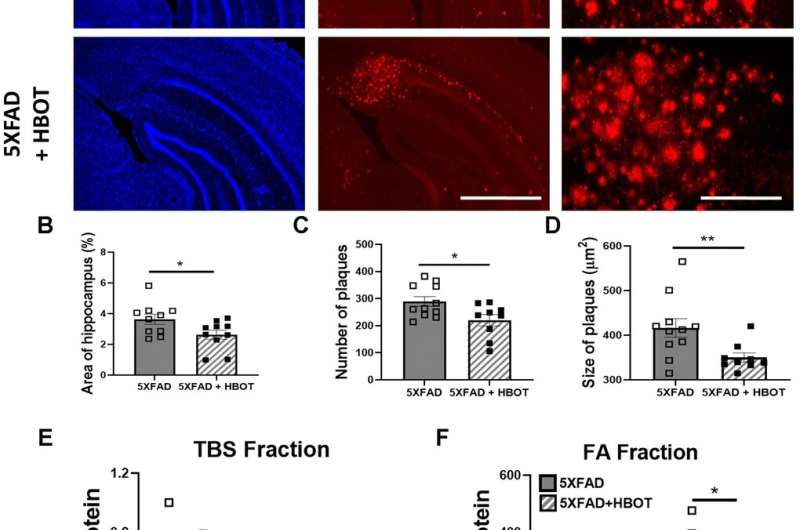
Figure 1. HBOT reduces amyloid plaques in the hippocampal area of 6-month old 5XFAD mice. Amyloid plaques were visualized by immunostaining with anti-Aβ antibodies (4G8). (A) Representative images of Aβ in the hippocampal field of HBO-treated 5XFAD (n=10, lower panel) and control 5XFAD mice (n=10, upper panel); left and middle panels, x4 magnification, scale bar: 1000 μm; right panel, x20 magnification, scale bar: 200 μm. (B) Quantification of the percentage of hippocampal area occupied by plaques. (C) Number of plaques. (D) Mean size of plaques. (E, F) Soluble Aβ was initially extracted from hippocampi with TBS by ultracentrifugation and then insoluble Aβ was extracted with 70% formic acid (FA) after ultra-centrifugation. ELISA analysis of soluble (E) and insoluble (F) Aβ40 and Aβ42 in hippocampal lysates of HBO-treated 5XFAD and control 5XFAD mice (n = 5/group). (B, C, F) -t-test, (D, F)- welch correction t-test. Values represent means ± SEM. *P < 0.05, ** P < 0.01. Credit: DOI: 10.18632/aging.203485

Approximately 50 million people worldwide live with Alzheimer's or other related forms of dementia. Alzheimer's disease leads to memory loss and impairment in cognitive function, and is the most common cause of dementia among older adults. While certain treatments can help reduce symptoms and sometimes reduce disease progression, there is currently no way to prevent or cure Alzheimer's.

26 sep 2021--Amid that backdrop, researchers from Tel Aviv University have developed a process for reversing the precursors of the disease, providing a promising foundation for new preventative therapies. This marks the first time that a non-drug therapy has proven effective in preventing the core biological processes that lead to the development of Alzheimer's, providing hope that we will now be able to fight one of the greatest challenges to the Western world.

Targeting the root of Alzheimer's

Using hyperbaric oxygen therapy (HBOT), in which subjects breathe 100% oxygen in a special chamber of high atmospheric pressure, the researchers were able to reverse brain damages associated with the biological hallmarks of Alzheimer's.

"By treating the root problem that causes cognitive deterioration with age, we are in fact mapping out the way to prevention," says co-lead researcher Prof. Shai Efrati.

Often used to treat carbon monoxide poisoning and infections that starve tissues of oxygen, hyperbaric therapy, when applied in a specific way, has previously been found capable of repairing damaged brain tissue and renewing growth of blood vessels and nerve cells in the brain. Therefore, the researchers tested its potential for Alzheimer's.

"After a series of hyperbaric treatments, elderly patients who were already suffering from memory loss showed an improvement of blood flow to the brain as well as a real improvement in cognitive performance," said co-lead investigator Prof. Uri Ashery.

The new approach devised by the researchers unequivocally improved characteristics commonly associated with Alzheimer's disease. Specifically, the hyperbaric treatment resulted in:

  • Improved memory in 16.5% of patients on average
  • Increased blood flow in 16%-23% of cases
  • Improved attention and concentration in 6% of patients
  • Improved information processing speed in 10.3% of all cases

A future without Alzheimer's?

"Our findings provide hope that we will now be able to fight one of the greatest challenges to the Western world. According to our findings, hyperbaric therapy given at a young age is likely to prevent this severe disease entirely," explains TAU team member Dr. Ronit Shapira.

The approach was first tested in laboratory settings followed by testing in patients over the age of 65 in stages of deteriorating mental function that often precede Alzheimer's and dementia. The therapy included a series of 60 treatments in hyperbaric chambers over a period of 90 days.

The study is part of a comprehensive research program focused on reversing processes of aging and its accompanying ailments. The researchers note that the findings are an encouraging step toward new approaches to preventing Alzheimer's by addressing not only the symptoms or targeting biomarkers, but the core pathology and biology responsible for the disease's development.

The findings were published in the journal Aging.


More information: Ronit Shapira et al, Hyperbaric oxygen therapy alleviates vascular dysfunction and amyloid burden in an Alzheimer's disease mouse model and in elderly patients, Aging (2021). DOI: 10.18632/aging.203485
Provided by Tel Aviv University 

Sunday, March 25, 2018

No new drugs for Alzheimer's disease in 15 years

No new drugs for Alzheimer's disease in 15 years
There are currently 105 compounds being tested in clinical trials around the world as possible new treatment for Alzheimer’s disease. Credit: Shutterstock
How often to you read headlines proclaiming the arrival of a new, ground-breaking treatment for Alzheimer's?

25 mar 2018--The answer is probably, quite often. However, the harsh reality for patients today who are suffering from the disease, and their families, is that no new medications have been approved by the European Medicines Agency, or have entered the global market since 2003.
However, there is also some good news to share.
There are currently more than 400 clinical trials taking place around the world and the likelihood that new medications will soon reach patients in the near future, is high.
Here is a summary of the types of clinical trials that are under way and when we might expect to see new treatments for this debilitating condition.

Clinical trials testing pharmaceuticals for Alzheimer's patients

Over the years, more than 190 compounds have been tested for Alzheimer's disease. Out of these, just five have been approved and marketed globally (donepezil, galantamine, memantine, rivastigmine and a combination of memantine and donepezil).
However, none of these compounds are able to stop the progression of the disease, they can only counter the rate of disease progression for a limited period.
For that reason, numerous drugs are currently being tested to find new ways to treat the disease.

Active trials around the world

We do this by clinical trials, which are controlled studies performed on human participants to test new treatments. Of the 400 trials that I mentioned earlier, many of them are currently testing new pharmaceuticals (medicinal drugs) and the rest are testing non-pharmaceutical treatments, which do not involve medicinal drugs, such as physical exercise and acupuncture.
Clinical trials are arranged in three phases (1, 2, and 3. See the Fact Box below for more details), which test for both the safety of the drug and its effectiveness.
There is also an earlier phase, phase 0, which is performed on animals only and a later phase, phase 4, to study sales and assess the patients' risks and benefits.
At the time of writing, there are currently 105 compounds being tested in clinical trials around the world, all of which are at various stages of development. Nine trials are registered in Europe, and four are taking place in Denmark. (See Fact Box).
Let's review some of these exciting new developments in turn.

Treatment 1: Targeting the protein, amyloid-beta

Numerous companies are producing potential treatments that target different aspects of the disease.
Many are developing drugs that target the reduction of a toxic substance, called amyloid-beta. This is a protein that is produced naturally by cells and is found in the brain. However, if amyloid-beta reaches very high levels it becomes toxic, causing cells to die. This is what happens in Alzheimer's.
Two drugs (sargramostim and AZD3293) are currently on trial to reduce the build-up of toxic levels of amyloid-beta. Sargramostim also has an added benefit in helping to stimulate the immune system. AZD3293 is currently one of the drugs being trialled by Eli Lilly, here in Denmark.
Targeting this protein makes good sense in combating the disease since it is a key pathology of the disease. But so far, no drugs have been able to successfully counteract cognitive decline in the patients or prevent their death. We will have to wait and see whether these drugs fair any better.

Treatment 2: Targeting the immune system

Other companies are trialling pharmaceuticals (aducanamab, crenezumab, and gantenerumab) that target the immune system. They are referred to as passive immunity drugs and target amyloid-beta, either in the brain or in the blood, which provides short-term immunity from a few weeks to a few months.
One of these drugs, crenezumab is designed to only work on the cells in the brain that are affected by the disease, and not on other cell types, such as cells important for the immune system and for maintaining the blood-brain barrier. This drug is currently being tested in Phase 3 trials in several European countries and there are plans to initiate testing in Denmark. The trial expects to end in 2022 and the outcomes of it are still unknown.
Unfortunately, one such passive immunity drug, solanezumab from the pharmaceutical company, Eli Lilly, failed to deliver promising results in late phase clinical trials. The good news though, is that there are eight more drugs currently being tested in Eli Lilly's Clinical Trials pipeline, which may yet yield better results.

Treatment 3: Vaccines targeting amyloid-beta

A number of experimental vaccines are also being tested in order to train the body to fight against amyloid-beta in the brain.
These include CAD106, which provides immunity against amyloid-beta, and AADvac1, which is currently being developed to target tau—another substance that accumulates in the brain of patients.
CAD106 is currently in Phase 2 trials, but preliminary outcomes from one completed Phase 2 trial suggested that quite a few patients (25 per cent) suffered severe adverse affects.
In contrast, the AADvac1 has had relatively promising results following completion of a Phase 1 trial with a high efficiency in stimulating an immune response in patients and relatively good outcome for patient safety.

Treatments closest to approval stage are not "new"

Interestingly, of the seven pharmaceuticals that have entered Phase 4 trials (marketing and sales testing), none of them target Amyloid-beta. They consist of either natural compounds or drugs that are already approved and used to treat other diseases. Phase 4 trials run for at least two years so these could enter the market in the not too distant future.
These include:
  • AVP-923: Consists of two drugs. It is an ingredient in cough syrup and used in combination with a drug currently used to treat irregular heartbeats.
  • Carvedilol: Currently used to treat high blood pressure, but it has been shown to slow cognitive decline through its antihypertension effects.
  • Prazosin: Has been shown to aid Alzheimer's disease by its hypertension effects.
  • Simvastatin: Currently used for treatment of hypercholesterol and cardiomyopathy. It demonstrates that drugs developed to treat cardiovascular disease and high blood pressure may have a beneficial effect in treating Alzheimer's.
  • DHA: These are polyunsaturated fatty acids, naturally found in the brain. One study has shown that high ingestion of foods rich in DHA (fatty fish, walnuts, flax seeds) is correlated with a low incidence of Alzheimer's disease.
  • Ketasyn: A nutritional drink derived from processed coconut or oils. It is suggested to provide an alternative glucose to the brain.
  • Resveratrol: A natural bioactive polyphenol found in foods such as chocolate and red grapes, which has antioxidant properties and is also close to entering the market.
Alternative treatments and trials in development

There are also a number of other ongoing trials that do not involve drugs at all.
They instead target behaviour or focus on physical activities, such as yoga. Special programs such as, Describe, Investigate, Evaluate and Create (DICE) have been developed for caregivers to help cope and manage with their patient's changing behaviour. While alternative treatments such as acupuncture, electromagnetic treatment, and deep brain stimulation aim to stimulate the patient's brain or body activity and activate the cells that remain in the brain.
Some clinical trials even combine non-drug approaches with already approved pharmaceuticals such as the combination of electroacupuncture with donepizil. It is anticipated that this combination treatment may be more effective than just treatment with donepizil. The trial is ongoing and we still await the outcome.

New treatments are on the horizon

In summary, there are currently hundreds of trials ongoing around the world as part of a maximal effort to find new medications and treatments for Alzheimer's disease.
Despite the fact that no drugs have entered the market in the last 15 years, there is hope on the horizon that new drugs will emerge soon.
These new treatments will target the underlying pathology of the disease, and hopefully stop or limit its progression. However, at this stage, it is too soon to say whether any of these new and upcoming pharmaceuticals can reverse the effects of the disease.
Only long-term studies will reveal if any of these drugs can in fact completely halt the progression of Alzheimer's disease.

This story is republished courtesy of ScienceNordic, the trusted source for English-language science news from the Nordic countries. Read the original story here.

Provided by ScienceNordic

Tuesday, February 06, 2018

Deep brain stimulation may be promising Alzheimer's treatment

Deep brain stimulation may be promising alzheimer's treatment
For patients with Alzheimer's disease (AD), the use of deep brain stimulation (DBS) at the ventral capsule/ventral striatum (VC/VS) region is well tolerated and is associated with less decline on the Clinical Dementia Rating-Sum of Boxes (CDR-SB), according to a study published online Jan. 30 in the Journal of Alzheimer's Disease.

06 feb 2018--Douglas W. Scharre, M.D., from The Ohio State University Wexner Medical Center in Columbus, and colleagues conducted a non-randomized phase I prospective open label intervention trial of three AD patients with matched comparison groups. The CDR-SB was compared for AD participants given DBS for at least 18 months at the VC/VS target to matched groups without DBS from the AD Neuroimaging Initiative cohort. In addition, over time, AD participants' serial 2-deoxy-2-[18F]fluoro-D-glucose (FDG) positron emission tomography (PET) images were compared longitudinally.
The researchers found that DBS was well tolerated by all participants, without significant adverse events. Relative to matched comparison groups, all three participants had less performance decline, and two had meaningfully less decline over time on CDR-SB using score trajectory slopes. After chronic DBS at the VC/VS target, minimal changes or increased metabolism were seen on FDG-PET in frontal cortical regions.
"The first use of DBS in AD at a frontal lobe behavior regulation target (VC/VS) was well tolerated and revealed less performance decline in CDR-SB," the authors write. "Frontal network modulation to improve executive and behavioral deficits should be furthered studied in AD."

More information: Abstract/Full Text (subscription or payment may be required)

Wednesday, February 19, 2014

JAMA study shows medication to treat agitation for Alzheimer's disease shows mixed results

The results of a Journal of the American Medical Association study offer a glimmer of hope to families caring for a loved one with Alzheimer's disease. Researchers at the University of Rochester, Johns Hopkins University, and six other academic medical centers found that a high dose of a common antidepressant drug (citalopram) significantly reduced agitation in patients participating in the study. However, given potentially concerning side effects of citalopram, researchers say further investigation is needed to determine whether a smaller dose will be as effective.
19 feb 2014--Agitation can be one of the most heartbreaking symptoms of the disease, and it is one of the most common reasons Alzheimer's patients are moved out of their homes into higher levels of care. Caregivers watch as their loved ones become increasingly short-tempered, physically restless, resistant to help, or even verbally and physically abusive. Treatment options are very limited. Antipsychotics are often prescribed, but these significantly increase a patient's risk of a stroke, heart attack, or death.
Citalopram, sold under the brand names Celexa and Cipramil, is one of the most common antidepressants taken by older adults in America. In this study, published in the February 19 issue of JAMA, 30 milligrams of citalopram were given to 94 patients with agitation.
Another group of 92 patients with these symptoms took a placebo. At the end of the study, 40 percent of patients who took citalopram had "considerable relief" from their agitation symptoms, compared to 26 percent in the placebo group. Researchers obtained these result by comparing the results of two common rating scales (Neurobehavioral Rating Scale NBRS-A and a modified Alzheimer Disease Cooperative Study-Clinical Global Impression of Change mADCS-CGIC), administered by clinicians at the beginning and the end of the study.
In addition, caregivers of patients taking citalopram experienced reduced caregiver distress, further illustrating the clinical relevance of the treatment and its impact.
"It has been a long time since we've had such positive results in a field that has seen a sea of negative study results," says Anton P. Porsteinsson, M.D., the William B. and Sheila Konar Professor at the University of Rochester and lead author of the study.
However, for older adults, the FDA recommends a maximum dose of 20 milligrams of citalopram to avoid risk of QT interval prolongation, a heart rhythm disorder that could eventually lead to death if not successfully treated. Patients in this study were monitored, and researchers confirmed a greater increase in QT interval occurred in the group of patients taking citalopram.
"There are very limited options for the treatment of this tremendously distressing and difficult to treat behavioral disruption. If non-pharmacological intervention is not beneficial, judicious use of citalopram appears to have a role in managing agitation in patients with Alzheimer's disease but generally the dose should not surpass 20 mg daily" says Porsteinsson.
More information: Paper: doi:10.1001/jama.2014.93
Editorial: doi:10.1001/jama.2014.94
Provided by University of Rochester Medical Center

Saturday, July 21, 2012


Anti-tau drug improves cognition, decreases tau tangles in Alzheimer's disease models

While clinical trial results are being released regarding drugs intended to decrease amyloid production - thought to contribute to decline in Alzheimer's disease - clinical trials of drugs targeting other disease proteins, such as tau, are in their initial phases.
21 july 2012--Penn Medicine research presented today at the 2012 Alzheimer's Association International Conference (AAIC) shows that an anti-tau treatment called epithilone D (EpoD) was effective in preventing and intervening the progress of Alzheimer's disease in animal models, improving neuron function and cognition, as well as decreasing tau pathology.
By targeting tau, the drug aims to stabilize microtubules, which help support and transport of essential nutrients and information between cells. When tau malfunctions, microtubules break and tau accumulates into tangles.
"This drug effectively hits a tau target by correcting tau loss of function, thereby stabilizing microtubules and offsetting the loss of tau due to its formation into neurofibrillary tangles in animal models, which suggests that this could be an important option to mediate tau function in Alzheimer's and other tau-based neurodegenerative diseases," said John Trojanowski, MD, PhD, professor of Pathology and Laboratory Medicine in the Perelman School of Medicine at the University of Pennsylvania. "In addition to drugs targeting amyloid, which may not work in advanced Alzheimer's disease, our hope is that this and other anti-tau drugs can be tested in people with Alzheimer's disease to determine whether stabilizing microtubules damaged by malfunctioning tau protein may improve clinical and pathological outcomes."
The drug, identified through Penn's Center for Neurodegenerative Disease Research (CNDR) Drug Discovery Program, was previously shown to prevent further neurological damage and improve cognitive performance in animal models*. The Penn research team includes senior investigator Bin Zhang, MD, and Kurt Brunden, PhD, director of Drug Discovery at CNDR.
More information: Bristol-Myers Squibb, who developed and owns the rights to the drug, has started enrolling patients into a phase I clinical trial in people with mild Alzheimer's disease.
Presentation: "Microtubule Stabilizing Drugs for Abrogation and Prevention of Alzheimer's Disease," during symposium on "Insights into Non-Alzheimer's Disease Dementia Also Inform Us About Alzheimer's Disease"
*Brunden, K.R., Zhang, B., Carroll, J., Yao, Y., Poduzak, J.S., Hogan, A.M., Iba, M., James, M.J., Xie, S., Ballatore, C., Smith, A.B., III, Lee, V.M-Y., and Trojanowski, J.Q. Epothilone D improves microtubule density, axonal integrity and cognition in a transgenic mouse model of tauopathy. J. Neurosci., 30: 13861-13866, 2010.
Provided by University of Pennsylvania School of Medicine

Saturday, June 09, 2012

McGill discovery: Alzheimer's drugs make bones stronger


09 jun 2012-- The drugs commonly used to treat memory loss in Alzheimer’s patients can make bones stronger, according to a recent study led by Faleh Tamimi, assistant professor at McGill University's Faculty of Dentistry.  The findings, published in Journal of Bone and Mineral Research and highlighted in Nature Reviews: Endocrinology, could help further research into the idea that bone strength is controlled centrally within the brain.

Two drugs frequently used to treat Alzheimer disease (AD), donepezil and rivastigmine, are known to stimulate a group of neurons in the brain that play a major role in maintaining memory. While these drugs have been widely used in the treatment of AD and other forms of dementia since the mid-1990s, their potential effect on bone biology had not been explored.
Recent research indicated that certain neurons can regulate bone metabolism and that their damage results in weaker bones. But little was known about the potential that increased activity by these neurons might have on bone. The McGill-led team determined that the use of donepezil and rivastigmine, two drugs that in theory could increase the activity of bone-regulating neurons, is associated with a beneficial effect on bone strength and a decreased risk of hip fracture in Alzheimer’s patients.
The researchers studied Alzheimer’s patients, aged 75 or older, who were treated at a single hospital in Spain.  Eighty recorded cases of hip fractures were compared with 2,178 patients without hip fracture (control group). The study showed that patients who were receiving donepezil and rivastigmine were associated with a lower risk of hip fracture.
"These findings improve our understanding of bone disease and open a new therapeutic window for the treatment of osteoporosis,” explained Prof. Tamimi. "An added value of this discovery is that the drugs we found to be beneficial for preventing hip fractures are readily available in pharmacies. Even though more tests are required to confirm our findings, the fact that donepezil and rivastigmine have been proven safe will facilitate the translation of our discovery into clinical application for treating patients suffering from osteoporosis.”
More information: To view the full paper in Journal of Bone and Mineral Research: http://www.jbmr.or … s_disea.html
To read the review in Nature Reviews: Endocrinology: http://www.nature. … 2012.68.html
Provided by McGill University

Saturday, March 10, 2012

Commonly used dementia drugs can help more patients with Alzheimer's

The dementia drug donepezil (Aricept), already widely used to treat mild to moderate Alzheimer's disease, can also help in moderate to severe patients, according to a report funded by the UK Medical Research Council (MRC) and the Alzheimer's Society. The study suggests that extending treatment to this group could help treat twice as many sufferers worldwide. Encouragingly, the drug has greater positive benefits for patients more severely affected than for those in the earlier stages of dementia.

10 march 2012--It is estimated that 18 million people worldwide suffer from Alzheimer's disease, which is the most common cause of dementia. According to the World Health Organization, of the 35 million people currently living with dementia globally, 58% live in low- and middle-income countries and by 2050 this figure is projected to reach 71% of the total.

The multi-centre UK study, led by Professor Robert Howard at King's College London, is the first trial to demonstrate the value of continued drug intervention for those patients with moderate to severe Alzheimer's disease who have deteriorated beyond the point where donepezil is currently recommended.

The study, to be published in the New England Journal of Medicine, looked at two drugs: donepezil and memantine. Donepezil is the most commonly prescribed of the dementia drugs and is recommended for patients at the earliest stages of Alzheimer's disease. Doctors are currently advised to stop prescribing donepezil when the disease progresses to become moderate to severe and until now there has been no clear evidence that continuing treatment is of benefit to patients.

Over the course of the trial, patients who continued to take donepezil showed considerably less decline in cognition – memory, orientation, language function – and function (retained ability to carry out simple daily tasks and self-care) than those taking a placebo drug. The benefits seen with continued treatment were clinically important and were greater than those previously seen in patients with less severe Alzheimer's disease. Whilst the effect was slightly smaller, starting memantine treatment also resulted in significantly better cognitive and functional abilities compared with those taking a placebo.

Professor Robert Howard, lead author from the Institute of Psychiatry at King's says: "As patients progress to more severe forms of Alzheimer's disease, clinicians are faced with a difficult decision as to whether to continue or not with dementia drugs and, until now, there has been little evidence to guide that decision. For the first time, we have robust and compelling evidence that treatment with these drugs can continue to help patients at the later, more severe stages of the disease. We observed that patients who continued taking donepezil were better able to remember, understand, communicate and perform daily tasks for at least a year longer than those who stopped taking the drugs. These improvements were noticeable to patients, their caregivers and doctors. Both donepezil and memantine will soon be off patent and available in very cheap generic preparations. These findings will greatly increase the numbers of patients in the developed and developing world that we are able to treat."

Professor Nick Fox, MRC Senior Clinical Fellow at the Institute of Neurology, University College London, says: "The number of people with Alzheimer's disease and other forms of dementia is reaching critical levels. It has never been more important to invest in research which will enable doctors to make informed decisions based on the best evidence possible when deciding what treatments to give patients. The MRC has an ongoing commitment to the development of effective, safe treatments that will improve the quality of life for people with Alzheimer's disease and their care givers."

Professor Clive Ballard, Director of Research at Alzheimer's Society, says: "Thanks to the Alzheimer's drug donepezil, tens of thousands of people in the early to moderate stages of the condition are able to recognise their family for longer, play with their grandchildren and make vital plans for the future. This major new trial now shows that there could also be significant benefits on continuing the treatment into the later stages too. There are 750,000 people with dementia in the UK yet currently prescription levels of Alzheimer's drugs are still low. If this is to change we have to improve the shocking diagnosis rates and ensure everyone is given the opportunity to try treatments."

More information: Howard et al 'Donepezil and Memantine for Moderate-to-Severe Alzheimer's Disease' is published in New England Journal of Medicine.

WHO information on dementia epidemic in Asia: http://www.who.int … 1-020311/en/

Provided by King's College London