Showing posts with label cannabis. Show all posts

Saturday, October 30, 2021


Study shows medicinal cannabis products can help with depression and improve quality of life
Study shows medicinal cannabis products can help with depression and improve quality of life
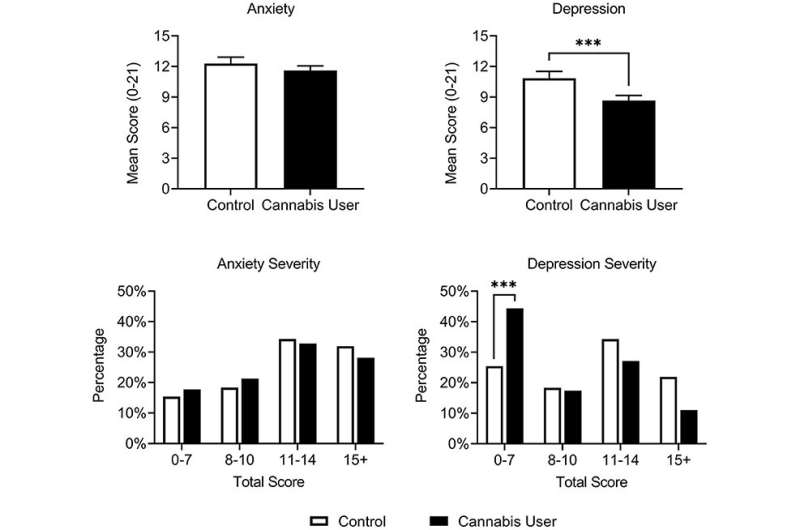
Figure 1. Cannabis Users (n = 368) had reduced depression, but not anxiety, relative to Controls (n = 170) on the HADS at baseline. A greater proportion of Cannabis Users also scored below the HADS cutoff for clinical concern (scores ≥ 8) relative to Controls. Scores ranging from 8 to 10, 11 to 14, and 15 to 21 represent approximate cutoffs for mild, moderate, and severe cases, respectively (83). ***p < 0.001. Credit: DOI: 10.3389/fpsyt.2021.729800

A team of researchers affiliated with multiple institutions in the U.S. has found evidence that medicinal cannabis products relieve depression and improve the quality of life. In their paper published in the journal Frontiers in Psychiatry, the group describes their study involving online surveys about the benefits of cannabis products.

30 oct 2021--Prior research findings regarding the use of cannabis-based products to treat depression and anxiety have been mixed. Some patients have shown improvements while others have not. Prior research has also found that other drugs developed to treat depression and anxiety also have mixed results—some have seen improvements while others have not, and some patients have found that they cannot tolerate the side effects of the drugs. Also, some people have begun using medicinally approved cannabis products to help with their depression, anxiety, chronic pain or sleep disorder, regardless of the research track record—either independently, or with assistance from a doctor. In this new effort, the researchers conducted a study to gauge the opinions of people who use such products, rather than focusing on reports from the medical community regarding how well they thought they worked.

The study was carried out over four years. At the onset, the researchers received responses from 368 people who reported using cannabis products to reduce their depression and/or anxiety, or to help them sleep. As a control group, they also received responses from 170 people who were not using cannabis products but who were considering doing so due to their problems with depression or anxiety.

The researchers found that those people taking cannabis products (mostly those containing CBD rather than THC) reported lower levels of depression than the control group, although they saw no difference in anxiety. They also found those taking cannabis products reported a higher quality of life and better sleep than the control group. The researchers also found reduced levels of depression later on in those who continued to take cannabis products and also in those who began using them during the study. And interestingly, they also found that those who began taking the products during the study also reported improvements in anxiety and quality of life.


More information: Erin L. Martin et al, Antidepressant and Anxiolytic Effects of Medicinal Cannabis Use in an Observational Trial, Frontiers in Psychiatry (2021). DOI: 10.3389/fpsyt.2021.729800

Saturday, June 01, 2019

Cannabis use among older adults rising rapidly

Medical marijuana
Credit: CC0 Public Domain
Cannabis use among older adults is growing faster than any other age group but many report barriers to getting medical marijuana, a lack of communication with their doctors and a lingering stigma attached to the drug, according to researchers.
01 jun 2019--The study, the first to look at how older Americans use cannabis and the outcomes they experience, was published this month in the journal Drugs & Aging.
"Older Americans are using cannabis for a lot of different reasons," said study co-author Hillary Lum, MD, Ph.D., assistant professor of medicine at the University of Colorado School of Medicine. "Some use it to manage pain while others use it for depression or anxiety."
The 2016 National Survey of Drug Use and Health showed a ten-fold increase in cannabis use among adults over age 65.
The researchers set out to understand how older people perceived cannabis, how they used it and the positive and negative outcomes associated with it.
They conducted 17 focus groups in in senior centers, health clinics and cannabis dispensaries in 13 Colorado counties that included more than 136 people over the age of 60. Some were cannabis users, others were not.
"We identified five major themes," Lum said.
These included: A lack of research and education about cannabis; A lack of provider communication about cannabis; A lack of access to medical cannabis; A lack of outcome information about cannabis use; A reluctance to discuss cannabis use.
Researchers found a general reluctance among some to ask their doctors for a red card to obtain medical marijuana. Instead, they chose to pay more for recreational cannabis.
Lum said this could be driven by feeling self-conscious about asking a doctor for cannabis. That, she said, points to a failure of communication between health care providers and their patients.
"I think [doctors can] be a lot more open to learning about it and discussing it with their patients," said one focus group respondent. "Because at this point I have told my primary care I was using it on my shoulder. And that was the end of the conversation. He didn't want to know why, he didn't want to know about effects, didn't want to know about side effects, didn't want to know anything."
Some said their doctors were unable or unwilling to provide a certificate, the document needed to obtain medical marijuana. They also said physicians need to educate themselves on the latest cannabis research.
Some older users reported positive outcomes when using cannabis for pain as opposed to taking highly addictive prescription opioids. They often differentiated between using cannabis for medical reasons and using it recreationally.
"Although study participants discussed recreational cannabis more negatively than medical cannabis, they felt it was more comparable to drinking alcohol, often asserting a preference for recreational cannabis over the negative effects of alcohol," the study said.
The researchers also found that despite the legalization of cannabis in Colorado and other states, some older people still felt a stigma attached to it.
"Some participants, for example, referred to the movie `Reefer Madness' (1936) and other anti-marijuana propaganda adverts that negatively framed cannabis as immoral and illegal," the researchers said.
The study adds to the growing literature on the diversity of marijuana use patterns in older adults, said co-author Sara Honn Qualls, Ph.D., ABPP, professor of psychology and director of the Gerontology Center at the University of Colorado Colorado Springs.
"Older adults who use marijuana are ingesting it in a variety of ways for multiple purposes," she said. "This and other papers from the same project show growing acceptance of marijuana use for medical purposes by older adults, and a clear desire to have their primary health providers involved in educating them about options and risks.
Lum agreed.
She said Colorado, the first state to legalize recreational marijuana, provides a unique laboratory to gauge public attitudes toward cannabis.
"From a physician's standpoint this study shows the need to talk to patients in a non-judgmental way about cannabis," she said. "Doctors should also educate themselves about the risks and benefits of cannabis and be able to communicate that effectively to patients."

More information: Julie Bobitt et al, Qualitative Analysis of Cannabis Use Among Older Adults in Colorado, Drugs & Aging (2019). DOI: 10.1007/s40266-019-00665-w
Provided by CU Anschutz Medical Campus 

Thursday, August 02, 2007

Cannabis Use Linked With Risk for Psychosis in Later Life

August 1, 2007 — A systematic review of longitudinal studies suggests there is sufficient new evidence that the use of cannabis (marijuana) increases the risk for later psychotic illness by roughly 40%. The study showed a trend towards an increased risk for depression in people who had used cannabis, but the evidence was not as strong.
The article by Theresa H.M. Moore, MSc, from the University of Bristol in the United Kingdom, and colleagues is published in the July 28 issue of The Lancet.
Study author Stanley Zammit, PhD, from Cardiff University in Wales, told Medscape that individuals who used cannabis on a weekly or daily basis had about a 2- to 3-fold increase in risk for psychotic outcomes, independent of transient intoxication or other confounding factors. He added, "We looked at the quality of the studies quite rigorously and feel the evidence is strong enough to warrant advising everyone, particularly young people, that the use of cannabis does potentially have some health risks, especially if they are using it on a regular basis."
Cannabis is the most commonly used illegal substance in most countries, the authors write, adding that in the United Kingdom and New Zealand, about 1 in 5 young people report using cannabis weekly or having used it more than 100 times. Previous studies have suggested that cannabis use can produce transient, usually mild, psychotic and affective experiences, but whether it increases the incidence of mental health outcomes such as schizophrenia or depression is unclear.
The group searched for population-based longitudinal studies that looked at the relationship between cannabis use and subsequent psychotic and affective outcomes. They found 11 studies from 7 cohorts that looked at psychotic outcomes and 24 studies from 15 cohorts that looked at affective outcomes.
Increased Risk, Dose-Response Effect
The researchers found a consistent increased risk for psychotic outcomes in the people who had ever used cannabis (adjusted odds ratio [OR], 1.41; 95% confidence interval [CI], 1.20 - 1.65), with a greater risk in individuals who had used it most frequently (OR, 2.09; 95% CI, 1.54 - 2.84).
Most studies excluded people with psychosis at baseline, so this association between cannabis use and psychosis is unlikely to result from reverse causation, the group writes. The studies also adjusted for about 60 confounding factors. "People who use cannabis might be different from other people in a number of factors and some of those might increase their risk of mental health disease, but even once we had adjusted for these factors, there was still an association," Dr. Zammit said.
The evidence that cannabis use leads to depression, suicidal thoughts, and anxiety outcomes was less consistent. "Overall, the quality of the studies wasn't as robust as the studies for psychosis," said Dr. Zammit, adding that for example, many of the studies did not try to adjust for confounding factors.
Although an individual's lifetime risk of developing a serious psychotic illness is only about 2% or 3%, he added, cannabis can be expected to have a large impact at a population level because exposure to this drug is so common.
"The overall message is that people who use cannabis on a regular basis need to be aware of this risk, so they can make an informed judgement about whether they want to continue using it, or perhaps try to cut down their use," or seek treatment of dependency, he concluded.
The study was funded by the Department of Health, United Kingdom. Dr. Zammit is funded by the National Assembly for Wales. Ms. Moore has disclosed no relevant financial relationships. Dr. Zammit has disclosed receiving honoraria for lectures and talks or consultancy fees (for work unrelated to cannabis) from pharmaceutical companies. The financial disclosures of the other authors are listed in the original article.
Editorial: "Need to Warn the Public... Establish Treatment"
In an accompanying editorial, Merete Nordentoft, MD, and Carsten Hjorthøj, from Copenhagen University Hospital in Denmark, write that the study is the most comprehensive meta-analysis to date of this possible causal relationship and the adjustment for confounding factors and transient effects "is done more thoroughly than in previous reviews." They report, "We therefore agree with the authors' conclusion that there is sufficient evidence to warn young people that cannabis use will increase the risk of psychosis later in life."
The general public has considered cannabis to be relatively harmless in comparison with alcohol and opioids, they note, cautioning that, "however, the potential long-term hazardous effects of cannabis with regard to psychosis seem to have been overlooked, and there is a need to warn the public of these dangers, as well as to establish treatment to help young frequent cannabis users."
Dr. Nordentoft and Mr. Hjorthøj have disclosed no relevant financial relationships.
Lancet. 2007;370:293-294, 319-328.

Wednesday, August 01, 2007

One Cannabis Joint Equals Smoking Up to Five Cigarettes

WELLINGTON, New Zealand, July 31 -- For heavy-duty users of marijuana, the joint is tough on the lungs, researchers here found.
In fact, a single marijuana joint for such patients can cause more lung damage than 2.5 to five cigarettes, Richard Beasley, MBChB, FRACP, of the Medical Research Institute of New Zealand here, and colleagues, reported online in Thorax.
Cannabis, the plant source of marijuana, was associated with a dose-related impairment of the large airways, causing airflow obstruction and hyperinflation, the researchers said. But unlike cigarette smoking, cannabis was rarely associated with macroscopic emphysema,
Cannabis is the most widely used illegal drug worldwide. Long-term use is known to cause chronic bronchitis and airflow obstruction, but the prevalence of macroscopic emphysema, the dose-response, and the dose equivalence of cannabis with tobacco had not been determined, Dr. Beasley said.
A sample of 339 adults, ages 18 to 70, was recruited from the Wellington region and put into four groups: cannabis only (75 people), tobacco only (92 people), combined cannabis and tobacco (91), and non-smokers of either substance (81).
Because of the small number of individuals who smoked cannabis in the original random population sample, the investigators used a convenience sample through newspaper and radio advertisements.
Respiratory status was assessed with high-resolution CT scans, pulmonary function tests, and a respiratory and smoking questionnaire. Associations between respiratory status and cannabis use were analyzed with covariance and logistic regression.
Inclusion criteria were a lifetime exposure of at least five joint-years of cannabis or at least one pack-year of tobacco. A joint-year of cannabis was defined as smoking one joint a day for one year and a pack-year of tobacco was equivalent to smoking 20 cigarettes a day for a year.
A dose-response relationship was found between cannabis smoking and reduced forced expiratory volume (FEV1) to forced vital capacity ratio and specific airways conductance, and increased total lung capacity.
For measures of airflow obstruction, one cannabis joint had a similar effect to 2.5 to five cigarettes, the researchers reported.
Airflow obstruction and hyperinflation are a consequence of the large airway impairment, probably due to inflammation and edema in the tracheobronchial mucosa of cannabis smokers, the researchers said.
Cannabis smoking was also associated with decreased lung density on high-resolution CT scans.
Wheezing was linked to both cannabis (OR 1.3) and tobacco smoking (OR 1.4), with no evidence of an interaction.
Chest tightness was associated with cannabis (OR 1.4) but not with tobacco smoking (OR 1.1).
Cough was associated with both cannabis (OR 1.5) and tobacco (1.9).
Chronic bronchitis was likelier with cannabis than with tobacco use (OR 2.0 versus 1.6).
The combined effects of smoking both cannabis and tobacco was to attenuate all these associations, the researchers reported.
On the other hand, macroscopic emphysema was seen in only those who smoked tobacco, either alone or in combination with cannabis.
Emphysema was detected in only one of the cannabis smokers (1.3%), in 15 (16.3%) of the cigarette smokers, in 17 (18.9%) of the combination smokers, and in none of the non-smoking groups.
This suggests that cannabis does not cause emphysema when smoked in sufficient quantities to cause airflow obstruction, hyperinflation, and chronic bronchitis, the researchers said.
The dose equivalence found in this study, the researchers said, is consistent with the reported three- to five-fold greater levels of carboxyhemoglobin and tar inhaled when smoking a cannabis joint compared with a tobacco cigarette of the same size.
This pattern is likely to relate to the different characteristics of the cannabis joint and the way it is smoked. Cannabis is usually smoked without a filter and to a shorter butt length, while the smoke temperature is higher.
Furthermore, the investigators said, cannabis smokers inhale more deeply, hold their breath longer, and perform the Valsalva maneuver at maximal breath hold.
No conflicts of interest were reported. Support for the study was provided by the New Zealand Ministry of Health, the Hawke's Bay Medical Research Foundation, and GlaxoSmithKline (UK).Primary source: ThoraxSource reference: Aldington S, et al "Effects of cannabis on pulmonary structure, function and symptoms" Thorax 2007; doi:101136/thx.2006.077081.