Showing posts with label elderly surgery. Show all posts

Friday, December 20, 2019

Spine surgery is safe in patients of advanced age
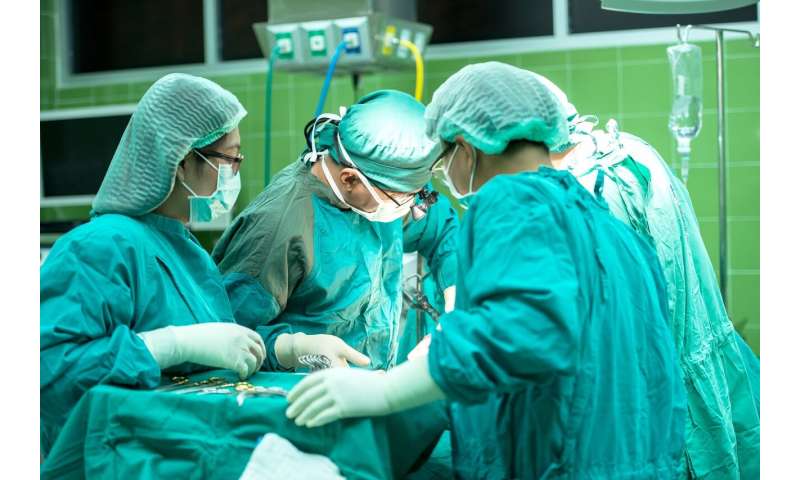
surgery
Credit: CC0 Public Domain
Spine surgeons from seven institutions in Sapporo, Hokkaido, Japan, conducted a multicenter, prospective study of spine surgeries performed in patients 80 years of age and older. Although the overall perioperative complication rate was high—20%, there were no major systemic complications and no deaths in the patients. The surgeons conclude that spine surgery is safe in this age group.
20 dec 2019--Detailed findings of this study can be found in a new article, "Perioperative complications of spine surgery in patients 80 years of age or older: a multicenter prospective cohort study," by Takamasa Watanabe, MD, and colleagues, published today in the Journal of Neurosurgery: Spine.
The world's population is steadily growing older. This can be seen most readily in Japan, where elderly people (ages 65 years and older) currently make up a quarter of the total population; that proportion is expected to reach one-third by 2050. The aging population in other countries is also growing. Along with increased age comes a variety of age-related health problems; degenerative spine diseases constitute a common health problem in .
Spine surgery can improve quality of life in many patients with damaged or deteriorating spinal components. This is true for older patients as well as for younger ones. But what about patients in the upper range of elderly, those 80 years of age or older? Is spine surgery advisable in this group and what risks does it carry?
The authors of this study conducted a prospective multicenter study with two goals: 1) determine what perioperative complications of spine surgery are associated with patients in this advanced-age group and 2) investigate the risk factors for perioperative systemic complications.
Seven spine centers with board-certified spine surgeons participated in the study. The patient group consisted of 270 patients, 80 years or older, who underwent elective spine surgery in 2017. (Patients with tumors, infection, or trauma were not included.)
Perioperative complications were defined as adverse events occurring during surgery or within 30 days postoperatively. Complications were separated into those occurring at the surgical site and those that were systemic.
The total perioperative complication rate in the study was 20% (67 complications in 54 patients). Complications at the surgical site occurred in 22 patients (8.1%), and minor systemic complications (anemia, delirium, or urinary tract infection) occurred in 40 patients (14.8%). No patient experienced a major systemic complication (one that could be potentially life-threatening or lead to prolonged hospitalization), and no patient died. The rate of repeated operations was 4.1%.
To identify risk factors for perioperative complications, the authors examined surgical factors (operative level, number of spinal levels treated, type of surgery, length of surgery, and estimated blood loss) as well as patient demographics (age, sex, and body mass index) and preoperative health status.
Each patient's preoperative health status was determined by using the following measurements: the Charlson Comorbidity Index (predicts survival based on comorbidities); the American Society of Anesthesiologists Physical Status Classification System (used to assess the patient's general condition); the Eastern Cooperative Oncology Group Performance Status (ECOG-PS) (used to evaluate patients' ability to take care of themselves); the presence of sarcopenia (loss of muscle mass and strength); and the Geriatric Nutritional Risk Index (used to evaluate nutritional risk).
Both the univariate and multivariate analyses identified spine surgery involving instrumentation (for example, inclusion of plates and screws), operations lasting more than 180 minutes, and the ECOG-PS (limited activities of daily living) as significant risk factors for minor systemic perioperative complications.
The authors suggest that spine surgeons be aware of these risk factors when preparing for surgery in this advanced-age patient group.
Older age itself, the presence of comorbidities, and being at nutritional risk were not found to be risk factors in this study. In addition, there were no severe complications. On the basis of their findings, the authors conclude that it is safe to perform  in patients of advanced age.

More information: Watanabe T, Kanayama M, Takahata M, Oda I, Suda K, Abe Y, Okumura J, Hojo Y, Iwasaki N: Perioperative complications of spine surgery in patients 80 years of age or older: a multicenter prospective cohort study. J Neurosurg Spine, published ahead of print December 17, 2019. DOI: 10.3171/2019.9.SPINE19754
Journal information: Journal of Neurosurgery: Spine 

Wednesday, June 20, 2018

How old is too old for surgery, and why?

How old is too old for surgery, and why?
Many changes in the body occur in response to the injury and trauma inflicted during surgery. Credit: www.shutterstock.com
Many of us will have been in situations with older loved ones where a doctor says surgery is too risky given the patient's advanced age. Why is it surgery becomes risky in the elderly, and is it based on chronological age or their health?
During surgery and anaesthesia, there are many changes in the body that occur in response to injury and trauma. This is known as the stress response to surgery.

The surgical stress response results in an increased secretion of hormones that promote the break down of carbohydrates, fats and proteins in the body to provide extra energy during and after surgery. The hormonal changes associated with the surgical stress response also activate the sympathetic nervous system.
The sympathetic nervous system is responsible for the "fight or flight" response and causes a rise in heart rate and blood pressure. The changes in the heart rate and blood pressure during surgery and anaesthesia create a state where the heart requires more oxygen, while the surgical stress response and anaesthesia often impedes the oxygen supply to the vital organs such as the heart and the brain. This is a result of less blood flow to the body organs during and after the operation.
Anaesthesia confers risks separate from the risks of surgery. These are mostly minor and easy to treat. But serious problems with the heart, lungs and other major organs are more likely during emergency surgery or in the presence of other health conditions. These factors may increase with chronological age, but frailty is the bigger factor for doctors in deciding whether a patient should undergo surgery and anaesthesia.

Frailty

Frailty is a state where a person is vulnerable due to decline in body function. This in turn reduces their ability to cope with acute and every day stressors.
In a frail person, there is an accumulation of defects in different organ systems of the body, causing them to function close to the threshold of failure. The organ systems near the threshold of failure are then unable to "bounce back" from an external or internal stressor.
An apparently small insult such as a simple fall can result in a significant and disproportionate reduction in reserve and function. The need to have surgery, and the condition that has caused a need for surgery, would often be considered a large insult in a frail person.
Although frailty is more common in older people, it's not exclusive to older people. Most frail people have chronic health problems, and their frailty increases with the number of chronic health conditions. But most people with chronic health conditions are not frail.
There are certain health conditions that are more common in people who are frail, such as heart failure, chronic airways disease and chronic kidney disease.

How do we identify frailty and how does it affect health?

There are many different tools we can use to detect frailty. The Clinical Frailty Scale is one tool based on clinical features present in the patient and the Frailty Index is another tool based on the accumulation of deficits in the patient.
The Clinical Frailty Scale is a single descriptor of a person's level of frailty using clinical judgement graded from one to nine. Level one is a very fit person; level four is "vulnerable" – where the person is not dependent on others for help with daily activities but does have symptoms that limit activities; and level nine is a terminally ill person.
It has been observed that people with a higher Clinical Frailty Scale were more likely to be older, female, have a degree of cognitive impairment and incontinence. The higher proportion of females will most likely reflect the longer life expectancy of women.
Frail people have a higher risk of recurrent falls and fractures and subsequent disability and reduced function. There have been many studies performed to examine how well frailty predicts outcomes after surgery.
In people who have surgery, frailty has been shown to be associated with a higher risk of surgical complications, a greater chance of requiring discharge to a residential care facility and a lower rate of survival. And the more frail the patient, the higher the risk the patient will require readmission after surgery, and the higher the risk of death.
As our population gets older and more frail people have surgery, this will become an important issue, and health care professionals in all areas will need to be more aware of it.

This article was originally published on The Conversation. Read the original article.The Conversation

Provided by The Conversation

Wednesday, February 25, 2015

1 minute test predicts how well a patient may recover after an operation


CHICAGO (February 25): Frailty has been used to predict how well a patient may recover from a major operation. Because frailty assessments are not routinely utilized in busy surgical practices, surgeons at Emory University School of Medicine in Atlanta have discovered that a short, approximately one-minute assessment can accurately determine how likely a patient is to have complications after an operation.
25 feb 2015--Their study results are published online as an "article in press" in the Journal of the American College of Surgeons (JACS). The study will appear in a print edition of the journal later this year.
Contrary to what most consumers believe, frailty is not always connected to old age. "Many people would suspect that frailty only applies to someone in their 80s," said study author Viraj Master, MD, PHD, FACS, associate professor of urology and director of clinical research. "It's startling to think that people in their 30s and 40s could actually be frail, but there is a population of patients who are young but are actually frail."
Measuring frailty before a major operation is important because frail patients, regardless of age, tend to be at a higher risk for postoperative complications. "Frail means they don't have the physiologic reserve to bounce back after the operation, so they start down a path that they may not easily recover from," explained Kenneth Ogan, MD, a study coauthor and associate professor of urology.
The standard test to measure frailty, described by geriatrician Linda P. Fried and colleagues at Johns Hopkins University, includes five criteria:
  1. Shrinking: Self-reported unintentional weight loss of more than 10 pounds in the last year
  2. Grip Strength: Measured by having the patient squeeze a hand-held dynamometer adjusted for gender and body mass index (BMI)
  3. Exhaustion: Measured by responses to questions about effort and motivation
  4. Low Activity: Ascertained by inquiring about leisure time activities
  5. Slowed Walking Speed: Measured by the speed at which a patient walks 15 feet adjusted by gender and height
Despite the importance of measuring patient frailty, many surgical practices may skip performing this five-step assessment for two reasons: it may take too long for a busy practice, and it requires a trained professional. The test also introduces bias since patients may overestimate activity levels and underestimate exhaustion.
A one- minute frailty assessment
Dr. Master, Dr. Ogan, and their colleagues set out to find a simpler, quicker, more accurate way to assess frailty. The research team completed the full five-step frailty assessment on 351 patients age 18 or older who were admitted to Emory for major abdominal, urologic, or gastrointestinal operations.
They then looked at medical records and found that 36.7 percent had experienced a complication within 30 days after an operation: 24.5 percent of patients experienced a minor complication, while 14.2 percent experienced a major complication. Examples of complications included, wound infection, pneumonia, stroke, and death.
The researchers next compared the full frailty test's ability to predict these complications to a more truncated version that only assessed two of the five factors: grip strength and involuntary weight loss. They found that assessing just those two factors was equally as accurate at predicting complications as doing the full five-step test.
They also found that adding two additional factors—American Society of Anesthesiology score (ASA), which measures physical status for anesthesia, and levels of hemoglobin, the protein in red blood cells that carries oxygen— improved the model's ability to predict postoperative complications.
"If you just looked at weight loss and grip strength, those factors were just as good as doing all five steps. And if you add in hemoglobin and ASA scores, the prediction was even better," explained Dr. Master. "The nice thing is that the patient's ASA and hemoglobin are already recorded in the chart before an operation."
The full five-step test normally requires a trained clinician to collect the data, and could take about 10 minutes. "This method—asking one question about weight loss and the grip strength activity—can take less than a minute and can be done by anyone who interacts with the patient," Dr. Master added.
Setting patient expectations
Moving forward, the research team's goal is to increase surgical teams' willingness to perform the frailty test on each patient before an operation, not to reject patients for a procedure but rather as a planning measure. "This step is important for setting expectations for the patient and the family," said Dr. Ogan. "If a patient is found to be frail prior to surgery, it is critical that the patient is aware that their risk of a postoperative complication is increased. Our data is clear: If you have a weak grip and you're losing weight, you're at risk. We want to be better prepared for any risks after the operation."
For patients who are considered frail, that could mean making lifestyle changes to address weight loss and grip strength. It could also mean planning for a longer hospital stay or arranging for the patient to be discharged to a skilled nursing facility before going home.
The truncated frailty test will be rolled out to all of Emory's surgical patients this year. Dr. Ogan and Dr. Master are also planning a larger study to assess whether frailty assessments can impact hospital readmissions and mortality post-operatively.
More information: Fried, LP; Tangen, CM; Walston, J; Newman, AB, et al. "Frailty in older adults: evidence for a phenotype." J Gerontol A Biol Sci Med Sci. 2001; 56 (3): M146–56.
Provided by American College of Surgeons

Sunday, September 30, 2012


Landmark guidelines for optimal quality care of geriatric surgical patients just released

New comprehensive guidelines for the pre- operative care of the nation's elderly patients have been issued by the American College of Surgeons (ACS) and the American Geriatrics Society (AGS). The joint guidelines—published in the October issue of the Journal of the American College of Surgeons—apply to every patient who is 65 years and older as defined by Medicare regulations. The guidelines are the culmination of two years of research and analysis by a multidisciplinary expert panel representing the ACS and AGS, as well as by expert representatives from a range of medical specialties.
30 sept 2012--"The major objective of these guidelines is to help surgeons and the entire perioperative care team improve the quality of surgical care for elderly patients," said Clifford Y. Ko, MD, FACS, Director of the ACS National Surgical Quality Improvement Program (ACS NSQIP®) and the ACS Division of Research and Optimal Patient Care in Chicago, professor of surgery at University of California, Los Angeles (UCLA) and director of UCLA's Center for Surgical Outcomes and Quality.
One of the driving forces behind the guidelines is America's expanding geriatric popu- lation, Dr. Ko explained. The U.S. Census Bureau projects the percentage of men and women 65 years and older will more than double between 2010 and 2050 and will increase by 20 per-cent of the total population by 2030.* In 2006, elderly patients underwent 35 percent of inpatient surgical procedures and 32 percent of outpatient procedures according to study authors.
"For elderly patients undergoing surgical procedures, we want to ensure we are optimiz-ing each patient's medical condition," Dr. Ko said. "This population is growing in numbers and we want to emphasize the depth and breadth of care required for them. These evidence-based guidelines will enhance surgical practice by setting higher standards and performance measures for surgeons and the entire perioperative care team," he said. This is the first time ACS has worked with AGS to develop guidelines for geriatric patients according to Dr. Ko.
The guidelines recommend and specify 13 key issues of preoperative care for the elderly: cognitive impairment and dementia; decision-making capacity; postoperative delirium; alcohol and substance abuse; cardiac evaluation; pulmonary evaluation; functional status, mobility, and fall risk; frailty; nutritional status; medication management; patient counseling; preoperative testing; and patient-family and social support system.
"There is no single magic bullet for rendering this level of surgical care," Dr. Ko said. "Each of the 13 issues covered by the guidelines is very important, comprehensive, and difficult to prioritize. For example, surgeons and perioperative team members may do perfectly well when analyzing a patient's cognitive functioning , but not so well on the polypharmacy issue. So then suddenly, polypharmacy becomes the number-one issue for the surgical team to address during the preoperative care phase," he explained.
Furthermore, the expert panel said there are complex problems specific to the elderly, including use of multiple medications, functional status, frailty, risk of malnutrition, cognitive impairment, and comorbidities. "When surgeons evaluate elderly patients before they undergo operations, they want to know how many and what specific medications their patients are taking. This step will enable them to identify potential medication issues before operations and before the surgeons start adding pain medication to the patient's medication list," Dr. Ko explained.
As the guidelines state: "consider minimizing the patient's risk for adverse drug reac-tions by identifying what should be discontinued before surgery or should be avoided and dose reducing or substituting potentially inappropriate medications."
Additionally, the number and severity of underlying medical problems call for special strategies by the entire surgical team, according to Dr. Ko.
"Patients who are 90 years old tend to have more comorbidities than those who are 65 years," he said. "There may be something wrong with the heart, the lungs, the kidneys, the liver. Surgeons have to plan and deal with these comorbidities simultaneously while the patient is undergoing a surgical procedure."
The guidelines state that evaluating patients for developing heart disease and heart attack is critical to identify patients at higher risk. All patients should be evaluated for perioperative cardiac risk.
"Caring for the elderly generally requires a team approach," said Dr. Ko. "The surgeon knows how to perform surgery and the cardiologist knows how to take care of the heart. It's best for everyone to work together to take care of the patient. We want everyone on the same page of providing good quality care."
These  have been developed in response to a performance measure that the ACS has developed with the Centers for Medicare & Medicaid Services (CMS), according to Dr. Ko. The performance measure evaluates the quality of care in patients eligible for Medicare.
ACS NSQIP has worked with CMS to develop "The Elderly Surgery Measure." This is a hospital-based measure that assesses the outcome of elderly patients undergoing surgical procedures. The ACS and CMS will launch a pilot program in October that gives hospitals the opportunity to publicly and voluntarily report the outcome results.
More information: * Source: U.S. Census Bureau Statistical Brief. Sixty-five Plus in the United States. Available at www.census.gov/pop… gebrief.html. Accessed September 26, 2012.
Provided by American College of Surgeons