Timing our meals can fend off diseases caused by bad genes or bad diet. Everything in our body is programmed to run on a 24-hour or circadian time table that repeats every day. Nearly a dozen different genes work together to produce this 24-hour circadian cycle. These clocks are present in all of our organs, tissues and even in every cell. These internal clocks tell us when to sleep, eat, be physically active and fight diseases. As long as this internal timing system work well and we obey them, we stay healthy.
07 sept 2018--But what happens when our clocks are broken or begin to malfunction?
Mice that lack critical clock genes are clueless about when to do their daily tasks; they eat randomly during day and night and succumb to obesity, metabolic disease, chronic inflammation and many more diseases.
Even in humans, genetic studies point to several gene mutations that compromise our circadian clocks and make us prone to an array of diseases from obesity to cancer. When these faulty clock genes are combined with an unhealthy diet, the risks and severity of these diseases skyrocket.
My lab studies how circadian clocks work and how they readjust when we fly from one time zone to another or when we switch between day and night shift. We knew that the first meal of the day synchronizes our circadian clock to our daily routine. So, we wanted to learn more about timing of meals and the implications for health.
Time-restricted eating

A few years ago we made a surprising discovery that when mice are allowed to eat within a consistent eight- to 12-hour period without reducing their daily caloric intake, they remain healthy and do not succumb to diseases even when they are fed unhealthy food rich in sugar or fat.
The benefit surpasses any modern medicine. Such an eating pattern – popularly called time restricted eating – also helps overweight and obese humans reduce body weight and lower their risk for many chronic diseases.
Decades of research had taught us what and how much we eat matters. But the new discovery about when we eat matters raised many questions.
How does simply restricting your eating times alter so many elements of personal health? The timing of eating is like an external time cue that signals the internal circadian clock to keep a balance between nourishment and repair. During the eating period, metabolism was geared toward nourishment. The gut and liver better absorbed nutrients from food, and used some for fueling the body while storing the rest.
During the fasting period, metabolism switched to rejuvenation. Unwanted chemicals were broken down, stored fat was burned and damaged cells were repaired. The next day, after the first bite, the switch flipped from rejuvenation to nourishment. This rhythm continued every day. We thought that timing of eating and fasting was giving cues to the internal clock and the clock was flipping the switch between nourishment and rejuvenation every day. However, it was not clear if a normal circadian clock was necessary to mediate the benefits of time restricted eating or whether just restricted eating times alone could flip the daily switch.

What if you have a broken internal clock?
In a new study, we took genetically engineered animals that lacked a functioning circadian clock either in the liver or in every cell of the body.
These mice, with faulty clocks don’t know when to eat and when to stay away from food. So, they eat randomly and develop multiple diseases. The disease severity increases if they are fed an unhealthy diet.
To test if time restricted eating works with a damaged or dysfunctional clock, we simply divided these mutant mice into two different groups – one group got to eat whenever they wanted and the other group was only given access to food during restricted times. Both groups ate the identical number of calories, but the restricted eaters finished their daily ration within nine to 10 hours.
We thought that even though these mice had restricted eating times, having the bad clock gene would doom them to obesity and many metabolic diseases. But to our utter surprise the restricted eating times trumped the bad effects of faulty clock genes. The mice without a functioning clock that were destined to be morbidly sick, were as healthy as normal mice when they consumed food during a certain period.
The results have many implications for human health.
The good news
First of all, it raises a big question: What is the connection between our genetically encoded circadian clock timing system and external time of eating? Do these two different timing systems work together like co-pilots in a plane, so that even if one is incapacitated, the other one can still fly the plane?

Deep analyses of mice in our experiment revealed that time restricted eating triggers many internal programs that improve our body’s resilience – enabling us to fight off any unhealthy consequences of bad nutrition or any other stress. This boost in internal resilience may be the key to these surprising health benefits.
For human health the message is simple, as I say in my new book “The Circadian Code.” Even if we have faulty circadian genes as in many congenital diseases, such as Prader-Willi syndrome or Smith-Magenis syndrome, or carry a malfunctioning copy of nearly a dozen different clock genes, as long as we have some discipline and restrict eating times, we can still fend off the bad effects of bad genes.
Similarly, other researchers have shown as we get older our circadian clock system weakens. The genes don’t function correctly so our sleep-wake cycles are disrupted – just as if we had a faulty clock. So, lifestyle becomes more important for older people who are at higher risk for many chronic diseases such as diabetes, heart disease, high cholesterol, fatty liver disease and cancer.
As a potential translation to human health, we have created a website where anyone from anywhere in the world can sign up for an academic study and download a free app called MyCircadianClock and start self-monitoring the timing of eating and sleeping.
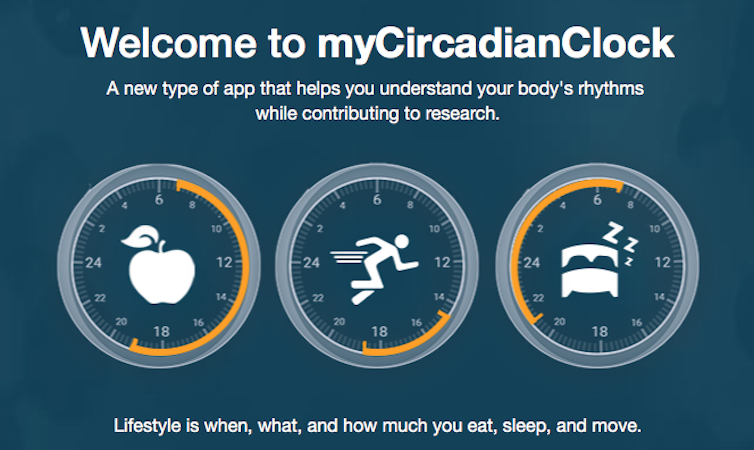
The app provides tips and guidance on how to adopt a time restricted eating lifestyle to improve health and prevent or manage chronic diseases. By collecting data from people with varying risk for disease, we can explore how eating times can help to increase our healthy lifespan.
We understand everyone’s lifestyle around home, work and other responsibilities is unique and one size may not fit all. So, we hope people can use the app and some tips to build their personalized circadian routine. By selecting their own time window of eight to 12 hours for eating that best fits their lifestyle, they may reap many health benefits.
