Showing posts with label fracture. Show all posts

Sunday, July 09, 2023


Surgical stabilization of odontoid fractures shown to improve outcomes
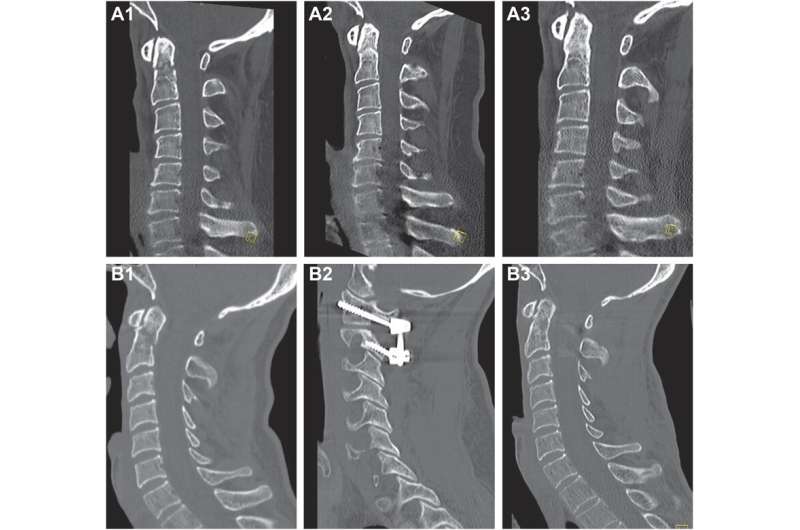
Surgical stabilization of odontoid fractures improves outcomes
Two illustrative cases. Case A is that of a middle-aged woman injured in a motor vehicle collision, found on trauma workup to have A1, a nondisplaced type II odontoid fracture that was treated with a rigid cervical orthosis and showed progressive healing at A2, 4 months and A3, 7 months after the injury. Case B is that of a middle-aged man injured in a cycling accident who had neck pain with movement and was neurologically intact on examination. CT revealed B1, a mildly displaced and angulated type II odontoid fracture treated with B2, C1-C2 posterior fixation with B3, excellent bony healing on follow-up CT. Credit: Neurosurgery (2023). DOI: 10.1227/neu.0000000000002557

Odontoid fractures—those occurring in the second cervical vertebra—are common in elderly patients after a low-energy fall. However, whether the initial treatment should be surgical or non-operative still isn't known. Previous studies haven't accounted for differences in injury severity, or the presence or absence of neurologic impairment, which can affect patients' results.

09 Jul 2023--On this topic, an article titled "Surgery Decreases Nonunion, Myelopathy, and Mortality for Patients with Traumatic Odontoid Fractures: A Propensity Score Matched Analysis" is published in the journal Neurosurgery.

Michael B. Cloney, MD, MPH, of the Department of Neurological Surgery at Northwestern University in Chicago, and colleagues have published evidence that surgery should be considered as the initial approach for many patients. Compared with non-operative approaches to treatment, surgical stabilization of the fracture was associated with less myelopathy (mobility impairment due to spinal cord damage), and lower rates of fracture non-union, 30-day mortality, and one year mortality.

"Given the increasing incidence of odontoid fractures with the aging population, we believe our findings could assist with neurosurgical decision-making for an increasingly common and complex problem," the researchers say.

Propensity score matching: A way to account for nonrandomized patient groups

Dr. Cloney and his colleagues reviewed initial treatment data on 296 patients who were cared for at Northwestern Memorial Hospital between January 1, 2010, and December 31, 2020, because of an odontoid fracture. Their average age was 73. During the hospitalization, 22% had surgery and 78% had non-operative treatment (5% were immobilized in a halo-vest and 73% received a cervical collar).

Since the patients weren't randomized to these treatments, the research team used a type of analysis called propensity score adjustment. They calculated "propensity scores" for each individual—the probability that the patient would have been assigned to receive one of the two treatment approaches based on certain characteristics.

For example, to study the effect of surgery on mortality rates, patients were matched on age, sex, Injury Severity Score, Nurick score (a measure of myelopathy), their number of chronic diseases and chronic conditions such as smoking, and whether they had to be admitted to the intensive care unit.

Surgical stabilization leads to better results

Follow up with patients lasted an average of 45 weeks. On the propensity score-matched analyses, the group that underwent surgery showed significantly better outcomes than the non-operative group:

  • Lower rate of fracture non-union—39.7% vs. 57.3%; treatment effect, 15% less risk of nonunion
  • Lower 30-day mortality rate—1.7% vs. 13.8%; treatment effect, 10% less risk of death
  • Lower one year mortality rate—7.0% vs. 23.7%; treatment effect, 10% less risk of death

Other analyses showed patients in the surgery group were 52% less likely than those in the non-operative group to have poor Nurick scores at the 26-week postoperative follow-up visit and were 41% less likely to die during the overall follow-up period. Both differences were statistically significant.

"The mortality benefit calculated in the existing literature typically represents an unadjusted mortality rate between two potentially different populations, which leaves it liable to confounding," the authors note. "Our study represents a relatively large institutional series that suggests a benefit from surgical stabilization in this population while controlling for confounding factors more thoroughly than existing literature."

More information: Michael Cloney et al, Surgery Decreases Nonunion, Myelopathy, and Mortality for Patients With Traumatic Odontoid Fractures: A Propensity Score Matched Analysis, Neurosurgery (2023). DOI: 10.1227/neu.0000000000002557

Wednesday, October 29, 2014

High milk intake linked with higher fractures and mortality

milk
A high milk intake in women and men is not accompanied by a lower risk of fracture and instead may be associated with a higher rate of death, suggests observational research published in The BMJ this week.
29 oct 2014--This may be explained by the high levels of lactose and galactose (types of sugar) in milk, that have been shown to increase oxidative stress and chronic inflammation in animal studies, say the researchers.   
However, they point out that their study can only show an association and cannot prove cause and effect. They say the results "should be interpreted cautiously" and further studies are needed before any firm conclusions or dietary recommendations can be made.  
A diet rich in milk products is promoted to reduce the likelihood of osteoporotic fractures, but previous research looking at the importance of milk for the prevention of fractures and the influence on mortality rates show conflicting results.  
So a research team in Sweden, led by Professor Karl Michaëlsson, set out to examine whether high milk intake may increase oxidative stress, which, in turn, affects the risk of mortality and fracture.  
Two large groups of 61,433 women (aged 39-74 years in 1987-1990) and 45,339 men (aged 45-79 years in 1997) in Sweden completed food frequency questionnaires for 96 common foods including milk, yoghurt and cheese.  
Lifestyle information, weight and height were collated and factors such as education level and marital status were also taken into account. National registers were used to track fracture and mortality rates.  
Women were tracked for an average of 20 years, during which time 15,541 died and 17,252 had a fracture, of whom 4,259 had a hip fracture.  
In women, no reduction in fracture risk with higher milk consumption was observed. Furthermore, women who drank more than three glasses of milk a day (average 680 ml) had a higher risk of death than women who drank less than one glass of milk a day (average 60 ml).  
Men were tracked for an average of 11 years, during which time 10,112 died and 5,066 had a fracture, with 1,166 hip fracture cases. Men also had a higher risk of death with higher milk consumption, although this was less pronounced than in women.  
Further analysis showed a positive association between milk intake and biomarkers of oxidative stress and inflammation.  
In contrast, a high intake of fermented milk products with a low lactose content (including yoghurt and cheese) was associated with reduced rates of mortality and fracture, particularly in women.  
They conclude that a higher consumption of milk in women and men is not accompanied by a lower risk of fracture and instead may be associated with a higher rate of death. Consequently, there may be a link between the lactose and galactose content of milk and risk, although causality needs be tested.  
"Our results may question the validity of recommendations to consume high amounts of milk to prevent fragility fractures," they write. "The results should, however, be interpreted cautiously given the observational design of our study. The findings merit independent replication before they can be used for dietary recommendations."  
Michaëlsson and colleagues raise a fascinating possibility about the potential harms of milk, says Professor Mary Schooling at City University of New York in an accompanying editorial. However, she stresses that diet is difficult to assess precisely and she reinforces the message that these findings should be interpreted cautiously.  
"As milk consumption may rise globally with economic development and increasing consumption of animal source foods, the role of milk and mortality needs to be established definitively now," she concludes.  
Provided by British Medical Journal