Showing posts with label glucose levels. Show all posts

Tuesday, December 06, 2022


Novel ways to measure glucose levels without drawing blood
Novel ways to measure glucose levels without drawing blood
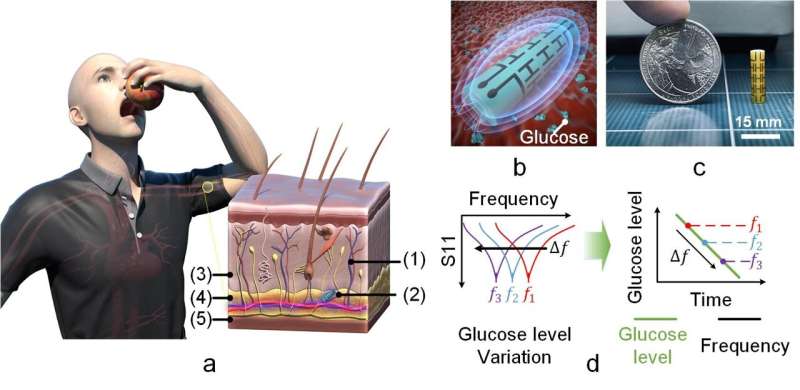
EM-based subcutaneous implant glucose sensor. (a) Illustration of EM-based implantable sensor for BGL tracking; (1) blood capillary (2) electromagnetic sensor (3) dermis (4) subcutaneous fat (5) muscle tissue. (b) Proposed implant sensor. (c) Sensor size (15 mm × 4 mm ∅) compared with a coin. (d) Sensor frequency trend and corresponding variations in BGL. Credit: UNIST

A recent study affiliated with UNIST has reported a new route for measuring blood sugar levels (BGLs) without drawing blood. This is a revolutionary, non-invasive technique for testing blood glucose levels, using electromagnetic (EM)-wave-based glucose sensor inserted under the skin. Their findings have attracted much attention, as the method eliminates the need for patients with diabetes to repeatedly prick their fingers with a glucose meter.

05 dec 2022--This breakthrough has been led by Professor Franklin Bien and his research team in the Department of Electrical Engineering at UNIST.

In this study, the research team proposed an electromagnetic-based sensor that can be subcutaneously implanted and is capable of tracking minute changes in dielectric permittivity owing to changes in BGLs. The proposed sensor, which is about one-fifth the size of a cotton swab, can measure changes in glucose concentrations in interstitial fluid (ISF), the liquid that fills spaces between cells.

"[Our] present work is an effort for the realization of an implantable electromagnetic-based sensor, which can be an alternate to an enzyme-based or optical-based glucose sensor," noted the research team. "The proposed implantable sensor has not only overcome the disadvantages of the existing continuous glucose monitoring systems (CGMS), such as short lifespan, but has also enhanced the blood glucose prediction accuracy."

Credit: Ulsan National Institute of Science and Technology

Diabetes can be diagnosed if fasting blood glucose levels are 126 mg/dL or higher. A normal fasting glucose test result is lower than 100 mg/dL. One of the main aims of diabetes treatment is to keep blood glucose levels within a specified target range. More than 400 million people worldwide are living with diabetes and they still suffer while pricking their fingers multiple times a day to check their blood glucose levels.

Various methods alternate to the finger-pricking method have been extensively studied for blood glucose detection, such as enzyme-based or optical-based glucose sensor. Yet, they still have issues in terms of long lifetime, portability, and accuracy.

In this study, the research team introduced semi-permanent and continuous blood sugar management with low maintenance costs and without the pain caused by blood collection, enabling patients to enjoy quality life through proper treatment and management of diabetes. This is expected to increase the use of CGMS, which currently accounts for only 5% of active treatments.

The research team also performed both the intravenous glucose tolerance test (IVGTT) and oral glucose tolerance test (OGTT) with the sensor implanted in swine and beagles in a controlled environment. The results of initial proof-of-concept in vivo experiment showed promising correlation between BGL and sensor frequency response, according to the research team.

"Our proposed sensor and system are indeed in the early stage of development," noted the research team. "Despite that, the proof-of-concept in vivo results show promising correlation between BGL and sensor frequency response. Indeed, the sensor shows the ability to track BGL trend."

"For actual sensor implantation we must consider bio compatible packaging and foreign body reactions (FBR) for long term applications. In addition, improved sensor interface system is under development," added the research team.

Their findings have been published in Scientific Reports.

More information: Seongmun Kim et al, Subcutaneously implantable electromagnetic biosensor system for continuous glucose monitoring, Scientific Reports (2022). DOI: 10.1038/s41598-022-22128-w
Provided by Ulsan National Institute of Science and Technology 

Sunday, February 27, 2011

Elderly patients admitted with high glucose levels are more likely to die in hospital

A two-country hospital study of 808 elderly patients found a strong association between high, undiagnosed blood glucose in non-diabetic patients and increased hospital death rates, according to the March issue of IJCP, the International Journal of Clinical Practice.

27 feb 2011--Researchers are now calling for routine blood glucose testing of elderly patients when they are admitted to hospital. The Spanish team looked at 447 consecutive patients admitted to a geriatric unit, while the Italian team studied 361 patients over 60 admitted to an internal medicine department.

They found that, when they excluded the 206 patients already diagnosed with diabetes, 25% of the remaining 602 patients had a fasting glucose level of 126 mg/dl or more, which is the threshold used to diagnose the disease, with just under a fifth of those exceeding 180 mg/dl.

Mortality rates in patients with a fasting glucose level of less than 126 mg/dl was just over 8% for both the total sample and the patients admitted without a diagnosis of diabetes. But when the researchers looked at the undiagnosed patients whose fasting glucose levels were 126 mg/dl to 180mg/dl, the death rate rose to 18% and, in patients whose levels exceeded 180mg/dl, the rate increased to 31%.

These levels were much higher than the 14% and 23% recorded for diabetic patients with fasting glucose levels exceeding 126 mg/dl and 180 mg/dl respectively.

"This is the first multi-centre prospective study to assess the relationship between fasting serum glucose levels and in-hospital mortality in a large cohort of elderly patients" says lead author Dr Pedro Iglesias from the Department of Endocrinology at Hospital Ramon y Cajal in Madrid, Spain.

"Our findings clearly show that fasting glucose is a significant risk factor for death during hospitalisation, especially in patients who have not been diagnosed with diabetes."

Other key findings of the study included:

  • The average age of the total cohort was 84 years and 57% were female, but the Spanish geriatric cohort was older than the Italian internal medicine cohort (86 versus 80 years), with a higher percentage of women (62% versus 50%).
  • There was a higher incidence of high blood pressure, lower systolic and diastolic blood pressure, higher serum glucose and creatinine and lower total cholesterol concentrations in the Spanish cohort.
  • The five most common reasons for hospital admission in the total cohort were: congestive heart failure (19%), respiratory tract infection (12.5%), acute cerebrovascular disease (12%), exacerbation of chronic obstructive pulmonary disease (9%) and cancer (8%). However, there were significant variations between the two cohorts.
  • 25% of the total cohort had a pre-existing diagnosis of diabetes, with 2% more patients in the Spanish cohort than the Italian cohort having the disease.
  • Median fasting glucose rates for the total cohort were more than 20% higher in patients who died (127 mg/dl) than those who survived (105 mg/dl).
  • Hospital stays averaged 10.5 days for the total cohort and the average time from admission to death was 11.3 days. The Italian internal medicine cohort had a lower death rate (8% versus 14%) and lower average hospital stay (nine days versus 12 days) than the Spanish geriatric group, but the intervals from admission to death were similar in both groups.
"Our study shows a high mortality rate and short hospital survival in non-diabetic elderly patients with a high baseline fasting glucose level of more than 180 mg/dl" concludes co-author Professor Fabio Monzani from the Department of Internal Medicine at the University of Pisa, Italy.

"It underlines the importance of testing elderly patients for fasting glucose levels on admission to hospital for acute illnesses and suggests that a blood glucose level of 180 mg/dl or less might be an appropriate target in people who have not been diagnosed with diabetes.

"These findings should help us to identify those patients at high risk during hospitalisation, so that they can be offered intensive therapy to reduce their risk of death and improve their prognosis."

More information: Fasting hyperglycaemia and in-hospital mortality in elderly population. Iglesias et al. IJCP. 65.3, pp308-313. (March 2011). DOI: 10.1111/j.1742-1241.2010.02514.x