Showing posts with label microbiota. Show all posts

Friday, December 11, 2020

Gut microbiota plays a role in brain function and mood regulation
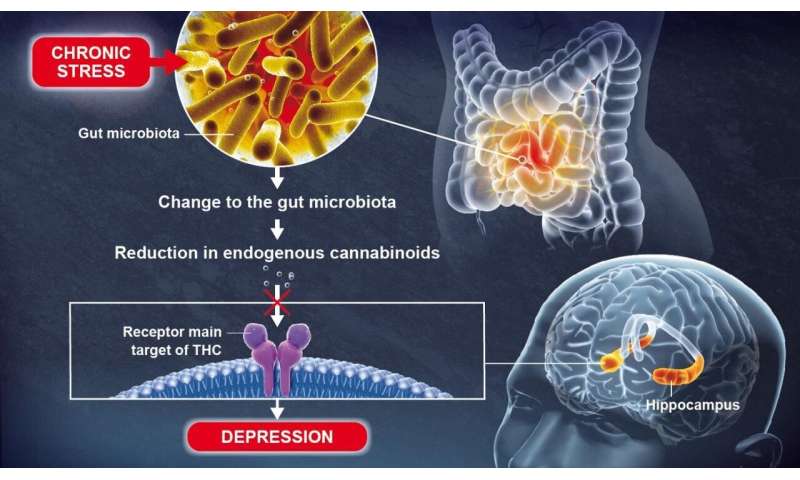
Gut microbiota plays a role in brain function and mood regulation
Credit: Pascal Marseaud

Depression is a mental disorder that affects more than 264 million people of all ages worldwide. Understanding its mechanisms is vital for the development of effective therapeutic strategies. Scientists from the Institut Pasteur, Inserm and the CNRS recently conducted a study showing that an imbalance in the gut bacterial community can cause a reduction in some metabolites, resulting in depressive-like behaviors. These findings, which show that a healthy gut microbiota contributes to normal brain function, were published in Nature Communications on December 11, 2020.

11 december 2020--The bacterial population in the gut, known as the gut microbiota, is the largest reservoir of bacteria in the body. Research has increasingly shown that the host and the gut microbiota are an excellent example of systems with mutually beneficial interactions. Recent observations also revealed a link between mood disorders and damage to the gut microbiota. This was demonstrated by a consortium of scientists from the Institut Pasteur, the CNRS and Inserm, who identified a correlation between the gut microbiota and the efficacy of fluoxetine, a molecule frequently used as an antidepressant. But some of the mechanisms governing depression, the leading cause of disability worldwide, remained unknown.

Using animal models, scientists recently discovered that a change to the gut microbiota brought about by chronic stress can lead to depressive-like behaviors, in particular by causing a reduction in lipid metabolites (small molecules resulting from metabolism) in the blood and the brain.

These lipid metabolites, known as endogenous cannabinoids (or endocannabinoids), coordinate a communication system in the body which is significantly hindered by the reduction in metabolites. Gut microbiota plays a role in brain function and mood regulation

Endocannabinoids bind to receptors that are also the main target of THC, the most widely known active component of cannabis. The scientists discovered that an absence of endocannabinoids in the hippocampus, a key brain region involved in the formation of memories and emotions, resulted in depressive-like behaviors.

The scientists obtained these results by studying the microbiotas of healthy animals and animals with mood disorders. As Pierre-Marie Lledo, Head of the Perception and Memory Unit at the Institut Pasteur (CNRS/Institut Pasteur) and joint last author of the study, explains: "Surprisingly, simply transferring the microbiota from an animal with mood disorders to an animal in good health was enough to bring about biochemical changes and confer depressive-like behaviors in the latter."

The scientists identified some bacterial species that are significantly reduced in animals with mood disorders. They then demonstrated that an oral treatment with the same bacteria restored normal levels of lipid derivatives, thereby alleviating the depressive-like behaviors. These bacteria could therefore serve as an antidepressant. Such treatments are known as "psychobiotics".

"This discovery shows the role played by the gut microbiota in normal brain function," continues Gérard Eberl, Head of the Microenvironment and Immunity Unit (Institut Pasteur/Inserm) and joint last author of the study. If there is an imbalance in the gut bacterial community, some lipids that are vital for brain function disappear, encouraging the emergence of depressive-like behaviors. In this particular case, the use of specific bacteria could be a promising method for restoring a healthy microbiota and treating mood disorders more effectively.


More information: Grégoire Chevalier et al, Effect of gut microbiota on depressive-like behaviors in mice is mediated by the endocannabinoid system, Nature Communications (2020). DOI: 10.1038/s41467-020-19931-2
Provided by Pasteur Institute 

Monday, January 02, 2017

Gut microorganisms affect our physiology

gut
Credit: CC0 Public Domain
Researchers have found evidence that could shed new light on the complex community of trillions of microorganisms living in all our guts, and how they interact with our bodies.

02 jan 2017--Scientists at the University of Exeter Medical School and University of Zaragoza in Spain studied a protein known as TLR2, a critical detector of the microbiota found in the intestine. They found that it regulates levels of serotonin - a neurotransmitter which carries messages to the brain, and is also found in the gut, where it regulates our bowel routines.
The research, carried out in cell cultures and verified in mice, provides strong evidence that microbiota can interfere with human physiology by modulating the serotonin transporter activity. Serotonin transporter is a target for numerous diseases and it seems that microbiota living in our guts is able to interfere with this transporter, controlling our serotonin levels.
The finding, published in PLOS ONE, comes as scientists across the world are working to understand the complicated interactions between the "invisible world" of the microbiota in our bodies and the impact they have on our health and even our moods. Recently, scientists in California found evidence that the bacteria in the gut play a role in causing Parkinson's Disease.
It may also help explain how the microbiota in our guts affect our physiology. Inflammatory bowel disease is thought to be triggered when TLR2 is not functioning properly, but so far, the mechanisms behind this have not been fully understood. This study aimed to further this understanding, and was supported the Foundation for the Study of Inflammatory Bowel Diseases in Aragón (ARAINF), in Spain.
Dr Eva Latorre, a postdoctoral researcher at the University of Exeter Medical School, said the new finding helped to further understanding in a fast-growing research area. She said: "This paper has concluded that the protein TLR2 alters the availability of serotonin, which is important in a range of conditions from depression to inflammatory bowel disease. It is early days in this research though. We need to understand much more about the relationship between the microbiota in our guts and how they interact, before we can hope to harness effective new treatments."
The research team examined human cells in a model of the intestine in the laboratory, looking at how they express proteins and RNA - activities which regulate how they behave. They found that TLR2 controls serotonin transporter - obtaining the same result in studies on mice.
Principal investigator of this study, Professor José E Mesonero, at the University of Zaragoza, said: "This paper opens our minds about the complex universe of this forgotten organ: the microbiome. We have concluded that TLR2 not only can detect microbiota, but also modulate serotonin transport, one of the crucial mechanism in neurological and inflammatory diseases. Much has to be yet studied, but this work can improve our understanding about the connection between gut and brain thought microbiota."
The paper, called 'Intestinal serotonin transporter inhibition by Toll-like receptor 2 activation. A feedback modulation', is published in PLOS ONE, by Eva Latorre, Elena Layunta, Laura Grasa, Marta Castro, Julián Pardo, Fernando Gomollón, Ana I. Alcalde and José E. Mesonero.


Provided by University of Exeter