Showing posts with label pandemics. Show all posts

Saturday, April 11, 2020

What we've learned from the Spanish flu—and what we haven't

What we’ve learned from the Spanish flu—and what we haven’t
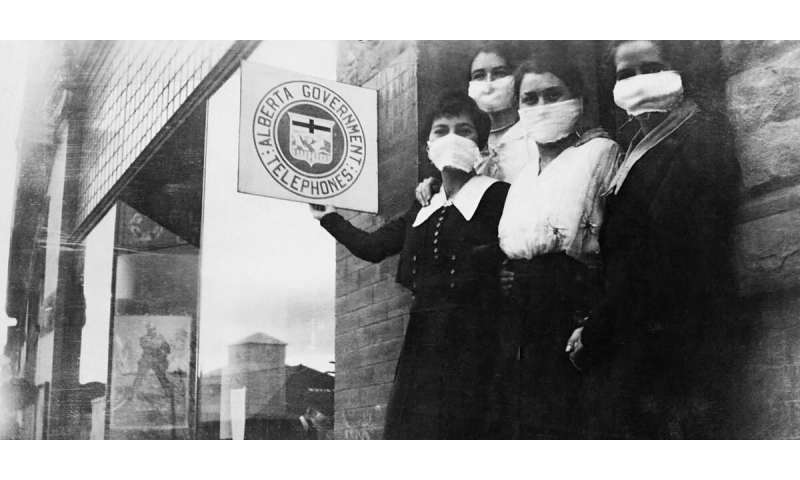
Alberta Government Telephones operators in High River wear masks during the 1918 Spanish flu pandemic. Many of Canada's pandemic protocols were established in the wake of the Spanish flu, according to a U of A public health expert. Credit: Glenbow Archives NA-3452-2
It's easy to feel trapped in the present by COVID-19—stuck at home, preoccupied with fears of what's to come.
11 april 2020--But as history reminds us, it's not the first time we've lived through a pandemic, and it can be instructive to look to the past for guidance.
Previous pandemics, such as the Spanish flu of 1918, produced strikingly similar shades of panic, political opportunism, racism, xenophobia and debates around public health versus the economy, according to University of Alberta historian Susan Smith.
Serious outbreaks also had the power to make or break political leaders. She said successful politicians did not deny or delay. They conveyed accurate, timely information.
"In the U.S. during the 1918 flu, those cities with good leadership, like Milwaukee, Wisconsin, had much lower rates of disease," said Smith.
Milwaukee recorded just over 291 excess deaths per 100,000 people, half that of many other cities including Denver, Pittsburgh, San Francisco and Boston.
"Those who put their heads in the sand, working against public health needs—that's where you see some of the worst problems."
The Spanish flu infected a third of the world's population, claiming somewhere between 50 and 100 million lives, far more than were killed in the First World War.
Lapses in leadership
An outbreak of bubonic plague in San Francisco's Chinatown at the turn of the 20th century provides a stark example of poor leadership. It took two years for the governor of the day, Henry Gage, to admit the plague's existence for fear it would hurt the economy. It took four years to stamp out the disease, after the governor was voted out of office for not taking it seriously.
"The historical lesson is that when leaders use strong-arm tactics or conflicting, mixed messages, or provide only limited information, the citizens are reluctant to follow along.
"Good public co-operation was based on a clear government and public health message with frequent and honest communications," said Smith.
The plague also demonstrated how racism and xenophobia tend to accompany epidemics. Since it was believed to be a Chinese disease, Chinatown was quarantined, but Caucasian citizens were free to come and go.
"There had been this whole anti-Chinese movement since the late 1800s, so it fits into existing patterns of discrimination," said Smith.
Blame game
During the 1918 flu, Indigenous populations around the world were hit harder than most, she added. The mortality rate among Indigenous groups in Australia, New Zealand, Canada and the United States was four times as high as that of white urban populations because of poverty and lack of access to fresh water and sanitation.
In Labrador, the flu killed close to one-third of the Inuit population and forced some communities out of existence.
Attempts to scapegoat, to blame someone else for the disease, often accompany pandemics, said Smith. Spanish flu, for example, is a "complete misnomer," named after Spain only because Spanish journalists, unencumbered by state censorship, were the first to report on its spread.
"In World War One, they actually blamed the Germans for starting it, just as today countries (such as Iran) blame the United States for engineering coronavirus, and some Americans have blamed China (calling it the China or Wuhan virus).
"Conspiracy theorists promote the idea someone must have created this in a laboratory. When people don't know, they assume it must be some enemy."
Necessity of nursing
There are some notable differences between the Spanish flu and COVID-19. No one knew what a virus was in 1918, and scientists wasted precious time trying to identify the bacteria responsible.
"There was such optimism that 'germ theory,' or microbiology, would save the day," but it turned out to be false hope, said Smith, a reminder that you can never make hasty assumptions about how any new disease will behave.
As with COVID-19, the role of nursing was crucial in 1918. Then as now, there was no effective treatment or vaccine. Nurses on the front lines bore the brunt of suffering and death.
"The essential, absolutely life-saving element was nursing, as it is now," said Smith. "Doctors would get patients in the morning and by evening, they're dead. They don't understand what's happening, and then they realize it's the pneumonia that's killing people. The key was keeping down the fever, getting liquids into the patient and dealing with respiratory distress."
Second wave
The Spanish flu also taught us viruses come in waves, according to U of A public health expert Stephanie Yanow. The second wave in the fall of 1918 was far deadlier than the first the spring before, as huge numbers of soldiers returned home from war, spreading it widely as people congregated in celebration of victory.
In Canada, the pandemic quickly moved west, devastating communities amidst a severe shortage of doctors. All told, 50,000 died in Canada, including 4,000 in Alberta.
At the U of A, the second wave of the pandemic hit just as students were starting a new term, many having just returned home from the front. By October, the university was "disbanded" to treat the ill and prevent further infection. A third wave hit the following winter.
"This was one of our first experiences of a disease on such a global scale, especially in the context of the war and this massive movement of populations carrying disease to all of these far-flung places," said Yanow.
One reason America may have been slow to pick up on those lessons of 1918 is that those who lived through it were determined to forget, said Smith. After the devastation of war, people preferred to celebrate victory and put the pandemic behind them.
"Epidemics sweep in very fast and it's very scary," said Smith. "Everybody has this feeling of shock. Before the war, people felt they had lived in an age of innocence, and it was ripped out from under them, first by the war, and then the pandemic."
In contrast, Canada's pandemic protocols—still for the most part observed today—were established in the immediate aftermath of the Spanish flu, said Yanow, after Vincent Massey introduced a scathing critique of the Canadian response to the disease in Parliament in the fall of 1918.
That led to the creation of the federal Department of Health, along with the first draft of Canada's pandemic plan. It included five of the core pillars of a public health response we have today—ensuring a uniform and co-ordinated response, issuing warnings, circulating evidence-based information, monitoring the disease while compiling statistics, and tracking the pandemic's pattern of movement across the country.
The good news is that pandemics do eventually end, said Smith, and if handled successfully, COVID-19 may reinforce for Canadians the value of their health-care system. One reason Canada has responded with consistent messaging and public trust is that it did learn from the past.
"A crisis like this is a reminder of why a universal health-care system is so essential," she said.
It's also a reminder that the right decisions made by leaders—properly informed by science and the basic principles of public health—can make a crucial difference.
"We have to remember that we have choices," said Smith. "It's not inevitable how this pandemic ends up, if we keep our goals of equality, social justice and human rights in the foreground."
Provided by University of Alberta

Friday, April 10, 2020

6 lessons we can learn from past pandemics


6 lessons we can learn from past pandemics
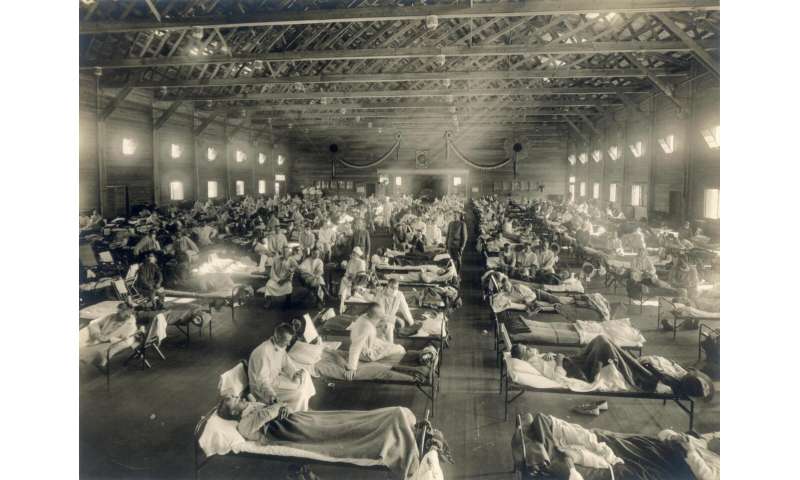
A hospital in Kansas during the influenza epidemic of 1918. Credit: National Museum of Health and Medicine
With 1.4 million confirmed cases and 81,000 deaths worldwide as of this writing, the coronavirus pandemic has become a global tragedy unlike any in our lifetimes. But, as historians remind us, this is neither our first nor our most deadly war with an infectious disease.
10 april 2020--A century ago, the flu epidemic of 1918 swept the globe, killing as many as 100 million people –5% of the world's population—before social distancing helped curb its spread. In the early 1780s, smallpox ravaged the American West, ripping through indigenous communities with case fatality rates of 38% or higher and leading to the development of the world's first vaccine less than two decades later.
Other outbreaks—from cholera in the 1830s to HIV-AIDS in the 1980s—brought xenophobia along with disease and revealed that fear and blame can distract from efforts to find a cure.
"Epidemics highlight the fault lines in our society," says CU Boulder history Professor Elizabeth Fenn, a Pulitizer Prize winning writer, scholar of epidemics and author of Pox Americana: The Great Smallpox Epidemic of 1775-82. "They reveal our weaknesses, but they also illuminate the profound kindness, generosity and cooperation we are capable of. We have a lot to learn from them."
Here's a look at some of those lessons:
Lesson No. 1: Names matter
Contrary to popular belief, the flu epidemic of 1918—commonly referred to as the Spanish flu—did not originate in Spain, but likely got its start at a military base in Fort Riley, Kansas.
"It was designated the Spanish flu completely erroneously, only because Spain put out the first news accounts of it," says CU Boulder history Professor Susan Kent, author of The Influenza Pandemic of 1918-1919.
Spain was neutral at the time, she notes, so the country was free of the media blackouts that (in the spirit of wartime morale) prohibited warring countries like Germany, the United States and France from reporting on illness.
Some scholars have since suggested that dubbing it the Spanish flu sent the inaccurate message that it was a distant threat, delaying steps to prevent it in the United States.
Similar themes resonate today, Kent notes, in the debate over terms like "Wuhan flu" and "Chinese flu" to describe coronavirus.
Lesson No. 2: Social distancing works
In 1918, as in 2020, travel swiftly spread the virus, with U.S. soldiers traveling to the East Coast and on to European battlefields and carrying it with them.
"The reason it was so deadly and passed so quickly across the entire world was that it took place during wartime," Kent says. "That's not unlike this moment of massive globalization we are living in now."
Without the luxury of today's high-tech microscopes and genetic sequencing, researchers wrongly assumed it was bacterial, and efforts to treat it or vaccinate against it failed. With no other tools to rely on, towns ultimately closed schools, theaters and libraries. The National Hockey League called off the Stanley Cup. Military leaders quarantined troops, and public servants were urged to wear masks.
In all, 675,000 people died in the United States, more than died in World War II. But it could have been more.
"The only way to prevent its spread was to isolate people from one another. Some communities did that and fared well. Others did not and suffered high death rates," says Kent. "That lesson for us now is crucial. If we don't learn from it, shame on us."
Lesson No. 3: Viruses don't spare the young
The influenza epidemic of 1918 was most likely to hit the young and healthy, felling people ages 15 to 45 with swift lethality.
"They got sick so rapidly, some literally dropped in the streets," Kent recalls, noting that their faces often turned bluish red due to lack of oxygen.
As it turned out, the patients' own robust immune systems were part of the problem, unleashing a torrent of virus-fighting molecules called cytokines that latched on to lung tissue causing lethal damage.
While the demographics of coronavirus are very different—it's hitting older populations and the immune-compromised the hardest—its behavior in the young and healthy is eerily similar to that of the virus a century ago. Recent news reports point to immune responses called "cytokine storms" as a likely cause of the collateral damage occurring in younger patients.
"Exactly the same thing occurred in 1918," Kent notes. "Strong immune systems overwhelmed the other organs of the body, especially the lungs."
That realization is already sparking new ways of thinking about treatments for COVID-19.
Lesson No. 4: Inoculation works
During the smallpox epidemic that swept across North America from 1775 to 1782, Revolutionary War soldiers took an unusual approach to protecting themselves from the virus known as Variola major. In a process known as variolation (a.k.a. inoculation), they took virus-loaded material from an infected person's smallpox pustule, carved an incision into the flesh of a healthy solder, and rubbed it in.
Recipients of variolation invariably got the disease, so were quarantined. About 5% died. But most got a mild version of the smallpox disease.
"There is no question that it worked," says Fenn. "Assuming you lived through it, you would garner immunity and go about the world without worrying about smallpox."
Years later, in 1796, Edward Jenner, who himself had been variolated as a child, would try a similar method, taking lesion material from a woman who had cowpox and rubbing it into the wound of an 8-year-old boy. When he later tried to infect the boy with smallpox, no disease developed.
The concept of vaccination—named after the Latin word for cow, or vacca, was born.
Fast forward to today, and variolation has come full circle, as researchers explore the idea of using "convalescent plasma" (survivor blood believed to contain antibodies to COVID-19) as a treatment.
Lesson No. 5: Don't blame the sick
With the spread of coronavirus has come a wave of anti-Asian backlash in cities across the globe, driven in part by the fact that the illness emerged in the Chinese city of Wuhan and swept through the Chinese population first.
That's nothing new, says Fenn.
"We are very prone to blaming the people who get sick," she says. "It's happened over and over throughout history."
During the cholera epidemics that hit from the 1830s to 1860s, white protestants shunned Irish immigrants as vectors of the scourge. In the 1950s, as polio swept the nation, African Americans and the poor were targeted. In the 1980s, blame was placed on the LGBTQ community for spreading HIV-AIDS.
"While people dithered around blaming (HIV-AIDS) on gay lifestyles or nightclub dancing, precious years of looking for pathogens were lost," Fenn says.
In contrast, Fenn notes, the World Health Organization in 1980 announced that smallpox was officially the first and only human infectious disease to be eradicated.
How was that accomplished? Through collaboration.
"Today, we can learn and act upon the fact that global cooperation and sharing of knowledge will help us deal with these outbreaks, or we can shut ourselves away and insist on going alone," says Kent.
Lesson No. 6: This can end
As horrific as coronavirus is, Kent does not believe its death toll will reach the meteoric levels of the flu epidemic of 1918. Our public health systems, scientific tools and medical supplies (albeit in short supply) are far better.
In comparison to past pandemics, we also have a head start in tackling this one, adds Fenn.
"This is the first pandemic of this scope where we have known what the pathogen is from the very start."
The coming months will no doubt be painful, but with social distancing in place, herd immunity building and collaborative work underway to develop treatments and a vaccine, Fenn and Kent are hopeful.
Now, all we need is time.
Says Fenn: "I would suggest that this is a time for us to pay attention and learn what this illness reveals about us, so we can take that knowledge forward."

More information: View a recent Conference on World Affairs Panel discussion featuring Kent and Fenn: www.youtube.com/watch?v=M9G_Ly … xOSfVnEGVzrtdKo5eUcQ
Provided by University of Colorado at Boulde