Showing posts with label quarantine. Show all posts

Friday, April 03, 2020

Top tips to maintain a healthy routine while staying at home
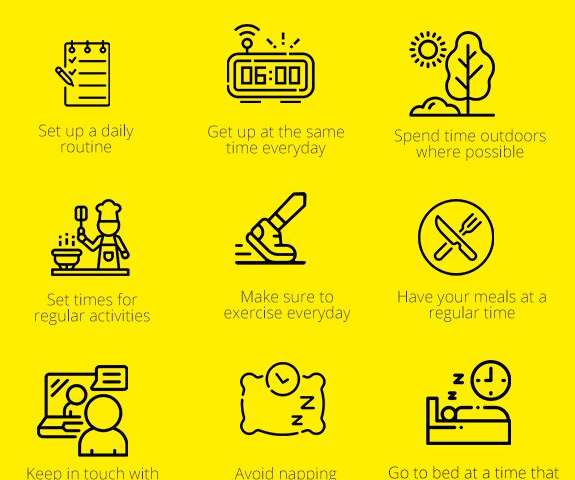

Top tips to maintain a healthy routine
The COVID-19 pandemic poses a serious global health risk.
Governments have been implementing a variety of new regulations to try to stem the spread of COVID-19, including self-quarantine, self-isolation and social distancing. While medically necessary to limit the spread, these new policies are also disrupting many of the stabilizing factors in our lives that support mental health.
03 april 2020--"One of the most important systems contributing to our daily wellbeing is the body's internal biologic clock. This clock keeps our body and our behavior synchronized with the 24-hour cycle of light and dark," says Professor Greg Murray, Director of the Centre for Mental Health.
Predictable, daily schedules and regular routines help keep our body clock running smoothly. "Research shows that disrupted body clocks are associated with many physical and mental health conditions, including depression, diabetes, obesity and cancer" he adds.
Helping your body clock stay on track during major life disruptions such as the COVID 19 pandemic is important to maintaining positive physical and mental health.
Here are some tips for improving the regularity of your daily routines at a time where nothings feels regular. These recommendations have been co-developed by Professor Murray as part of the International Society of Bipolar Disorders Task Force on Chronobiology and Chronotherapy.
Set up a routine
Routines help stabilize your body clock, so whether you're working from home or in quarantine, it's important to set a daily routine for yourself.
Get up at the same time every day
Waking up and starting your day at the same time every day is the most important way to stabilize your body clock.
Spend some time outdoors
Your body clock needs to "see" light in the morning to know that it's daytime. If you can't go outside, try to spend some time next to a window to get sunlight and focus on being calm.
Set times for regular activities
Whether you are tutoring your kids, checking in with a friend or cooking making dinner, try to do these activities at the same time each day.
Exercise every day
It's easy to lose track of time when you're working from home. Make sure you set aside some time to exercise. This could be going for a walk around the block or doing an online exercise class.
Eat your meals at the same time every day
If you're not hungry, at least eat a small snack at the prescribed time.
Stay in touch with friends and family
Staying at home and complying with social distancing rules means we now have far fewer social interactions. It's important at this time to keep in regular contact with friends, family and colleagues. This may be through video calls, phone calls or even real-time text-messaging. Book in these interactions at the same time every day.
Avoid naps during daylight hours
If you must nap, restrict your sleep to 30 minutes. Napping makes it hard to fall asleep at night. Avoid bright light in the evening, including the 'blue light' from computer screens and smartphones. Blue spectrum light suppresses the hormone that helps us sleep.
Stick to consistent sleep and wake times that fit your natural rhythm
If you are a night owl, it's okay to stay up a little bit later and get up a little bit later than others in the household. Just make sure you go to sleep and get up at the same time every day.
Provided by Swinburne University of Technology 

Thursday, April 02, 2020

Adherence to quarantine during COVID-19 pandemic

window look
Credit: CC0 Public Domain
Information, social influence, the practicalities of isolation and a clear understanding of the benefits of quarantine are key to people adhering to this measure to contain infectious disease outbreaks, according to new research from King's College London.
02 april 2020--Entire cities have already gone into quarantine during the current COVID-19 outbreak and more are likely to follow.
However, quarantine will not work if people do not adhere to it. To provide guidance on how to ensure quarantine measures are effective during the current COVID-19 outbreak, researchers from the NIHR Health Protection Research Unit in Emergency Preparedness and Response at King's College London analyzed previous research investigating the factors associated with adherence to quarantine during previous disease outbreaks.
Published online in the journal Public Health, the research identified 14 studies that looked at the adherence of different groups to quarantine protocol during a range of disease outbreaks, including Ebola, SARS, swine flu and Mumps. Analysis showed that people vary in their adherence to quarantine and from the eight studies that reported on this, adherence rates of quarantined individuals ranged from 0 to 92.8%.
One of the major factors affecting adherence to quarantine is knowledge about the infection and the quarantine protocol, according to the study. If instructions or language are unclear then people tend to make up their own rules. Social pressure from others to comply with quarantine is also important.
Cultural factors also played a role, according to the researchers, and when caring for others is inherent in a culture this could mean people might break quarantine in order to follow this cultural norm.
"Our study shows that people vary in their adherence to quarantine during infectious disease outbreaks and to improve this public health officials should provide a timely, clear rationale for quarantine and  about protocols and emphasize social norms to encourage this altruistic behavior," says lead author Dr. Rebecca Webster.
"Our research also showed that messaging around the benefit that engaging in quarantine will have on public health could be influential as well as ensuring that sufficient supplies of food, medication and other essentials are provided." Rebecca said.
If people believed that quarantine was beneficial in controlling the outbreak then adherence was better, particularly if it could be observed in a slowing in the spread of the outbreak. In addition, when the disease itself is believed to be more risky, adherence to quarantine was better.
Practical issues were also influential with fear of running out of supplies and loss income both affecting whether people broke quarantine.
"The effectiveness of quarantine depends on how many people do it so it is important to know what makes people more likely to comply. Our research shows that information and knowledge around the quarantine are central to its effectiveness," says contributing author Professor Sir Simon Wessely, IoPPN.
He continued, "In the era of 'fake news' consistent messaging is difficult but leaving the information needs of the public unmet can be dangerous. Public health teams should provide clear, authoritative information where needed, and then check the messages are getting through. This is happening in this country, but needs to be worldwide."
The paper is still undergoing formatting and copy-editing and may be subject to slight changes.

More information: Rebecca K. Webster et al. How to improve adherence with quarantine: Rapid review of the evidence, Public Health (2020). DOI: 10.1016/j.puhe.2020.03.007
Provided by King's College London