Showing posts with label resolutions. Show all posts

Sunday, December 26, 2021


The best way to follow through on your New Year's resolution? Make an 'old year's resolution'
The best way to follow through on your New Year's resolution? Make an 'old year's resolution'
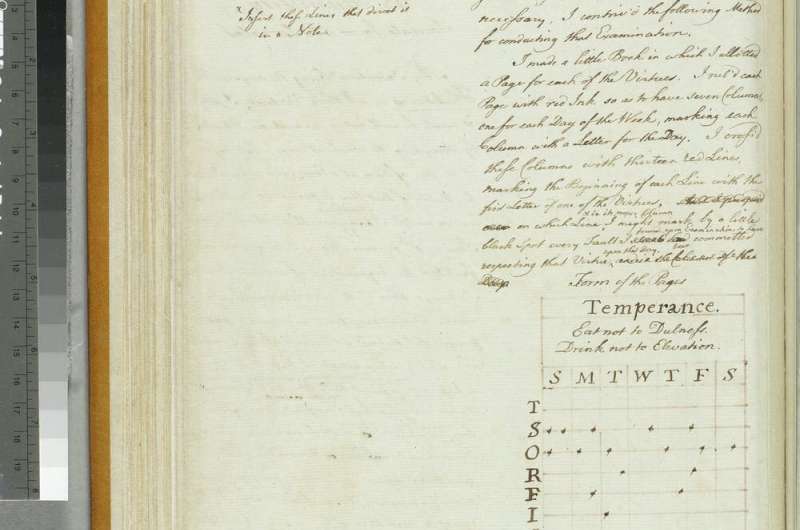
Benjamin Franklin recorded his slip-ups over the course of a week. Credit: The Huntington Library, Art Museum, and Botanical Gardens

If you've made a New Year's resolution, your plot for self-improvement probably kicks into gear sometime on Jan. 1, when the hangover wears off and the quest for the "new you" begins in earnest.

But if research on habit change is any indication, only about half of New Year's resolutions are likely to make it out of January, much less last a lifetime.

As experts in positive psychology and literature, we recommend an unconventional but more promising approach.

We call it the "old year's resolution."

It combines insights from psychologists and America's first self-improvement guru, Benjamin Franklin, who pioneered a habit-change model that was way ahead of its time.

With the "old year" approach, perhaps you can sidestep the inevitable challenges that come with traditional New Year's resolutions and achieve lasting, positive changes.

A period to practice—and fail

Research has highlighted two potential pitfalls with New Year's resolutions.

First, if you lack the confidence to invest in a full-fledged effort, failure to achieve the goal may become a self-fulfilling prophesy. Furthermore, if you maintain the change but perceive progress as unacceptably slow or inadequate, you may abandon the effort.

The old year's resolution is different. Instead of waiting until January to start trying to change your life, you do a dry run before the New Year begins.

How does that work?

First, identify a change you want to make in your life. Do you want to eat better? Move more? Sock away more savings? Now, with Jan. 1 days away, start living according to your commitment. Track your progress. You might stumble now and then, but here's the thing: You're just practicing.

If you've ever rehearsed for a play or played scrimmages, you've used this kind of low-stakes practice to prepare for the real thing. Such experiences give us permission to fail.

Psychologist Carol Dweck and her colleagues have shown that when people see failure as the natural result of striving to achieve something challenging, they are more likely to persist to the goal.

However, if people perceive failure as a definitive sign that they are not capable—or even deserving—of success, failure can lead to surrender.

If you become convinced that you cannot achieve a goal, something called "learned helplessness" can result, which means you're likely to abandon the endeavor altogether.

Many of us unintentionally set ourselves up for failure with our New Year's resolutions. On Jan. 1, we jump right into a new lifestyle and, unsurprisingly, slip, fall, slip again—and eventually never get up.

The old year's resolution takes the pressure off. It gives you permission to fail and even learn from failure. You can slowly build confidence, while failures become less of a big deal, since they're all happening before the official "start date" of the resolution.

A gardener weeding one bed at a time

Long before he became one of America's greatest success stories, Franklin devised a method that helped him overcome life's inevitable failures—and could help you master your old year's resolutions.

When he was still a young man, Franklin came up with what he called his "bold and arduous project of arriving at moral perfection." With charming confidence, he set out to master 13 virtues, including temperance, frugality, chastity, industry, order and humility.

In a typically Franklinian move, he applied a little strategy to his efforts, concentrating on one virtue at a time. He likened this approach to that of a gardener who "does not attempt to eradicate all the bad herbs at once, which would exceed his reach and his strength, but works on one of the beds at a time."

In his autobiography, where he described this project in detail, Franklin did not say that he tied his project to a new year. He also did not give up when he slipped once—or more than once.

"I was surpris'd to find myself so much fuller of faults than I had imagined; but I had the satisfaction of seeing them diminish," Franklin wrote.

He made his progress visible in a book, where he recorded his slip-ups. One page—perhaps only a hypothetical example—shows 16 of them tied to "temperance" in a single week. (Instead of marking faults, we recommend recording successes in line with the work of habit expert B.J. Fogg, whose research suggests that celebrating victories helps to drive habit change.)

Repeated failures might discourage someone enough to abandon the endeavor altogether. But Franklin kept at it—for years. To Franklin, it was all about perspective: This effort to make himself better was a "project," and projects take time.

'A better and a happier man'

Many years later, Franklin admitted that he never was perfect, despite his best efforts. His final assessment, however, is worth remembering: "But, on the whole, tho' I never arrived at the perfection I had been so ambitious of obtaining, but fell far short of it, yet I was, by the endeavor, a better and a happier man than I otherwise should have been if I had not attempted it."

Treating self-improvement as a project with no rigid time frame worked for Franklin. In fact, his scheme probably helped him succeed wildly in business, science and politics. Importantly, he also found immense personal satisfaction in the endeavor: "This little artifice, with the blessing of God," he wrote, was the key to "the constant felicity of his life, down to his 79th year, in which this is written."

You can enjoy the same success Franklin did if you start on your own schedule—now, during the old year—and treat self-improvement not as a goal with a starting date but as an ongoing "project."

It might also help to remember Franklin's note to himself on a virtue he called, coincidentally, "Resolution": "Resolve to perform what you ought; perform without fail what you resolve."

Provided by The Conversation 

Thursday, January 08, 2015

Resolutions linked to 'ideal self' most effective, Stanford psychologist says

Resolutions linked to 'ideal self' most effective, Stanford psychologist says
New Year's resolutions can be an action plan or just an expression of hope for the future, says Kelly McGonigal, a lecturer in Stanford's Graduate School of Business and senior teacher at the university's Center for Compassion and Altruism Research. Credit: Sondem/Shutterstock

08 jan 2015--New Year's resolutions present opportunities to connect to one's ideal self, a Stanford expert says.
Psychologist Kelly McGonigal says that research shows that when people resolve to change, they may immediately feel more confident, in control and hopeful.
A lecturer in Stanford's Graduate School of Business and senior teacher at the university's Center for Compassion and Altruism Research, McGonigal is an instructor for a Stanford Continuing Studies course on willpower and change and the author of the book, The Willpower Instinct.
She talked about New Year's resolutions in a recent conversation with Stanford News Service.
Are New Year's resolutions an effective approach for personal growth?
It depends what kind of resolutions you set. For many people, New Year's Resolutions are an expression of hope, not an action plan for the future. Research shows that when people resolve to change, they immediately feel more confident, in control and hopeful. They even feel stronger and taller, which is kind of ridiculous, but this just shows how uplifting resolving to change can be. If people want to make resolutions as a way to connect to a growth mindset – the belief that through effort and support, you can change and grow in meaningful ways – that's fine. It's not necessarily a tragedy if you fall short.
The problem comes when people fall prey to "false hope syndrome," a term psychologists use to describe the cycle of 1) vowing to change, 2) being surprised by how difficult it is, and 3) giving up, all because the actual process of change doesn't provide the same emotional boost as the initial resolution. Then you get into the territory of people making the same resolution five years in a row, without ever making progress – and you may eventually "learn" from this experience that there's no point in trying to change.
If you're going to make a resolution, I say, either use it as an opportunity to connect to your ideal self, but don't turn it into a reason to beat yourself up when you aren't totally transformed on Jan. 2 – or really reflect on what you want and who you want to be, and invest in yourself from that perspective.
The worst thing to do is make a promise to yourself that you don't really care about and don't really plan to see through.
Are concrete resolutions easier to achieve than more abstract ones?
I can't imagine having one without the other. People who set exceptionally specific goals often succeed, but the small habit doesn't inspire greater change. If you want to create health, setting a small goal – like eating one more serving of vegetables a day – is great. But without remembering the big "why," eating the vegetable can become a kind of game that you feel good about winning – it feels good to mentally check it off your to-do list for the day. But succeeding at this small goal won't necessarily make you identify as someone who cares about your health, and wants to make healthier choices across the board.
The best kind of resolution is one that has a "big why" – to create health, to reconnect with a personal passion, to strengthen an important relationship, to change your financial situation, to develop yourself in some way, or to contribute to others in some way. And then you pick a small action or change that reflects this big goal, to remind yourself of it and to help you take steps toward it.
These can be very small if the "why" is clear, and still lead to big change in the long-term. One of my favorite examples of a small "what" that's been shown to have a major impact is delaying the first cigarette of the day by 10 minutes. That's doable.
I encourage people to think of a New Year's resolution that small after they've gotten clear on the big "why."
What types of "inner questions" should people ask themselves in developing their goals?
All too often people skip the "why" and go straight for a "what" that they think they can nail. But why vow to change something that isn't connected to the vision you have for your life? It may be a little more intimidating to think about the biggest "why's," but you have a much better chance of making a meaningful resolution.
I like to go big. For example:
  • What do I want to experience more of in my life, and what could I do to invite that/create that?
  • How do I want to be in the most important relationships or roles in my life? What would that look like, in practice?
  • What do I want to offer the world? Where can I begin?
  • How do I want to grow in the next year?
Your mindset when you contemplate these questions matters. If people want to seriously engage in the process of change, it takes more than five seconds of reflection.
I have a few favorite "pre-resolution" suggestions:
  • List your favorite memories and triumphs of 2014, including the challenges you faced, even if things didn't turn out the way you hoped. This can help you take a big-picture perspective on how you want to grow.
  • Make a list of what you are grateful for in your life. If you make a "gratitude list" first, you might be surprised how it shapes your wish list for 2015.
  • Write yourself a letter from your future self, dated 1/1/2016. Imagine looking back at 2015. In your letter, thank your present self for all you did to achieve your goals – and be specific. Or give yourself some compassionate advice from your wiser, 2016 self. This can lead to a reflection on what you might like to resolve for the coming year.
How can people hold themselves accountable to their resolutions?
Find a partner. It doesn't have to be someone who shares the same goal – just see if there's someone in your life who is interested in being a support buddy. Studies show that something as simple as texting a buddy when you take an action toward your goal triples the rate of success.
Another way to hold yourself accountable is to check in with whether the goal feels meaningful, and is serving you well. True self-accountability means paying attention to whether your choices are creating what you want in your life.
Or, is trying to stick to the goal creating more self-criticism or resentment than positive change? Have there been any negative consequences?
For example, you could set the goal to get up one hour earlier to exercise, and find that the sleep deprivation is making you enjoy being a parent less. That would be an excellent reason to hold yourself accountable to changing the "how" of exercising more to something else, like dancing in your kitchen for two songs after you do the dishes.
How can people cope with failure when they regress on their resolutions?
If you've connected to a big "why," and you have recruited a buddy, you're going to have a much better chance recovering from these setbacks. The other real resource is mindset.
Change involves setbacks – research shows that people who ultimately succeed have no fewer setbacks early on than people who eventually give up. So, the first thing is to expect to fail at some point, and not take it as evidence that change is futile.
One mindset trick I like to use is to imagine that I already know the ending of this story: I have made the change or reached the goal that I set. And so I ask, from that point of view, what did I do that led to the outcome of long-term success?
People give up after setbacks when they don't know the ending –and they suspect it will be "I failed." But you can choose the ending and make it a self-fulfilling prophecy.
This perspective – psychologists sometimes call it encoding prospective memories, or making a future memory – can trick your brain into making what you need to do feel very possible and real, as if you've already done it.
Provided by Stanford University