Showing posts with label senolytic drugs. Show all posts

Sunday, May 01, 2022


Senolytic drugs can boost key protective protein against certain diseases and aspects of aging
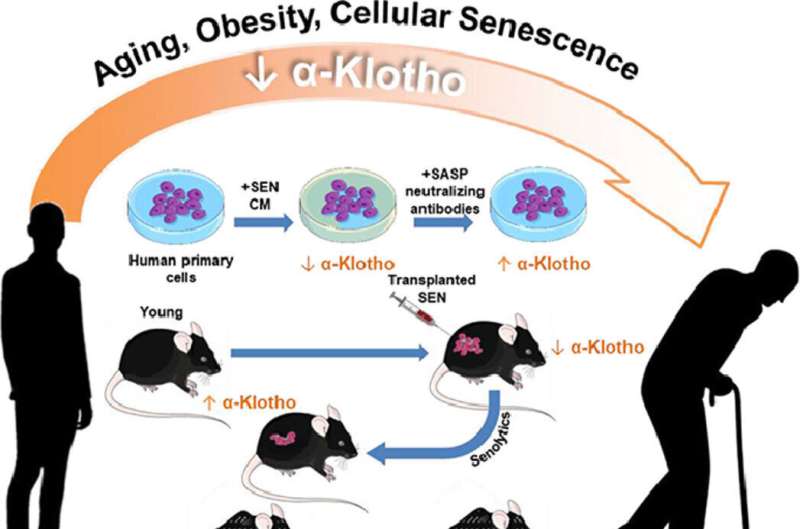
Senolytic drugs can boost key protective protein against certain diseases and aspects of aging
Graphical abstract. Credit: eBioMedicine (2022). DOI: 10.1016/j.ebiom.2022.103912

Mayo Clinic researchers say senolytic drugs can boost a key protein in the body that protects older people against aspects of aging and a range of diseases. Their findings, which are published in eBioMedicine, demonstrate this in mice and human studies.

01 may 2022--Senolytics developed at Mayo Clinic and given once clear the bloodstream of senescent or "zombie" cells. These cells contribute to multiple diseases and negative aspects of aging. This study shows that the removal of senescent cells significantly boosts the production of a protective protein called α-Klotho.

"We show that there is an avenue for an orally active, small-molecule approach to increase this beneficial protein and also to amplify the action of senolytic drugs," says James Kirkland, M.D., Ph.D., a Mayo Clinic internist and senior author of the study.

The researchers first showed that senescent cells decrease levels of α-Klotho in three types of human cells: umbilical vein endothelial cells, kidney cells and brain cells. They also demonstrated through using the senolytics desatinib plus quercitin in three types of mice that α-Klotho was increased. They also showed that after administering desatinib plus quercitin in clinical trial participants with idiopathic pulmonary fibrosis, α-Klotho also increased.

"We also are first to link the potential impact of fat-resident senescent cells on brain α-Klotho," says Yi Zhu, Ph.D., a Mayo Clinic physiologist and biomedical engineer, and first author of the study. "This may open another avenue to investigate the impact of peripheral senescent cells on brain aging."

The protein α-Klotho is important to maintaining good health, as it tends to decrease with age, and especially decreases in multiple diseases, including Alzheimer's, diabetes and kidney disease. Animal studies have shown that decreasing α-Klotho in mice shortens life span and increasing α-Klotho in mice by inserting a gene that causes its production increases life span by 30%.

Discovering ways to increase α-Klotho in humans has been a major research goal, but that has been difficult because of its size and instability. Introducing it directly is problematic, as it would have to be administered into a vein instead of by mouth.

This study shows that senolytics, which can be administered orally, increase α-Klotho in humans with idiopathic pulmonary fibrosis, a senescence-associated disease that leads to frailty, serious breathing difficulties and death.


More information: Yi Zhu et al, Orally-active, clinically-translatable senolytics restore α-Klotho in mice and humans, eBioMedicine (2022). DOI: 10.1016/j.ebiom.2022.103912

Tuesday, July 10, 2018

Senolytic drugs reverse damage caused by senescent cells in mice

Injecting senescent cells into young mice results in a loss of health and function but treating the mice with a combination of two existing drugs cleared the senescent cells from tissues and restored physical function. The drugs also extended both life span and health span in naturally aging mice, according to a new study in Nature Medicine, published on July 9, 2018. The research was supported primarily by the National Institute on Aging (NIA), part of the National Institutes of Health (NIH).

10 july 2018--A research team led by James L. Kirkland, M.D., Ph.D., of the Mayo Clinic in Rochester, Minnesota, found that injecting even a small number of senescent cells into young, healthy mice causes damage that can result in physical dysfunction. The researchers also found that treatment with a combination of dasatinib and quercetin could prevent cell damage, delay physical dysfunction, and, when used in naturally aging mice, extend their life span.
"This study provides compelling evidence that targeting a fundamental aging process—in this case, cell senescence in mice—can delay age-related conditions, resulting in better health and longer life," said NIA Director Richard J. Hodes, M.D. "This study also shows the value of investigating biological mechanisms which may lead to better understanding of the aging process."
Many normal cells continuously grow, die, and replicate. Cell senescence is a process in which cells lose function, including the ability to divide and replicate, but are resistant to cell death. Such cells have been shown to affect neighboring ones because they secrete several pro-inflammatory and tissue remodeling molecules. Senescent cells increase in many tissues with aging; they also occur in organs associated with many chronic diseases and after radiation or chemotherapy.
Senolytics are a class of drugs that selectively eliminate senescent cells. In this study, Kirkland's team used a combination of dasatinib and quercetin (D+Q) to test whether this senolytic combination could slow physical dysfunction caused by senescent cells. Dasatinib is used to treat some forms of leukemia; quercetin is a plant flavanol found in some fruits and vegetables.
To determine whether senescent cells caused physical dysfunction, the researchers first injected young (four-month-old) mice with either senescent (SEN) cells or non-senescent control (CON) cells. As early as two weeks after transplantation, the SEN mice showed impaired physical function as determined by maximum walking speed, muscle strength, physical endurance, daily activity, food intake, and body weight. In addition, the researchers saw increased numbers of senescent cells, beyond what was injected, suggesting a propagation of the senescence effect into neighboring cells.
To then analyze whether a senolytic compound could stop or delay physical dysfunction, researchers treated both SEN and CON mice for three days with the D+Q compound mix. They found that D+Q selectively killed senescent cells and slowed the deterioration in walking speed, endurance, and grip strength in the SEN mice.
In addition to young mice injected with senescent cells, the researchers also tested older (20-month-old), non-transplanted mice with D+Q intermittently for 4 months. D+Q alleviated normal age-related physical dysfunction, resulting in higher walking speed, treadmill endurance, grip strength, and daily activity.
Finally, the researchers found that treating very old (24- to 27-month-old) mice with D+Q biweekly led to a 36 percent higher average post-treatment life span and lower mortality hazard than control mice. This indicates that senolytics can reduce risk of death in old mice.
"This is exciting research," said Felipe Sierra, Ph.D., director of NIA's Division of Aging Biology. "This study clearly demonstrates that senolytics can relieve physical dysfunction in mice. Additional research will be necessary to determine if compounds, like the one used in this study, are safe and effective in clinical trials with people."
The researchers noted that current and future preclinical studies may show that senolytics could be used to enhance life span not only in older people, but also in cancer survivors treated with senescence-inducing radiation or chemotherapy and people with a range of senescence-associated chronic diseases.

More information: Senolytics improve physical function and increase lifespan in old age, Nature Medicine (2018). DOI: 10.1038/s41591-018-0092-9 , https://www.nature.com/articles/s41591-018-0092-9


Provided by National Institutes of Health