Showing posts with label smartphones apps. Show all posts

Saturday, October 14, 2023


Smartphones could be used to monitor liver disease patients at home
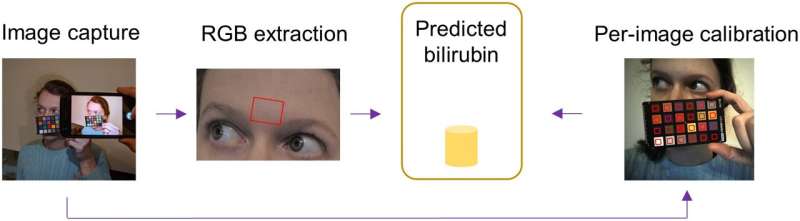
Smartphones could be used to monitor liver disease patients at home
Assessment of bilirubin levels in patients with cirrhosis via forehead, sclera and lower eyelid smartphone images. Credit: PLOS Digital Health (2023). DOI: 10.1371/journal.pdig.0000357

A smartphone camera was able to detect changes in skin tone and eye color that require patients to seek medical help, in new research from UCL and the Royal Free Hospital.

14 oct 2023--The study, published in PLOS Digital Health, is the first to assess and compare how smartphone images of the forehead, white of the eye and lower eyelid could be used to accurately predict the bilirubin level of patients with advanced cirrhosis. It found that images of the white of the eye was the best way to predict bilirubin level from an image.

The approach has the potential to monitor liver cirrhosis patients at home more closely, easily and cost effectively than they are currently. The authors expect that this would detect worsening of symptoms before the situation becomes critical, as well as simplify workflows for health care professionals.

Liver disease is the third most common cause of working-age premature death in the UK. While mortality rates have greatly improved for many chronic diseases, the mortality rate for liver disease in the UK increased by 400% between 1970 and 2010. This has increased the need to find non-invasive, cost-effective ways to monitor cirrhosis progression.

Bilirubin is a yellowish pigment that indicates poor liver function when visible in the skin or eye, a condition known as jaundice. Advanced cirrhosis patients' skin and eyes become more yellow as the bilirubin concentration in the blood becomes higher.

Bilirubin levels are currently checked by a blood test performed by a medical professional, which then has to be analyzed. This is usually done in a health care setting. If the level has increased, this indicates that the patient's liver function has deteriorated further and that they need medical help.

In this study, researchers developed a smartphone app that was able to detect the severity of jaundice with a high degree of accuracy. They used a smartphone to take photos of the forehead, white of the eye and lower eyelid of 66 cirrhosis patients. After calibrating the images for lighting conditions, they were analyzed and used to train an algorithm that could predict bilirubin level based on the degree of yellowness in the image.

When these predictions were checked against blood test data, the white of the eye images provided the strongest correlation.

Professor Raj Mookerjee (UCL Medicine), co-author of the study, said, "One of the reasons that liver disease is so challenging is that patients can deteriorate very quickly. It's an unfortunate fact that if a patient arrives at the clinic much more jaundiced than they were previously, the chances are that they have already progressed their disease considerably. The approach that we've assessed in this study could allow us to monitor patients from their own homes much more frequently, than is currently possible and, hopefully, detect worsening of clinical signs and symptoms before things become critical."

One of the challenges the study sought to overcome is the degree of yellowness in patients with cirrhosis, which can be fifty times higher than normal.

"You can look at a patient and tell if they have jaundice right away. But it's a not a question of if the skin looks yellow or not, it's about how much more yellow it looks, which gives you an indication of how badly the  function has deteriorated," said Professor Mookerjee. "The smartphone app gives us this degree of accuracy. It's a remarkable feat of engineering and shows the power of clinicians and engineers collaborating to solve urgent health care problems."

The next step would be a larger trial to validate the safety and accuracy of the approach. In practice, the approach would likely work by patients frequently taking pictures of their eye via an app, which would inform the clinical care providers of a meaningful change in bilirubin, that might require a change in patient management.

Dr. Terence Leung (UCL Medical Physics & Biomedical Engineering), co-author of the paper, said, "Smartphone camera technology is improving every year, which is allowing us to develop innovative solutions to unmet health care needs using devices that most people have at home. It's great to be able to engineer solutions that are not only cheap and easy to implement, but which will make a real difference to people's lives."

More information: Miranda Nixon-Hill et al, Assessment of bilirubin levels in patients with cirrhosis via forehead, sclera and lower eyelid smartphone images, PLOS Digital Health (2023). DOI: 10.1371/journal.pdig.0000357

Tuesday, January 01, 2013


Smartphone apps for health and fitness an exploding craze


When Jon Mead, a devoted cyclist, visits a new city, he goes right to his smartphone app Strava to find the best bike routes. In Sacramento, Calif., where he works at a Fleet Feet running-gear shop, the 24-year-old uses MapmyRide to track his course in an archive.
01 jan 2013--Bethany Scribner, a runner who also works at the fitness gear retailer, likes the apps MapmyRun and Livestrong, which tracks nutrition in a daily pie chart showing fat, protein and carbs. Saucony Run4Good is a favorite, too, said Scribner, 21, because the company donates to anti-obesity programs for kids if enough runners cover enough miles.
MapMyRide, MapMyRun, Livestrong, Run4Good, MyFitnessPal – they're all part of an exploding arena of health and fitness applications for smartphones. The trend, which falls under the umbrella of Health 2.0, an international tech movement grounded in San Francisco, is proving an obsession for programmers at code-a-thons, as well as users who get hooked on tracking their workouts, calorie intake and weight loss.
Among users, a pinch of competition - a social network of friends who sign up to share fitness scores - is all you need to make this an activity as additive as Twitter is for some and Facebook is for others.
The Pew Research Center, in a new report titled Mobile Health 2012, found smartphone owners in the vanguard, with 52 percent gathering health information on their palm-sized, micro-computers. That compares to 6 percent of owners of regular cellphones, the report said.
In addition, Pew found, 19 percent of smartphone owners have at least one health app on their devices - with exercise, diet, and calorie-counting programs the most popular.
Overall, the proportion of cellphone owners who use their phones to access health data nearly doubled from 17 percent two years ago to 31 percent today, according to the report.
Ale Lauth is a senior health educator for Kaiser Permanente in the North Sacramento Valley region. She has witnessed the trend first-hand in her role as wellness guru for hundreds of Kaiser employees and physicians.
"We've definitely seen their usage increase," Lauth said. "The apps have come a long way, and they're constantly upgrading."
They are also proliferating. Click on Apple's health and fitness apps page and you'll find iRunner, Fitocracy, Fitter Fitness, Fitness Buddy, Fitbit, Fitness Pro, miCoach, Abs Workout, RunKeeper, Virtual Trainer - and about 250 more.
And it's not just fitness. There's a parallel world of apps geared to other aspects of health and wellness: iTriage, iFirstAidLite, InstantHeartRate, CuresA-Z, not to mention a host of downloadable apps such as OvulationCalendar that help women track their menstrual and fertility cycles. And, yes, there are apps with tips for carrying on when that fertility cycle is spot on.
The medical community is embracing the trend, holding contests to encourage programmers to design disease-specific apps that doctors can "prescribe" to patients with heart disease, diabetes and other chronic conditions.
The American Medical Association has launched its own consumer weight app, and the U.S. Department of Health and Human Services Office of the National Coordinator of Health Information Technology held a contest in July for the best app to help consumers identify and reduce their risk of heart disease.
The next phase is already in the works: apps that will transform your smartphone into a regulated medical device. Think phones as electrocardiography, or ECG, machines that can detect abnormal heart rhythms and determine if a patient is having a heart attack.
Such clinical apps will not go forward without approval from the federal Food and Drug Administration. Already, U.S. Rep. Mike Honda, D-San Jose, is working on a bill to establish a new FDA Office of Mobile Health designed to regulate health apps.
In the meantime, the private sector is leading the charge at Health 2.0-inspired code-a-thons, live events where developers gather to build apps and tools for improved health care. A topic getting prime billing at the International Consumer Electronics Show in Las Vegas this January: "The Human Body: The Next Digital Revolution."
For now, most physicians are happy to see patients using simple apps to motivate them to exercise, eat well and lose weight.
MyFitnessPal has emerged as one of the more popular apps in this category, allowing users to set weight loss goals then diligently chart calories consumed, calories burned and poundage. Lauth, of Kaiser Permanente, said dozens of her charges use MyFitnessPal, getting into the swing of competition when they add friends to their wellness social network who can track each other's progress - or lack thereof.
"These are great motivators," said Lauth. "When you hit your goals, you and your friends see the results."
Others in this category flash smiley-faces or other positive on-screen icons as rewards. They also offer pre-programmed verbal pats-on-the-back.
Says Lauth, "It's like they are saying, 'You are fantabulous!'"
Scribner, who helps Fleet Feet customers gear up for their runs, says she likes the social network aspect of workout apps.
"You can compete with your friends over your course, and it shows your elevation," she said. "Simply hit go."