Showing posts with label surgery. Show all posts

Sunday, December 26, 2021


Men aged 40-80 more likely to die after surgery than women of the same age, German study finds

surgery
Credit: CC0 Public Domain

Middle-aged men are around 50% more likely to die after surgery than middle-aged women, according to new research being presented at Euroanaesthesia, the annual meeting of the European Society of Anaesthesiology and Intensive Care (ESAIC), held online this year. The study of more than 100,000 non-cardiac patients at a leading German hospital found that mortality rates are higher in men in their 40s and 50s, as well as those in their 60s and 70s.

26 dec 2021--Some previous studies have found that sex affects the risk of complications after surgery but the results have been mixed. One1 showed that men were at higher risk of complications and death after non-cardiac surgery, while another2 found that survival rates after some types of vascular surgery were lower in women than men. A third study3, of ICU patients, found no difference in death rates between the sexes.

To find out more, Dr. Dimislav Andonov and colleagues at the Technical University of Munich, Munich, Germany, analyzed data on 107,471 patients who had undergone non-cardiac surgery at the university's hospital between January 2014 and March 2020.

The procedures included a wide range of elective (planned) operations, such as hip replacements and cancer surgery, and emergency surgeries, such as acute appendicitis and operations on victims of car accidents.

Outpatient and day cases were excluded, as were diagnostic procedures under anaesthesia, electroconvulsive therapy and patients that were in ICU before their operation.

The patients' average age was 53.8 and just over half (54.1%) were male.

No link was found between a patient's sex and the likelihood of them being admitted to the post-anaesthesia care unit or PACU for prolonged post-operative follow-up (Patients who stay more than four hours in the post-anaesthesia recovery room are defined as being in PACU).

Nor was there any link between sex and ICU admission, the need to be put on a ventilator or death before being discharged from hospital in those under 40.

But, in the 41-80 age group, men were more likely to be admitted to ICU, need ventilation and die before discharge than women of the same age.

Men aged 41-60 were 22% more likely to be admitted to ICU than women of the same age, 37% more likely to need ventilation and 54% more likely to die.

Those aged 61-80 were 20% more likely to be admitted to ICU than women of the same age, 31% more likely to need ventilation and 38% more likely to die.

After the age of 80, men's risk of ICU admission, ventilation and death reverted to being the same as that of women of the same age.

The researchers say: "This work demonstrates that male patients aged between 40 and 80 are at higher risk of death in the days after their operation. They are also more likely to be admitted to ICU and to need to be ventilated."

It isn't clear why the risks are higher for men aged 41-80 but one possibility is that higher rates of cardiovascular problems in males make surgical complications more likely.

Plus, the results may be skewed by the inclusion of trauma cases, such as injuries from car accidents, which are often life-threatening and are more common in men.

Male reluctance to go to the doctor may also play a part. Dr. Andonov says: "Men undergo health checks less often than women and, thus, their health problems (for example cancer) may be discovered at a later stage.

"We plan to do more research to clarify the reasons. If we find that men's higher risk isn't being driven by trauma cases, we can think about how to best raise men's awareness of their health.

"And while it isn't yet clear whether males are at higher risk of cardiovascular complications, our findings do suggest that more attention should be paid to cardiovascular risk factors during pre-operative assessments."


More information: 1. Moodley, Y. and B.M. Biccard, S Afr Med J, 2015. 105(2): p. 126-9.

2. Grootenboer, N., et al., Eur J Vasc Endovasc Surg, 2011. 42(4): p. 510-6.

3. Zettersten, E., et al., J Crit Care, 2020. 55: p. 22-27

Provided by The European Society of Anaesthesiology and Intensive Care (ESAIC)

Thursday, April 02, 2020

Critical care surgery team develops blueprint for essential operations during COVID-19


Critical care surgery team develops blueprint for essential operations during COVID-19
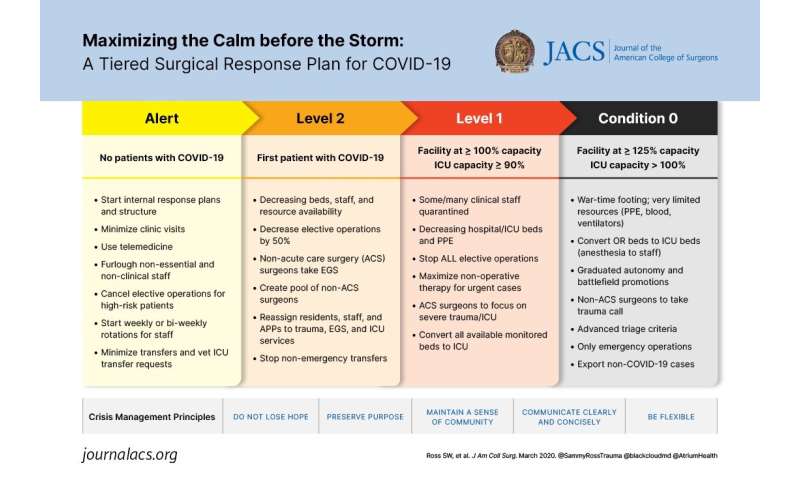
A Tiered Surgical Response Plan for COVID-19. Credit: American College of Surgeons
As patients with Coronavirus Disease 2019 (COVID-19) flood hospitals, the health care system must not only determine how to redeploy limited resources and staff to care for them but must also make well-calculated decisions to provide other types of critical care. For surgeons, this type of critical care involves performing an emergency operation to treat a ruptured appendix or perforated colon—to both virus-exposed and non-exposed patients—while keeping both hospital personnel and non-exposed patients safe.
02 april 2020--To help guide hospital surgery departments through this crisis, the acute surgery division at Atrium Health's Carolinas Medical Center in Charlotte, N.C., has developed a tiered plan for marshaling limited resources, which the authors have published as an "article in press" on the American College of Surgeons website ahead of print publication in the Journal of the American College of Surgeons. Atrium Health consists of more than 7,500 beds at 50 hospitals in North Carolina, South Carolina, and Georgia.
"The principles we address—such as triage criteria, beneficence, and justice—are ethical principles that we all learn as physicians, but it's also looking at the scenarios that are unfolding around the world, in China and Italy, and how health care providers are having to deal with this crisis on the fly," said lead author Samuel Wade Ross, MD, MPH, an assistant professor of surgery in the division of acute care surgery at Atrium Health Carolinas Medical Center. "We felt it would be better to have thought about this before the tsunami of COVID-19 patients is upon us."
The Atrium Health recommendations came about when acute care surgery team members approached the department of surgery leadership with the concept, drawing upon their different areas of expertise in disaster management. In addition to Dr. Ross's background in public health, coauthor Cynthia W. Lauer, MD, FACS, was a military surgeon who served two tours in Afghanistan; William S. Miles, MD, FACS, FCCM, brought extensive experience in surgical critical care management; and Ashley Britton Christmas, MD, FACS, is president of the Eastern Association for the Surgery of Trauma.
Key steps include reassigning acute care surgeons to care for COVID-19 patients, creating principles for triaging surgical cases, deferring non-emergency operations or sending these procedures to less-strained centers, and considering "battlefield promotion" for senior surgical residents. The suggestions employ recommendations included in the American College of Surgeons (ACS) recently released guidance for triage of non-emergent operations and recommendations for elective surgeries during the COVID-19 outbreak, Dr. Ross said.
The ACS triage recommendations, incorporating expertise from Allan Kirk, MD, Ph.D., FACS, of Duke University Medical Center, and the Elective Surgery Acuity Scale (ESAS) developed by Sameer Siddiqui, MD, FACS, of St. Louis University, provide guidance to determine the need for surgery in a hospital dealing with a COVID-19 surge. ESAS recommends that only essential operations, such as those for acute symptoms and most types of cancers, be performed in a hospital with a high COVID-19 population; all other operations should be postponed or sent to an outpatient facility or a hospital with a no-to-low COVID-19 population.
"Those acuity levels would help you decide if a surgery was emergent, urgent, or if it was completely elective; we actually started using those levels here at Atrium Health," Dr. Ross said.
The Atrium Health model uses an operating room case screening board that reviews the day's scheduled cases and determines if these procedures really must be done based on the hospital's response level. Response levels range from "Alert," when disaster preparedness must begin and non-time sensitive elective cases and even high-risk cases should be avoided, to "Condition Zero," which Dr. Ross described as "wartime footing," and only the most pressing emergency operations would be done. "Most centers in the country now are probably beyond the Alert status," he said. Atrium Health is following the guidance of both the Surgeon General and ACS to reschedule all non-essential operations, procedures, and ambulatory appointments.
The recommendations can be used in any type of hospital setting, Dr. Ross said, and have been adopted by all surgical subspecialties systemwide at Atrium Health. "It's really important to plan now so that when a COVID-19 patient surge occurs, there's a blueprint in place," he said.
The most comprehensive recommendations involve personnel. "As the hospital is getting more and more COVID-19 patients and as acute care surgeons are going to have to flex to do more intensive care unit (ICU) critical care, our plan is to shift away from doing the emergency surgery and trauma in order to shift toward focusing on the ICU and pulling more resources from the medical intensivists that cover those patients," Dr. Ross said.
Older health care providers, at higher risk of contracting COVID-19, could be assigned lower-risk roles, such as telemedicine and virtual critical care triage. Fellows and senior medical residents can be advanced to attending status to free up general surgeons for emergency surgery and trauma. "Acute care surgeons are integrated within the emergency department, the operating room, and the ICU," Dr. Ross said. "We're really the Swiss Army Knife of the hospital."
Attrition is also a consideration as staff may become exposed to the virus. The recommendations state that agreements should be in place to shift surgical services among different facilities, and large health systems or regional cooperatives could use a pool of surgeons to deploy at satellite hospitals that run short of staff.
Provided by American College of Surgeons 

Wednesday, July 24, 2019

Characteristics in older patients associated with inability to return home after operation

Older adults have a different physiology and unique set of needs that may make them more vulnerable to complications following a surgical procedure. The American College of Surgeons National Surgical Quality Improvement Program (ACS NSQIP) Geriatric Surgery Pilot Project has, for the first time, identified four factors in older patients that are associated with an inability to return home after an operation. The NSQIP Geriatric Surgery Pilot Project is unique in that it is the only specifically defined data set focused on outcomes for older surgical patients.
24 july 2019--In presenting study results at the ACS Quality and Safety Conference 2019, concluding today in Washington, DC, researchers reported on geriatric-specific conditions among Geriatric Pilot Project patients that were associated with not living at home 30 days after surgery. This information can help surgeons advise patients about the possible effects of a surgical procedure on their lifestyle as well as their clinical outcomes before an operation. It also may guide hospital quality improvement programs to address pre- and postoperative conditions that may keep elderly surgical patients from returning home soon afterward.
"When surgeons speak with older patients about the decision to operate, we discuss complication rates and the risk of mortality. We don't usually talk about whether they will have the independence they had beforehand. In this study, we looked at the NSQIP data set to find factors that influence whether patients are living at home or require support for their functional needs in some kind of facility, such as a nursing home, 30 days after surgery. This information should help us make better preoperative decisions with our patients by allowing us to tell them about the impact a surgical procedure will have on their way of life," said study coauthor Ronnie Rosenthal, MD, FACS, co-principal investigator of the ACS-led Coalition for Quality in Geriatric Surgery (CQGS) and professor of surgery and geriatrics, Yale University School of Medicine, New Haven, CT.
The NSQIP Geriatric Surgery Pilot Project was created in 2014 to measure and improve the quality of surgical care for older Americans. The project measures preoperative variables and outcome measures that specifically target elderly patients, reflect the quality of their surgical care, and identify interventions that may improve their treatment and well-being.
"Hospitals may implement protocols that improve patient function or prevent postoperative problems that make it less likely for a patient to return home," said study co-author Lindsey Zhang, MD, MS, John A. Hartford Foundation James C. Thompson Clinical Scholar in Residence at ACS, and a general surgery resident at the University of Chicago Medical Center.
The researchers looked at 3,696 patients in the NSQIP Geriatric Surgery Pilot registry who had inpatient procedures between 2015 and 2017 and whose living location 30 days after surgery was known. Eighteen percent of these patients were still living in a care facility 30 days after surgical treatment. The four characteristics identified among these older patients were: a history of a fall within the past year, preoperative malnutrition as defined by more than 10 percent of unintentional weight loss, postoperative delirium, or a new or worsening pressure ulcer after surgery.
"This information empowers physicians to have a conversation with their older surgical patients about the possibility of a stay in an extended care facility, depending on patient characteristics and the nature of the operation they are about to undergo," Dr. Zhang said.
Because this study shows geriatric risk factors that appear to be associated with an extended stay in a care facility, its results may lead to quality improvement initiatives in a hospital. "Should we consider nutrition programs for patients with malnutrition or create programs to improve function for patients who have had a fall? Do we implement protocols in the postop period to prevent delirium and pressure ulcers? Will these steps lead to more patients going home after surgery? We can't say for sure, but these results provide strong evidence to say it's worth the effort for a hospital to address these issues," Dr. Zhang said.
On July 19, the ACS introduced the Geriatric Surgery Verification (GSV) Program by releasing the GSV standards for geriatric surgical care for hospitals to review prior to enrolling in this new surgical quality improvement program in late October. These standards address many key factors in geriatric surgery, including those that may delay an older patient's return home postoperatively.
Provided by American College of Surgeons 

Thursday, June 12, 2014

Study of over 10,000 patients suggests men experience more pain after major surgery

New research presented at this year's Euroanaesthesia meeting in Stockholm suggests that gender plays a part in pain experienced after surgery, with men feeling more pain following major surgery while women feel more pain after minor procedures. The study is by Dr Andreas Sandner-Kiesling, Dept of Anaesthesiology & Intensive Care, Medical University of Graz, Austria, and colleagues.
12 jun 2014--"The influence of gender and sexes is a key issue of today's research in medicine. However, current literature in the field of perioperative medicine rarely focuses on this question," says Dr Sandner-Kiesling. "Our aim was to analyse a large population to find differences in postoperative pain perception in females and males."
Patients were interviewed 24 hours following their operation based on a purpose-designed questionnaire. This incorporated details about surgery and anaesthesia and questions about the patient's wellbeing and postoperative pain, The study took more than four years and 10,200 patients were interviewed (42% male, 58% female). The patients included in the study were from the University Hospitals of the Ruhr University of Bochum, Germany.
When analysing data for influences of sexes on postoperative pain overall, the researchers found no significant differences. However, after arranging data according to the different kind of surgeries, sexes showed significantly different results. Men were 27% more likely to experience a greater number of moderate pain episodes after major vascular and orthopaedic surgery, while women were 34% more likely to report higher pain ratings after minor procedures, such diagnostic procedures and biopsies.
The authors conclude: "The gender differences on pain perception are still heavily disputed, both in experimental and clinical fields. Our data do not definitely clarify this issue; however, based on our findings it can be presumed that the type (and severity) of surgery may play a pivotal role, as females express higher pain scores after minor procedures, whereas males are more affected after major surgery."
Provided by European Society of Anaesthesiology

Tuesday, April 15, 2014

For sick, elderly patients, surgical decision making 'takes a village'

For sick, elderly patients, surgical decision making 'takes a village'
Surgical decision making for sick, elderly patients should be orchestrated by a multidisciplinary team, including the patient, his or her family, the surgeon, primary care physician, nurses and non-clinicians, such as social workers, advocates Laurent G. Glance, M.D., in a perspective piece published in the New England Journal of Medicine.
15 april--For this group of patients, surgery can be very risky. Glance, professor and vice-chair for research in the Department of Anesthesiology at the University of Rochester School of Medicine and Dentistry believes a more patient-centered, team-based treatment approach would lead to higher quality care that matches the values and preferences of the sickest patients.
Usually, patients undergo a one-on-one consultation with their surgeon, who is frequently solely responsible for most of the decision making and management surrounding a possible surgical procedure. However, this traditional approach has potential pitfalls. For example, patients may not always be presented the full range of treatment options, such as medical treatment, less invasive surgical options, or watchful waiting.
"Evaluating treatment options, formulating recommendations and articulating the benefits and risks to patients comprehensively require more than a well-informed or experienced surgeon," noted Glance, who is also a professor of Public Health Sciences and a cardiac anesthesiologist at UR Medicine's Strong Memorial Hospital, in addition to holding an adjunct appointment at RAND Health.
Consultation with a team of medical personnel, on the other hand, helps patients better understand the benefits and risks of each option, the likelihood of a good outcome and the risks of complications, enabling them to make informed decisions that are driven by what's most important to them and their family.
According to the article, one-third of elderly Americans have surgery in the last 12 months of their lives, most within the last month. But, three-quarters of seriously ill patients say they would not choose if they knew they are likely to have severe cognitive or functional complications afterward.
Currently, such teamwork occurs mostly on an ad hoc basis, says Glance. In the future, multidisciplinary teams could meet regularly – in person or virtually – to discuss high-risk cases. By limiting the focus of such efforts to frail, elderly patients or to those with complex conditions who stand to benefit most from this multidisciplinary approach, healthcare organizations could minimize the costs involved. However, Glance acknowledges that gaining acceptance of this shift in the current culture of surgical decision making may not be straightforward.
Provided by University of Rochester Medical Center

Sunday, November 22, 2009

Surgery not linked to memory problems in older patients

22 nov 2009--For years, it has been widely assumed that older adults may experience memory loss and other cognitive problems following surgery. But a new study from researchers at Washington University School of Medicine in St. Louis questions those assumptions. In fact, the researchers were not able to detect any long-term cognitive declines attributable to surgery in a group of 575 patients they studied.

"There's a perception that people go in for surgery, and they aren't quite the same afterward," says first author Michael S. Avidan, M.D. "The reports of cognitive deterioration have varied, but several studies have suggested it affects many elderly people. In my experience as an anesthesiologist, I've found this is a very common concern."

But Avidan, associate professor of anesthesiology and surgery, and fellow investigator Alex S. Evers, M.D., the Henry E. Mallinckrodt Professor and head of the Department of Anesthesiology, questioned those conclusions.

"We wondered how reasonable it was to compare people having surgery to people who were perfectly healthy," Evers explains. "We thought a better comparison group might be people who were equally ill."

Past cognitive studies tested surgery patients just before an operation and then retested them several months later. So if a patient was just beginning to suffer declines at the time of the first test, it might be assumed that further declines at follow-up were caused by their operation when, in fact, they already were underway. To get better initial screenings, Avidan and Evers examined data from Washington University's Alzheimer's Disease Research Center (ADRC).

The ADRC tests cognitive function in volunteers annually, beginning at the age of 50. Having years of cognitive data on hand made it easier to map a person's cognitive trajectory before and after surgery or illness and see whether either had any long-term impact on cognitive performance.

The 575 patients they studied had been tested annually at the ADRC and include those with Alzheimer's-type dementia. At the start of the study, 361 people had mild to moderate dementia, and 214 were dementia-free. Those patients were divided into three groups: those who had surgery, those with illness, and a third group with neither.

"We were able to use patients as their own controls before and after surgery and to compare groups of patients over time, and we did not detect any evidence of a long-term cognitive decline," Evers says. "Our findings suggest that if older people physically recover from surgery, they should expect that within six months or a year, they will return to their previous level of cognitive ability, too."

Evers and Avidan say this study would have been impossible without a database of patients like those at the ADRC. Knowing how people functioned for years before and after surgery or illness allowed them to learn whether a major event somehow changed their cognitive trajectories. It did not, even in patients with dementia at the time of surgery.

"This is an important finding for persons with Alzheimer's and their families who may worry that a pending operation could adversely affect the patient's cognitive status" says John C. Morris M.D., the Harvey A. and Dorismae Hacker Friedman Distinguished Professor of Neurology and director of the ADRC. "There has been a widespread belief that the memory and thinking abilities of patients with early Alzheimer's disease may worsen as a consequence of surgery, but the evidence from this study does not support that belief."

The investigators say their study, published in the November issue of the journal Anesthesiology, is not the final word on the relationship between surgery and cognitive declines. They believe that some patients may be more vulnerable for genetic reasons or because of how their brains react to surgery or anesthesia. They also excluded cardiac surgery patients from this study because of elevated stroke risk and other risks posed by cardiac surgery that aren't as common in other types of operations. But they say, in general, the findings should be a relief for older people facing surgery.

"An older person should not anticipate cognitive deterioration following surgery," says Avidan. "If you need surgery, and you're elderly, even if you already have some cognitive impairment, whether you decide to have surgery or not should depend on surgical risks and benefits, and not the possibility of cognitive problems."

###

Avidan, MS, Searleman AD, Storandt M, Barnett K, Vannucci A, Saager L, Xiong C, Grant EA, Kaiser D, Morris, JC, Evers AS. Long-term cognitive decline in older subjects was not attributable to noncardiac surgery or major illness. Anesthesiology, vol. 111:5, pp. 1651-1657. Nov. 2009

This study was supported by grants from the University of Missouri Alzheimer's Disease and Related Disorders Program and from the National Institute on Aging of the National Institutes of Health.

Monday, November 02, 2009

Surgery Not Found to Affect Cognitive Function in Elderly

Non-cardiac surgery, illness not linked to cognitive decline even in those with mild dementia

02 nov 2009-- Non-cardiac surgery and major illness have no long-term effect on cognitive function in the elderly, including those with mild dementia, according to a study in the November issue of Anesthesiology.

Michael S. Avidan, from Washington University in St. Louis, and colleagues tracked cognitive function before and after non-cardiac surgery, illness, or neither in 575 elderly subjects (214 non-demented and 361 with mild dementia at enrollment).

The researchers found that cognitive trajectories remained similar among patients after surgery, illness or neither, although cognitive function declined more rapidly among demented patients. Although nearly a quarter (23 percent) of non-demented patients progressed to a clinical dementia rating greater than zero, this was not associated with surgery or illness.

"The study did not detect long-term cognitive decline independently attributable to surgery or illness, nor were these events associated with accelerated progression to dementia," Avidan and colleagues conclude. "The decision to proceed with surgery in elderly people, including those with early Alzheimer disease, may be made without factoring in the specter of persistent cognitive deterioration."

Full Text
Editorial

Friday, January 16, 2009

Simple Checklist Makes Surgery Safer

16 jan 2009--A checklist for surgical teams that includes steps as basic as having the doctors and nurses introduce themselves can significantly lower the number of deaths and complications, researchers reported Wednesday.

“Surgical complications are a considerable cause of death and disability around the world,” the researchers wrote in the online edition of The New England Journal of Medicine. “They are devastating to patients, costly to health care systems and often preventable.”

But a year after surgical teams at eight hospitals adopted a 19-item checklist, the average patient death rate fell more than 40 percent and the rate of complications fell by about a third, the researchers reported.

The senior author of the study, Dr. Atul A. Gawande of the Harvard School of Public Health, said it was hard to identify which items on the checklist had proved the most important.

But even a small change, like having surgical team members take a moment to say who they are and what they do before scalpel touches skin, can have important consequences later on should one of them develop a concern during the operation. Earlier studies have shown that communication problems are fairly common in operating rooms, with junior members of the team sometimes hesitant to speak up.

“Giving them a chance to say their names allows them to speak up later,” Dr. Gawande said.

Other items on the checklist are of more obvious importance, like a requirement that the nursing staff confirm that everything has been sterilized and that all equipment needed is present. Team members must also confirm that the patient has been given antibiotics ahead of the surgery, if called for, to reduce the chance of infection.

The checklist also requires team members to verify that there is enough blood on hand if there is a risk of blood loss, that a piece of equipment that measures blood oxygenation is working and that all the medical images needed are present.

Before the operation begins, the checklist calls for the team to confirm the identity of the patient and the nature of the procedure. Afterward, the doctors and nurses are supposed to review what has been done, including discussing any special steps that need to be taken to aid recovery and confirming no equipment has been left in the patient.

The researchers, working with the World Health Organization, conducted the study over a year at hospitals in the United States, Canada, England, Jordan, New Zealand, India, the Philippines and Tanzania. The lead author of the study was Dr. Alex B. Haynes of Harvard.

The researchers reviewed the outcome of 7,688 patients who were undergoing noncardiac surgery at the hospitals. About half the patients had surgery before the checklists were adopted, and half after. At the end of the study, the average death rate dropped to 0.8 percent from 1.5 percent, and the average complication rate fell to 7 percent from 11 percent.

Some of the hospitals in the study have already begun using the checklist regularly, the researchers said. The changes can be made quickly and at little cost, they said.

The improvements in outcome, the researchers said, most likely came about not because of any one or two items on the checklist but from a combination of factors. Beyond that, the changes in procedure may have brought about a broader change in behavior that improved safety. The fact that the surgical teams knew that they were being studied may also have kept them on their toes, the researchers said.

Friday, December 28, 2007

Hypothermia Increases Blood Loss During Surgery


By Michael Smith
CLEVELAND, Dec. 27 -- Less than a degree of hypothermia is enough to significantly increase blood loss during surgery (P<0.009), researchers here said. A meta-analysis of published studies shows that the same degree of hypothermia is also enough to increase the need for transfusions significantly (P<0.027), according to Daniel Sessler, M.D., and colleagues at the Cleveland Clinic.
Add that this study -- a meta-analysis -- suggests that allowing surgical patients to have lower than normal temperatures even by less than a degree, is enough to increase blood loss and the need for transfusions. The findings clarify an area of controversy, since studies of the issue had given conflicting results, the researchers reported in the January issue of Anesthesiology.
"When all the studies were evaluated together, the results clearly show that even very mild hypothermia increases blood loss and transfusion requirements by clinically important amounts," Dr. Sessler said.
The data imply that -- except for special cases -- patients should be maintained at a normal temperature during surgery, the researchers concluded.
In a literature search, the researchers narrowed 1,800 studies down to 18 that met initial criteria; four were excluded for reporting problems. The meta-analysis was thus based on 14 studies that met preset criteria for an analysis of blood loss and 10 that met criteria for analysis of transfusion.
Studies were excluded if they were retrospective, if the core temperature was reduced to less than 34° C, if local cooling methods had been used, or if the sample size was smaller than 15.
All told, there were 1,219 patients in the blood loss studies and 985 in the transfusion studies.
The median of the mean temperatures reported for normothermic patients in the 14 blood loss studies was 36.6° C, compared to 35.6° C in the hypothermic patients.
The median temperature difference between normothermic and hypothermic groups in the studies was 0.85° C.
Analysis found:
Normothermia was associated with significantly lower blood loss. The estimated ratio of geometric means of total blood loss was 0.84, favoring a normal temperature, with a 95% confidence interval from 0.74 to 0.96, which was significant at P<0.009.
Normothermia was also associated with a reduced need for transfusion. The overall estimated relative risk was 0.78, with a 95% confidence interval from 0.63 to 0.97, which was significant at P<0.027.
In other words, the researchers said, even mild hypothermia of less than 1° C increases blood loss by about 16% and the relative risk for transfusion by about 22%.
Dr. Sessler and colleagues noted that hypothermia in the evaluated studies was "of a magnitude that is typical for unwarmed surgical patients." They added that therapeutic hypothermia would probably produce greater impairment of coagulation.
But Dr. Sessler said there are still situations where induced hypothermia is necessary.
"In occasional patients, mostly those at risk for brain injury, hypothermia is perfectly appropriate," Dr. Sessler said. "In these patients, physicians need to trade off the potential benefits and risks and choose the optimal approach for each individual."
The researchers cautioned that the study -- like all meta-analyses -- is subject to any flaws in the underlying studies. It may also be confounded, they said, by publication bias.
They also cautioned that there are several instances of meta-analyses being contradicted by large prospective randomized trials. In this case, however, it is unlikely that a prospective randomized trial could be conducted ethically, since keeping surgical patients at normal temperatures has become the standard of care.
The study was supported by the NIH and the Joseph Drown Foundation.
Dr. Sessler reported no conflicts.
Additional source: AnesthesiologySource reference: Rajagopalan S, et al "The effects of mild perioperative hypothermia on blood loss and transfusion requirement" Anesthesiology 2008; 108: 71-7. Related Article(s):
Antifibrinolytics Found to Reduce Bleeding Safely in Elective Surgery

Sunday, December 02, 2007

RI hospital fined $50,000 after third wrong-site surgery this year


By Liz Kowalczyk
The Rhode Island Department of Health reprimanded Rhode Island Hospital today, and fined it $50,000, for its third wrong-site surgery this year, the most recent involving an 82-year-old patient in the neurosurgical intensive care unit.
The incident at the Providence hospital occurred Friday, when a resident, a doctor in training, began drilling into the right side of the patient's head during a bedside procedure. A CT scan had shown bleeding on the left side of the patient's brain. The resident realized the mistake, stitched closed the initial incision and performed the procedure on the left side.
The hospital reported the error to the health department, which conducted a surprise inspection on Sunday.
State health officials had ordered the hospital on August 2, 2007, to improve its procedures, because of a pattern of wrong site surgery dating back to 2001. This latest event is the hospital's fourth wrong site surgery in six years, all involving brain operations.
"We are extremely concerned about this continuing pattern," Dr. David R. Gifford, director of the agency, said in a statement today. ''We have not seen an adequate response in the hospital's system and protocols since the last order was issued. While the hospital has made improvements in the operating room, they have not extended these changes to the rest of the hospital."
In July, a surgeon also operated on the wrong side of the brain of a patient who had internal bleeding. Following that incident the health department ordered the hospital to hire a consultant to review policies and procedures related to neurosurgical services. Health officials also required the hospital to have a second physician review the proper site for all surgical cases prior to surgery.
The hospital said in a statement today that it had put the policy in place for procedures done in the operating room.
As a result of the latest incident, all intra-cranial neurosurgery procedures will have an attending physician present for the entire procedure, hospital officials said. A "timeout" process to verify the site for significant procedures in the operating room or at the bedside will include a physician, a nurse or physician assistant, as well as the resident.

Thursday, November 08, 2007

AHA: Surgery with Beta-Blockers Onboard May Be Risky


ORLANDO, Nov. 7 -- Beta-blockers given before noncardiac surgery to prevent cardiovascular events in at-risk patients may be counterproductive, researchers found.
Action Points
Caution interested patients that although the study did not support the use of beta-blockade for prevention of perioperative events, it did not suggest that patients should stop taking the drug prescribed for other indications.
Note that this study was published as an abstract and presented orally at a conference. The data and conclusions should be considered to be preliminary until published in a peer-reviewed publication.
Perioperative metoprolol (Lopressor, Toprol-XL) started two to four hours before surgery prevented 15 MIs, three revascularizations, and seven atrial fibrillation events per 1,000 treated patients compared with placebo, according to a large prospective trial presented here at the American Heart Association meeting.
But this came at the expense of eight deaths, five severe strokes, 42 cases of significant bradycardia, and 53 significant hypotension events per 1,000 patients, reported P.J. Devereaux, M.D., of McMaster University in Hamilton, Ontario, and colleagues.
The "disturbing" increase in death and stroke recommends against routine use, commented Gordon F. Tomaselli, M.D., of Johns Hopkins University, who moderated a press conference at which the results were presented.
However, the drug should not be withdrawn for patients who come in for surgery and are already on beta-blockers for other indications, Dr. Tomaselli cautioned. "That's absolutely the wrong thing to do."
Perioperative beta-blockade for noncardiac surgery is a quality-of-care measure of the Physicians Consortium for Performance Improvement and the Surgical Care Project.
Likewise, joint guidelines from the AHA and the American College of Cardiology recommend perioperative beta-blockers for patients with heart disease or with risk factors, and suggest use can be considered for patients with low or intermediate risk as well. Neither recommendation had better than a moderate level of evidence.
"There's an enormous push to do this based on small trials," Dr. Devereaux said, which he compared to the situation that existed with hormone replacement therapy before the Women's Health Initiative linked it to breast cancer risk.
However, even the small trials have not consistently found a benefit.
So, Dr. Devereaux's group conducted the large Perioperative Ischemic Evaluation (POISE) trial. It included 8,351 patients 45 or older who were undergoing noncardiac surgery and had or were at risk for atherosclerotic disease.
Patients were randomized to receive a continuous-release formulation of metoprolol or placebo starting two to four hours before surgery and continuing for 30 days afterward.
Overall, 82% of patients had evidence of coronary artery or peripheral vascular disease before surgery. Treatment groups were balanced in risk factors and type of surgery.
Metoprolol reduced risk of the primary composite endpoint of cardiovascular death, nonfatal MI, and nonfatal cardiac arrest at 30 days compared with placebo (5.8% versus 6.9%, hazard ratio: 0.83, P=0.04).
This benefit was driven by a decrease in nonfatal MI (3.6% versus 5.1%, HR: 0.70, P=0.0007), which, although important, is typically less important to patients than risk of stroke, Dr. Devereaux said.
Stroke was more common after surgery among patients who received beta-blockers (1% versus 0.5%, HR: 2.17, P=0.005). And, total mortality was elevated with metoprolol compared with placebo (3.1% versus 2.3%, HR: 1.33, P=0.03).
Dr. Devereaux noted that these were not "benign strokes" and may have been caused by increases in other secondary outcomes, particularly hypotension and atrial fibrillation.
Among the other secondary findings, rates for metoprolol compared with placebo included:
Elevated for clinically significant hypotension (15% versus 9.7%, HR: 1.55, P0.0001).
Elevated for clinically significant bradycardia (6.6% versus 2.4%, HR: 2.71, P0.0001).
Reduced for atrial fibrillation (2.2% versus 2.9%, HR 0.76, P=0.04).
Slightly reduced for revascularization (0.3% versus 0.6%, HR: 0.41, P=0.01).
These findings were disappointing and leave surgeons with few options for prevention of ischemic events, Dr. Devereaux said.
"One of the reasons beta-blockers were pushed despite weak evidence is that we have nothing than we know works," he said.
Rather than studying other similar drugs for perioperative prevention, Dr. Devereaux suggested that the best strategy might simply be better monitoring after surgery to quickly identify and treat any events that do occur.
Nevertheless, the decision on whether to use perioperative beta-blockade will need to be decided with patients individually, he concluded.
The study was funded by AstraZeneca and national granting agencies in several countries.
The researchers made no declarations regarding financial conflicts of interest. Dr. Tomaselli reported no conflicts of interest.
Primary source: American Heart Association meetingSource reference: Devereaux PJ, et al "The Perioperative Ischemic Evaluation (POISE) Trial: A Randomized Controlled Trial of Metoprolol versus Placebo in Patients Undergoing Noncardiac Surgery" AHA meeting 2007; Abstract LBCT-20825.

Friday, August 24, 2007

Single-incision belly-button surgery to remove kidney performed first

Using high-dexterity instruments, Dr. Jeffrey Cadeddu successfully removed a patient's kidney by performing a unique laproscopic nephrectomy entirely through the belly button.

DALLAS – Aug. 23, 2007 – Surgeons specializing in laparoscopic procedures at UT Southwestern Medical Center have successfully removed a patient’s kidney by performing a unique nephrectomy entirely through the belly button.
Dr. Jeffrey Cadeddu, associate professor of urology and radiology, performed the “single keyhole access” surgery, the first of its kind involving a kidney. The entire procedure was completed with only one incision and will leave the patient with a barely noticeable scar tucked in the umbilicus, or navel.
“We are proud of this novel surgical technique,” said Dr. Cadeddu, who leads the Clinical Center for Minimally Invasive Treatment of Urologic Cancer. “Laparoscopic surgery already gives patients smaller incisions, less pain and a faster recovery. This transumbilical technique is a further extension of laparoscopic surgery, which essentially removes scarring from the patient’s skin.”
Dr. Claus Roehrborn, chairman of urology at UT Southwestern, said, “Single-access surgery is the next major advance in making surgery even less invasive. For Dr. Cadeddu to be the first to perform such a surgery and remove the intact organ in this manner is a testament to the tremendous advances in clinical medicine that are being made at UT Southwestern and in our department.” Dr. Roehrborn is director of the Sarah M. and Charles E. Seay Center for Pediatric Urology.
Dr. Cadeddu performed the surgery with a newly developed set of high-dexterity instrumentation known as RealHand, manufactured by Novare Surgical Systems. The instruments enable surgeons to perform more difficult maneuvers that otherwise could not be completed. The high-dexterity instruments make it easy to manipulate and complete tasks regardless of whether the appliance is positioned over, under or around internal organs.
Using the high-dexterity instrumentation, Dr. Cadeddu, who does not receive support from Novare, was able to place all of the standard laparoscopic entry points at the umbilicus.
“The umbilicus is a circle. We put three holes next to each other – one at 12 o’clock, one at three o’clock, and one at six o’clock. I then connected the three of them together to make the hole large enough to take the kidney out,” Dr. Cadeddu said.
Most people have two kidneys, one on each side of the spine just above the waist. Each kidney is about the size of a small adult fist.
Tumors and a rare kidney cancer, called transitional cell cancer, are the primary reasons for kidney removal. Historically, kidneys have been removed through an 8- to 10-inch incision from the middle of the abdomen to the back.
Dr. Cadeddu said he believes the success of this new laparoscopic procedure and others like it are imperative as more physicians explore their options concerning natural orifice surgery.
“We can now perform procedures using only one opening in the body, which can be hidden in a cosmetically advantageous or less painful location,” Dr. Cadeddu said. “Our efforts to minimize invasive surgery led us to reduce the incision to a single hole.”

Sunday, August 12, 2007

5 operations you don't want to get -- and what to do instead

By Curt Pesmen

Maybe I'm the wrong ex-patient to be telling you this: Experimental surgery erased Stage III colon cancer from my shell-shocked body six years ago. But even I've got to admit that all is not well in America's operating rooms: At least 12,000 Americans die each year from unnecessary surgery, according to a Journal of the American Medical Association report. And tens of thousands more suffer complications.
The fact is, no matter how talented the surgeon, the body doesn't much care about the doc's credentials. Surgery is a trauma, and the body responds as such -- with major blood loss and swelling, and all manner of nerve and pain signals that can stick around sometimes for months.
Those are but a few reasons to try to minimize elective surgery. And I found even more after talking with more than 25 experts involved in various aspects of surgery and surgical care, and after reviewing a half-dozen governmental and medical think tank reports on surgery in the United States. Here's what you need to know about five surgeries that are overused and alternative solutions that may be worth a look.
Hysterectomy
There's long been a concern, at least among many women, about the high rates of hysterectomy (a procedure to remove the uterus) in the United States. American women undergo twice as many hysterectomies per capita as British women and four times as many as Swedish women.
The surgery is commonly used to treat persistent vaginal bleeding or to remove benign fibroids and painful endometriosis tissue. If both the uterus and ovaries are removed, it takes away sources of estrogen and testosterone. Without these hormones, the risk of heart disease and osteoporosis rises markedly. There are also potential side effects: pelvic problems, lower sexual desire and reduced pleasure. Hysterectomies got more negative press after a landmark 2005 University of California, Los Angeles study revealed that, unless a woman is at very high risk of ovarian cancer, removing her ovaries during hysterectomy actually raised her health risks.
So why are doctors still performing the double-whammy surgery? "Our profession is entrenched in terms of doing hysterectomies," says Ernst Bartsich, M.D., a gynecological surgeon at Weill-Cornell Medical Center in New York. "I'm not proud of that. It may be an acceptable procedure, but it isn't necessary in so many cases." In fact, he adds, of the 617,000 hysterectomies performed annually, "from 76 to 85 percent" may be unnecessary.
Although hysterectomy should be considered for uterine cancer, some 90 percent of procedures in the United States today are performed for reasons other than treating cancer, according to William H. Parker, M.D., clinical professor of gynecology at UCLA and author of the '05 study. The bottom line, he says: If a hysterectomy is recommended, get a second opinion and consider the alternatives.
What to do instead
Go knife-free. Endometrial ablation, a nonsurgical procedure that targets the uterine lining, is another fix for persistent vaginal bleeding. Health.com: Your guide to fibroid fixes
Focus on fibroids.Fibroids are a problem for 20 to 25 percent of women, but there are several specific routes to relief that aren't nearly as drastic as hysterectomy. For instance, myomectomy, which removes just the fibroids and not the uterus, is becoming increasingly popular. And there are other less-invasive treatments out there, too.
In France in the early 1990s, a doctor who was prepping women for fibroid surgery -- by blocking, or embolizing, the arteries that supplied blood to the fibroids in the uterus -- noticed a number of the benign tumors either soon shrank or disappeared, and, voila, Jacques Ravina, M.D,. had discovered uterine fibroid embolization.
Since then, interventional radiologists in the United States have expanded their use of UFE (typically a one- to three-hour procedure), using injectable pellets that shrink and "starve" fibroids into submission. Based on research from David Siegel, M.D., chief of vascular and interventional radiology at Long Island Jewish Medical Center, New Hyde Park, New York, 15,000 to 18,000 UFEs are performed here each year, and up to 80 percent of women with fibroids are candidates for it.
Another new fibroid treatment is high-intensity focused ultrasound, or HIFU. This even less invasive, more forgiving new procedure treats and shrinks fibroids. It's what's called a no-scalpel surgery that combines MRI (an imaging machine) mapping followed by powerful sound-wave "shaving" of tumor tissue.
Episiotomy
It can sound so simple and efficient when an OB-GYN lays out all the reasons why she performs episiotomy before delivery. After all, it's logical that cutting or extending the vaginal opening along the perineum (between the vagina and anus) would reduce the risk of pelvic-tissue tears and ease childbirth. But studies show that severing muscles in and around the lower vaginal wall (it's more than just skin) causes as many or more problems than it prevents. Pain, irritation, muscle tears, and incontinence are all common aftereffects of episiotomy.
Last year the American College of Obstetricians and Gynecologists released new guidelines that said that episiotomy should no longer be performed routinely -- and the numbers have dropped. Many doctors now reserve episiotomy for cases when the baby is in distress. But the rates (about 25 percent in the United States) are still much too high, experts say, and some worry that it's because women aren't aware that they can decline the surgery.
"We asked women who'd delivered vaginally with episiotomy in 2005 whether they had a choice," says Eugene Declercq, Ph.D., main author of the leading national survey of childbirth in America, "Listening to Mothers II," and professor of maternal and child health at the Boston University School of Public Health. "We found that only 18 percent said they had a choice, while 73 percent said they didn't." In other words, about three of four women in childbirth were not asked about the surgery they would soon face in an urgent situation. "Women often were told, 'I can get the baby out quicker,'" Declercq says, as opposed to doctors actually asking them, 'Would you like an episiotomy?'"
What to do instead
Communicate. The time to prevent an unnecessary episiotomy is well before labor, experts agree. When choosing an OB-GYN practice, ask for its rate of episiotomy. And when you get pregnant, have your preference to avoid the surgery written on your chart.
Get ready with Kegels. Working with a nurse or midwife may reduce the chance of such surgery, experts say; she can teach Kegel exercises for stronger vaginal muscles, or perform perineal and pelvic-floor massage before and during labor. Health.com: Me and my Kegels
Angioplasty
Every year in the United States, surgeons perform 1.2 million angioplasties, during which a cardiologist uses tiny balloons and implanted wire cages known as stents to unclog arteries. This Roto-Rooter-type approach is less invasive and has a shorter recovery period than bypass, which is open-heart surgery.
The problem: A groundbreaking study of more than 2,000 heart patients indicated that a completely nonsurgical method -- heart medication -- was just as beneficial as angioplasty and stents in keeping arteries open in many patients.
The bottom line: Angioplasty did not appear to prevent heart attacks or save lives among nonemergency heart subjects in the study.
What to do instead
Take the right meds. If the study is right, medications may be as strong as steel. "If you have chest pain and are stable, you can take medicines that do the job of angioplasty," says William Boden, M.D., of the University of Buffalo School of Medicine, Buffalo, New York, and an author of the study. Medicines used in the study included aspirin, and blood pressure and cholesterol drugs -- and they were taken along with exercise and diet changes. Health.com: Keep your heart healthy
"If those don't work, then you can have angioplasty," Boden says. "Now we can unequivocally say that."
Of course, what's right for you depends on the severity of your atherosclerosis risks (blood pressure, cholesterol, triglycerides) along with any heart-related pain. The onus is also on the patient to treat a doc's lifestyle recommendations -- diet and exercise guidelines -- just as seriously as if they were prescription medicines.
Heartburn surgery
A whopping 60 million Americans experience heartburn at least once a month; 16 million deal with it daily. So it's no wonder that after suffering nasty symptoms (intense stomach-acid backup or near-instant burning in the throat and chest after just a few bites), patients badly want to believe surgery can provide a quick fix. And, for some, it does.
A procedure called nissen fundoplication can help control acid reflux and its painful symptoms by restoring the open-and-close valve function of the esophagus. But Jose Remes-Troche, M.D., of the Institute of Science, Medicine, and Nutrition in Mexico, reported in The American Journal of Surgery that symptoms don't always go away after the popular procedure, which involves wrapping a part of the stomach around the weak part of the esophagus.
"That may be because surgery doesn't directly affect healing capacity or dietary or lifestyle choices, which in turn can lead to recurrence in a hurry," he says.
The surgery can come undone, and side effects may include bloating and trouble swallowing. Remes-Troche believes it's best for very serious cases of long-standing gastroesophageal reflux disease, or GERD, or for those at risk of Barrett's esophagus, a disease of the upper gastrointestinal tract that follows years of heartburn affliction and can be a precursor to esophageal cancer.
What to do instead
Make lifestyle changes. A combination of diet, exercise, and acid-reducing medication may help sufferers beat the burn without going under the knife. But it's a treatment that requires perseverance.
"It took me four years of appointments, diets, drugs, sleeping on slant beds -- and even yoga -- to keep my heartburn manageable," says Debbie Bunten, 44, a Silicon Valley business-development manager for a software firm, who was eager to avoid surgery. "But I did it, and am glad I did." Health.com: Feel better, naturally
Pose for a picture. Another technological development can make a heartburn diagnosis easier to swallow -- a tiny camera pill that beams pictures of your esophagus (14 shots per second) through your neck to a receiver or computer in the doctor's office; it passes harmlessly out of your system four to six hours later. The device can be used instead of standard endoscopy to screen chronic-heartburn sufferers for various esophageal complaints, including GERD, which can develop into the potentially precancerous Barrett's esophagus. Unlike an endoscopy, in which you're sedated and a lighted tube is snaked down your throat, a capsule camera leaves you wide awake and is finished within 20 minutes, says Pillcam guru David Fleischer, M.D., a staff physician in gastroenterology and hepatology, and professor of medicine at Mayo Clinic College of Medicine. If anesthesia makes you sick, the capsule camera may be for you.
Lower-back surgery
Since the 1980s, operations for lower-back pain and sciatica have increased roughly 50 percent, from approximately 200,000 to more than 300,000 surgeries annually in the United States. That rise is largely due to minimally invasive advances that include endoscopic keyhole tools used in tandem with magnified video output.
To its credit, surgery (endoscopic or the traditional lumbar-disc repair) does relieve lower-back pain in 85 to 90 percent of cases, docs say. "Yet the relief is sometimes temporary," says Christopher Centeno, M.D., director of the brand new Centeno-Schultz Pain Clinic near Denver, Colorado. And that adds up to tens of thousands of frustrated patients who find the promise of surgery was overwrought or short-lived.
What to do instead
Try painkillers and exercise. Despite the relentless nature of lower-back pain, the most common cause is a relatively minor problem -- muscle strain -- not disc irritation, disc rupture, or even a bone problem, experts say. Despite its severity, this type of spine pain most often subsides within a month or two. That's why surgery, or any other invasive test or treatment beyond light exercise or painkillers, is rarely justified within the first month of a complaint. Even pain caused by a bulging or herniated disc "resolves on its own within a year in some 60 percent of cases," orthopedists claim.
"Seventy to eighty percent of the time we can get to a concrete diagnosis, find a way to manage pain, and get patients off the drugs without surgery," Centeno says. "Or, more appropriately, never start the drugs."
"We used to prescribe 30 days bed rest for patients with herniated discs, but that was 15 to 20 years ago," says Venu Akuthota, M.D., medical director of the Spine Center at University of Colorado Hospital and associate professor of medicine at the University of Colorado School of Medicine. "Actually, movement is very helpful for treating back conditions. Nowadays, we prescribe moderate, low-impact exercise, like walking, or working out on an elliptical trainer or treadmill." Health.com: The best new pain cures
Learn about stem cells. I've seen the future of back surgery firsthand. And it looked to me, from behind my surgical mask, as if a woman's bare behind was doing much of the work. Up close, huddled inside the Centeno-Schultz Pain Center, I joined a team of M.Ds., a Ph.D., and two nurses to witness orthopedic history in vivo: an adult stem cell transplant to help bones and joints grow anew.
In the midst of the huddle, Centeno, the back- and neck-pain specialist, is plunging a needle that looks big enough to use on a horse deep into the hip bone of a 54-year-old weekend athlete and skier who's been forced to the sidelines by injury and long-term lower-back pain. The patient is tired of pain pills but wary of major surgery. Instead she's undergoing one of the first ASC orthopedic transplants in the nation.
The harvested stem cells will be used to grow millions of new ones that will be implanted in her back to spur and regenerate more youthful, healthy joint tissue -- if all goes as planned in this part of an ongoing study approved by a medical research institutional review board, that is. So far, at least, it has. Early MRI pictures of related procedures have shown impressive growth of regenerative tissue. And there's even better news: By using the patient's own stem cells, the surgical team avoids the ethical debate over using embryonic tissue for research purposes.

Tuesday, July 03, 2007

When the Surgeon Is Infected, How Safe Is the Surgery?

By RONI CARYN RABIN
A few years ago, two Long Islanders with hepatitis C met in a support group and soon discovered they had something in common: both had become infected with the virus after open-heart surgery — by the same surgeon.
Public health investigators, who were looking into one of the two cases, had not asked members of the patient’s surgical team whether one of them might be infected. Now they did. Eventually they determined that the surgeon, Dr. Michael Hall, was infected and that he was the inadvertent source of both patients’ infections — and that of at least one other patient.
Dr. Hall was never found legally liable, and he continues to do hundreds of open-heart operations each year. His lawyer, Tony Sola, said last week that the doctor had tested negative for hepatitis C in recent years, that there were no restrictions on his practice and “that he did absolutely nothing wrong and operated in a perfectly reasonable manner.”
Still, the episode was a window into a risk about which troublingly little is known: the possibility of getting a viral infection from a health care worker.
Viruses like hepatitis B, hepatitis C and H.I.V. are spread by blood-to-blood contact. Doctors, like cooks, often cut or nick themselves, and if it happens while a surgeon’s hands are inside the patient’s body cavity, the doctor is at risk of both picking up and passing on an infection. A survey in The New England Journal of Medicine last week reported that surgeons-in-training suffer an average of eight needle sticks in their first five years.
Despite the risk, however, there is no mandatory testing of surgeons for blood-borne viruses, and infected health care workers are not prohibited from practicing medicine or invasive surgery. Local expert panels are convened to review cases if they come up, but many surgeons simply refrain from being tested.
Where all of this leaves patients is a subject of fierce debate. Federal health officials say the risk of a health care worker’s transmitting a blood-borne viral infection to a patient is insignificant. But some critics say a double standard is in effect: While clear protocols are in place to protect health care workers exposed to a patient’s blood, no such protections exist for patients undergoing invasive procedures.
“Patients don’t know when they’ve been exposed to blood — they’re under anesthesia when this happens,” said Janine Jagger, an epidemiologist who is director of the International Health Care Worker Safety Center at the University of Virginia Health System. “If there’s no report of it in the record, then nothing is done about it.
“Patients never suspect this could happen to them,” Dr. Jagger went on. “It’s really swept under the carpet.”
Health care workers, on the other hand, are required to report any exposure to a patient’s blood so they and the patient can be tested and monitored, and they can take advantage of protective treatments like antiviral medications against H.I.V., Dr. Jagger said.
In recent years, meanwhile, Lawrence O. Gostin, a prominent public health law expert who works with the federal Centers for Disease Control and Prevention, has been urging health authorities to drop any restrictions that pertain to infected health care workers. Such rules, he says, lead to discrimination and discourage testing.
C.D.C. officials insist they are not planning to change the current policy, but they note that relatively few such infections from doctor or nurse to patient have ever been identified, even when retrospective studies have been done on patients treated by physicians later found to have the AIDS virus.
“In general, the risk for a health care worker transmitting hepatitis B, C or H.I.V. to a patient is very, very remote,” said Dr. Elise M. Beltrami, a medical epidemiologist at the disease centers’ division of health care quality promotion. “If we look at transmission in the health care setting, the biggest risk is to health care workers themselves.”
In addition, she said, hepatitis B vaccinations of health care workers have made that virus less widespread.
But hepatitis C is more easily transmitted than H.I.V., and Dr. Jagger says monitoring is so spotty that it is impossible to know the number of health care worker-to-patient transmissions. In a sharply worded commentary last year in The American Journal of Infection Control, she and co-authors said there were “cavernous gaps” in the identification of worker-to-patient infections in the United States, and characterized the review of infected doctors’ practices as “a capricious process that is all too vulnerable to local interests and conflicts of interest.”
To some extent, the belief that such transmissions are extremely rare reduces the chance they will be identified; in the Long Island case, for example, the surgeon might never have been tested for hepatitis C if not for the chance encounter between two of his patients.
Public health officials are now investigating suspicious hepatitis infections among patients treated by a New York City anesthesiologist. So far they have asked some 4,500 patients to come in for testing, but have not publicly addressed whether the anesthesiologist has been tested.
Experts on both sides of the debate say adherence to strict infection-control and universal precautions — always wearing gloves when drawing blood, for example — are essential to protect both worker and patient. New technologies, like syringes with retractable needles, have drastically reduced needle-stick injuries in hospitals, though surgeons appear to be slower to adopt tools like blunt suture needles and scalpels with blade shields to prevent injuries.
Dr. Jagger and her colleagues have called for testing physicians for blood-borne pathogens before they start residencies in high-risk specialties, and for telling patients when they have been exposed to a health care worker’s blood. Her group has also called for establishing a national reporting system for infection rates.
Health care officials urge patients not to postpone important medical procedures because they are worried about infections, since the risk is so remote. Patients may want to simply ask their surgeons in advance whether they are infected with hepatitis B or C or H.I.V., Dr. Jagger suggested.
But it is all too likely, she said, that the doctor has not been tested and will reply, in all truthfulness, “I don’t know.”