Showing posts with label Constipation. Show all posts

Thursday, August 17, 2023


Constipation associated with increased risk of hypertension, cardiovascular events in elderly Australian patients
Constipation associated with increased risk of hypertension, cardiovascular events in elderly Australian patients
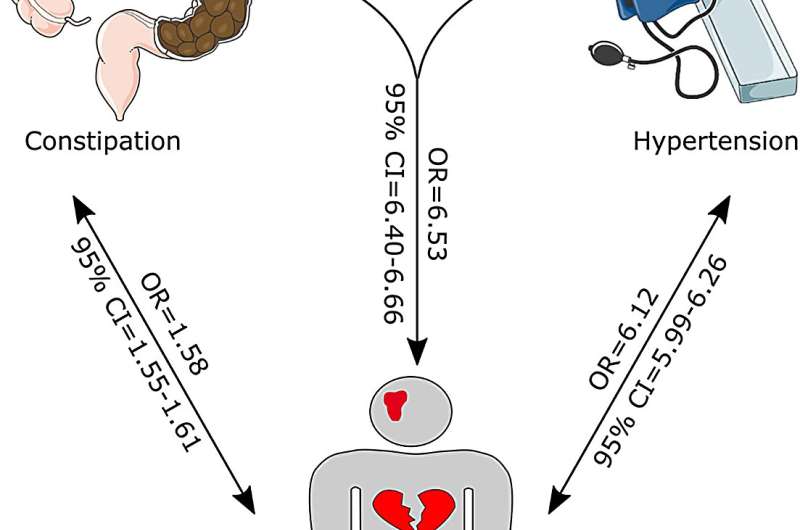
Summary of the findings. This study found that constipation was positively associated with hypertension and cardiovascular events. CI, confidence interval; OR, odds ratio. This figure was partly generated using Servier Medical Art, provided by Servier, licensed under a Creative Commons Attribution 3.0 unported license. Credit: Scientific Reports (2023). DOI: 10.1038/s41598-023-38068-y

A relatively common health problem—constipation—has been shown to be a risk factor for hypertension and cardiovascular events such as stroke in people over 60.

17 aug 2023--The extensive La Trobe University study of over half a million hospital admissions in Victoria suggests that interventions to address constipation may reduce these risks in elderly patients.

The study, led by Professors Grant Drummond and Chris Sobey and published in Scientific Reports, looked at 541,172 hospitalized patients over 60 years of age.

For each constipation admission, one exact age-matched non-constipated admission was randomly selected from all hospitalizations within two weeks to form the control arm of the study.

The researchers found that patients with constipation had almost double the risk for hypertension, and were also more likely to suffer from major cardiovascular events such as heart attack and stroke.

The number of people with cardiovascular diseases (CVD) has nearly doubled over the past 30 years, and the number of deaths from CVD has increased from 12.1 million to 18.6 million during this time.

According to Professor Drummond, despite efforts to modify traditional risk factors for CVD with lifestyle and drug interventions, cardiovascular events are still responsible for 32% of global deaths, 85% of which are due to heart attacks or stroke.

"Therefore, identifying non-traditional CVD risk factors and developing strategies to address them is critical to further reduce CVD-associated morbidity and mortality," Professor Drummond said.

While it is unclear whether constipation is a direct the cause of hypertension in elderly patients, according to Professor Sobey,

"Such a relationship is plausible because in constipation there is increased water absorption from the gut, microbiota changes, and inflammation, all of which could lead to hypertension," Professor Sobey said.

The study found that:

  • constipation in patients was associated with a 96% increased risk of hypertension and also a an increased risk of myocardial infarction, stroke and all cardiovascular events, compared to patients with no constipation
  • patients with both constipation and hypertension had a more than 500% higher risk of cardiovascular events than patients with neither condition.
  • these relationships were similar in males and females
  • 15.2% of people over 60 in the study suffered from constipation

More information: Courtney P. Judkins et al, Association of constipation with increased risk of hypertension and cardiovascular events in elderly Australian patients, Scientific Reports (2023). DOI: 10.1038/s41598-023-38068-y

Friday, June 01, 2007

AAPA: Constipation: It's Not Quantity That Counts

PHILADELPHIA, May 31 -- Infrequent bowel movements are not the most common symptom in patients with constipation.
In fact, frequency ranked next-to-last on a list of seven symptoms ordered according to the percentage of patients who suffer them, said Richard H. Davis Jr., P.A.-C., of the University of Florida in Gainesville at an industry-sponsored symposium held here conjunction with the American Academy of Physician Assistants meeting.
Straining was the most common symptom, experienced by 81% of patients, Mr. Davis said. In contrast, only 36% of patients reported fewer than three bowel movements per week, he said, citing a study published in the November 2001 issue of the American Journal of Gastroenterology.
The complete ranking is as follows:
Straining, 81%
Hard or lumpy stools, 72%
A feeling of incomplete emptying, 54%
Stool cannot be passed, 39%
Abdominal fullness or bloating, 37%
Fewer than three bowel movements per week, 36%
Need to press on the anus, 28%
This ranking suggests that primary care clinicians should broaden their definition of constipation beyond the strictly quantitative criterion, Mr. Davis said. A better, more qualitative, definition might be "unsatisfactory defecation characterized by infrequent stools, difficult stool passage, or both," he said.
Difficult stool passage includes straining, incomplete evacuation, hard/lumpy stools, and the need for manual maneuvers to pass stool, he said.
When assessing a patient's constipation, clinicians should ask about these symptoms as well as asking about frequency of bowel movements, he suggested. One important question: "What is your most distressing symptom?" he said.
Adequate evaluation and treatment of chronic constipation is important, because the condition can have a negative effect on a patient's psychological health and overall quality of life, said Satish S. Rao, M.D., Ph.D., of the University of Iowa in Iowa City. Constipation also has a significant economic impact, Dr. Satish said.
It's estimated that from 2% to 28% of the U.S. population suffers from chronic constipation, Dr. Rao said. And each year, 1.2% of the population seeks medical help to find relief, according to the CDC's National Center for Health Statistics, he added.
Chronic constipation accounts for 2.7 million ambulatory office visits and more than 500,000 trips to the emergency room each year, Dr. Rao said. Nearly 11 million laxative prescriptions were written in 1995, more than were written for antihypertensives or birth control pills, he noted. In addition, Americans spend about $800 million dollars on over-the-counter laxatives each year.
Recent evidence has also linked chronic constipation to psychological distress and disorders, including depression, obsessive-compulsive behavior, anxiety, hostility, and paranoid ideation, Dr. Rao said.