Showing posts with label ageing process. Show all posts

Sunday, December 26, 2021


Uncovered: Key to how exercise protects against consequences of ageing
Uncovered: Key to how exercise protects against consequences of ageing
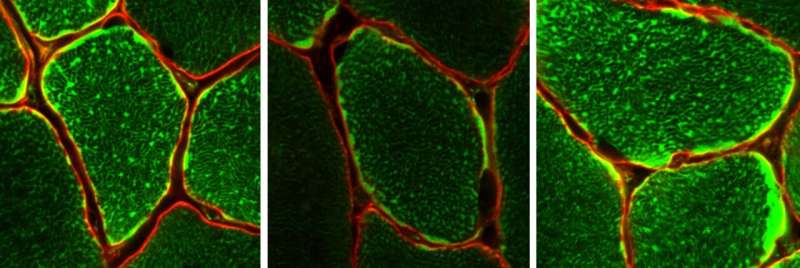
Staining showing mitochondria within individual muscle fibres. Credit: Monash University

Monash University, Australia scientists have discovered an enzyme that is key to why exercise improves our health. Importantly this discovery has opened up the possibility of drugs to promote this enzyme's activity, protecting against the consequences of aging on metabolic health, including type 2 diabetes.

26 dec 2021--The proportion of people worldwide over 60 years old will double in the next three decades and by 2031, more than six million Australians will be over 65 years old. The incidence of type 2 diabetes increases with age so this aging population will also result in an increased incidence of the disease globally.

One of the main reasons for the increased prevalence of type 2 diabetes with age is the development of insulin resistance, or an inability for the body to respond to insulin, and this is often caused by reduced physical activity as we age.

However, the precise mechanisms by which physical inactivity facilitates the development of insulin resistance has remained a mystery.

Now researchers from Monash University in Australia have discovered how  actually enhances insulin responsiveness and in turn promotes metabolic health. Importantly, the enzymes they have discovered that are key to this mechanism have the potential to be targeted by drugs to protect against consequences of aging such as muscle wasting and diabetes.

The team of scientists at the Monash University Biomedicine Discovery Institute (BDI), led by Professor Tony Tiganis, reveals that reductions in skeletal  reactive oxygen species (ROS) generation during aging is instrumental in the development of insulin resistance. According to Professor Tiganis, skeletal muscle constantly produces ROS and this is increased during exercise.

"Exercise-induced ROS drives adaptive responses that are integral to the health-promoting effects of exercise," he said.

In a paper published today (15 December) in the journal, Science Advances, the research team show how an enzyme called NOX-4 is essential for exercise-induced ROS and the adaptive responses that drive metabolic health.

In mice the researchers found that NOX4 is increased in skeletal muscle after exercise and that this then leads to increased ROS which elicits adaptive responses that protect mice from the development of insulin resistance, which otherwise occurs with aging or diet induced-obesity.

Importantly, the scientists have shown that the levels of NOX4 in skeletal muscle are directly related to age-associated decline in insulin sensitivity. "In this study we have shown, in animal models, that skeletal muscle NOX 4 abundance is decreased with aging and that this leads to a reduction in insulin sensitivity," Professor Tiganis said.

"Triggering the activation of the adaptive mechanisms orchestrated by NOX4 with drugs, might ameliorate key aspects of aging, including the development of insulin resistance and type 2 diabetes," he said.

"One of these compounds is found naturally, for instance, in cruciferous vegetables, such as broccoli or cauliflower, though the amount needed for anti-aging effects might be more than many would be willing to consume."

More information: Chrysovalantou Xirouchaki et al, Skeletal muscle NOX4 is required for adaptive responses that prevent insulin resistance, Science Advances (2021). DOI: 10.1126/sciadv.abl4988. www.science.org/doi/10.1126/sciadv.abl4988
Provided by Monash University 

Tuesday, September 17, 2019

Repeated periods of poverty accelerate the ageing process

ageing
Credit: CC0 Public Domain
Genetics, lifestyle and environment are all factors that somehow influence when and how we all age. But the financial situation is also important. Now, researchers from the Center for Healthy Aging and the Department of Public Health have found that four or more years with an income below the relative poverty threshold during adult life make a significant difference as to when the body begins to show signs of ageing.
17 sept 2019--To learn more about the context, the researchers have tested 5500 middle-aged persons, using various ageing markers: physical capability, cognitive function and inflammatory level. The results were then compared with the participants' income throughout the 22 years leading up to the test. An annual income of 60% below the median income is considered relative poverty.
In this way, the researchers found that there is a significant correlation between financial challenges and early ageing. And this is important in order to be able to instigate preventative measures, says co-author and Professor at the Center for Healthy Aging and the Department of Public Health, Rikke Lund.
"Early ageing also means more treatment at an earlier age, and it is a burden both to the individual and the society. With our results, we show that poor finances are a strong indicator of early ageing—this knowledge can be used to prevent the problems. Many people do not necessarily experience any noticeably poorer physical capability until they are growing older and are therefore not aware that their bodies have begun to age prematurely. This means that there will be no focus on preventative measures until it is too late," she says.
Poverty Affects Grip Strength and Memory
The participants have been through both physical and cognitive tests, each of which is an expression of general strength and function. Among other things, the researchers measured the participants' grip strength, how many times they could get up from and sit on a chair in 30 seconds, and how high they could jump. The cognitive tests have, for example, been tasks of memorising sequences.
"There is a significant difference between the test results. People who have been below the relative poverty threshold for four or more years in their adult life perform significantly worse than those who have never been below the threshold," says Rikke Lund.
The results show, among other things, that the financially challenged group, relative to the comparison group, can get up and sit down two times less per 30 seconds, and that their grip strength is reduced by 1.2 kilos.
In addition, the researchers have measured the inflammatory level of the participants—i.e. an inflammatory state that comes from within and is measured in the blood. A high inflammatory level is a sign that the body is in a state of alert and can likewise be used as a marker for illness and ageing. The study shows that the financially challenged also had higher inflammatory levels.
"The results draw a picture that groups which experience serious financial challenges several times in their adult lives age earlier than others. From a broader perspective, the results may inspire a reconsideration of the politically adopted reduced rates of public benefits," says Rikke Lund.

More information: Else Foverskov et al, Economic hardship over twenty-two consecutive years of adult life and markers of early ageing: physical capability, cognitive function and inflammation, European Journal of Ageing (2019). DOI: 10.1007/s10433-019-00523-z
Provided by University of Copenhagen 

Friday, December 12, 2014

Bilingualism and ageing


Many older people keep mentally active and enjoy using 'brain training' puzzles and games for their leisure, however the science on their efficacy is as yet partial and inconclusive.
12 dec 2014--Another area which is as yet, still not fully understood and has also resulted in conflicting results, is whether being bilingual offers a protective factor in age-related conditions such as Alzheimer's disease.   
A small-scale study of bilingual Welsh/English speakers funded by the Economic & Social Research Council, was led by Prof Linda Clare of Bangor University's School of Psychology. At the outset of the research, there was no evidence available about the effects of bilingualism for older Welsh speakers. The now completed study has found no evidence for a significant delay in the onset of Alzheimer's Disease in Welsh/English bilinguals. This finding was comparable to that in Montreal, Canada where no bilingual advantage was found in non-immigrant bilinguals.
One explanation, researchers suggest, is that where people have grown up speaking two languages in a bilingual community, the simultaneous language use may be an automatic and effortless process for lifelong bilinguals, so not sufficiently 'mentally challenging', as compared to the mental activity required by bilinguals who have acquired fluency in a second language at a later stage.
"This may perhaps make bilingualism less likely to provide resilience in the face of cognitive impairment" Professor Linda Clare suggests.
Prof Clare adds:
"Moving science forward can be very piece-meal and slow- we hear about the breakthroughs, but for each breakthrough, there are other research questions which are less dramatic in their results, but no less important. Having completed this small study, the information gained may lead the way for us or others to refine or enlarge the research to see whether we can learn more about what is actually taking place, and improve our understanding…"
A research paper on the findings is available in the Journal of Neuropsychology.
More information: "Bilingualism, executive control, and age at diagnosis among people with early-stage Alzheimer's disease in Wales." J Neuropsychol. 2014 Nov 25. DOI: 10.1111/jnp.12061. [Epub ahead of print]
Provided by Bangor University

Friday, July 29, 2011

Low income, poor diet linked to accelerated aging

A new study of the DNA of people living in Glasgow suggests that earning less than the average wage and eating an unhealthy diet could accelerate the ageing process.

29 july 2011--The study, conducted by the University of Glasgow in collaboration with the Glasgow Centre for Population Health, compared the length of telomeres in blood samples taken from 382 Glaswegians from the most and least deprived parts of the city. Telomeres, the tails on the ends of chromosomes, shorten throughout a person’s life and can be used as a measure of the ageing process.

Over a 10-year period, telomeres shortened by 7.7% in people whose household incomes were less than £25,000, but only 0.6% in people with greater incomes. In those living in rented accommodation, telomere length was reduced by 8.7% compared to 2.2% in those who owned their homes. The telomeres of people with the poorest diets were shortened by 7.7%, compared to 1.8% in those with a better diet.

It is hoped that the findings will help to create a test which can be used for faster feedback on the effects of public health improvement measures. Currently, these effects can take decades to become apparent.

However, due to natural variation in telomere length from person to person, the test is only effective at a population level, and will not provide useful information on how long an individual can expect to live.

Dr. Paul Shiels of the University of Glasgow’s Institute of Cancer Sciences, who led this aspect of the research, said: “Glasgow’s population has one of the most extreme socioeconomic gradients in the world, which makes it an ideal place to conduct a study such as this.

“This study is a first for the city in that it provides a link between how adverse social conditions can influence the biology of ageing and hence disease. What we’ve shown is that social status and deprivation play a major part in how quickly people age and develop disease.

“Eating poorly and earning less than average is likely to increase the rate you age, and can lead to increased inflammation and risk for cardiovascular disease, which is endemic in the city.”

The results are published in the journal PLoS one by the Glasgow Centre for Public Health, a consortium of health and local authorities, the Scottish Government and the University of Glasgow.

Provided by University of Glasgow

Saturday, October 30, 2010

Getting older leads to emotional stability, happiness: study

Getting older leads to emotional stability, happiness: study


"As people get older, they're more aware of mortality," researcher Laura Carstensen said. "So when they see or experience moments of wonderful things, that often comes with the realization that life is fragile and will come to an end. But that's a good thing. It's a signal of strong emotional health and balance."

30 oct 2010--As people age, they're more emotionally balanced and better able to solve highly emotional problems, says psychology professor and longevity expert Laura Carstensen.

It's a prediction often met with worry: In 20 years, there will be more Americans over 60 than under 15. Some fear that will mean an aging society with an increasing number of decrepit, impaired people and fewer youngsters to care for them while also keeping the country's productivity going.

The concerns are valid, but a new Stanford study shows there's a silver lining to the graying of our nation. As we grow older, we tend to become more emotionally stable. And that translates into longer, more productive lives that offer more benefits than problems, said Laura Carstensen, the study's lead author.

"As people age, they're more emotionally balanced and better able to solve highly emotional problems," said Carstensen, a psychology professor and director of the Stanford Center on Longevity. "We may be seeing a larger group of people who can get along with a greater number of people. They care more and are more compassionate about problems, and that may lead to a more stable world."

Between 1993 and 2005, Carstensen and her colleagues tracked about 180 Americans between the ages of 18 and 94. Over the years, some participants died and others aged out of the younger groups, so additional participants were included.

For one week every five years, the study participants carried pagers and were required to immediately respond to a series of questions whenever the devices buzzed. The periodic quizzes were intended to chart how happy, satisfied and comfortable they were at any given time.

Carstensen's study – which was published online Monday in the journal Psychology and Aging – was coauthored by postdoctoral fellows Bulent Turan and Susanne Scheibe as well as Stanford doctoral students and researchers at Pennsylvania State, Northwestern, the University of Virginia and the University of California's campuses in San Francisco and Los Angeles.

While previous research has established a correlation between aging and happiness, Carstensen's study is the first to track the same people over a long period of time to examine how they changed.

The undertaking was an effort to answer questions asked over and over again by social scientists: Are seniors today who say they're happy simply part of a socioeconomic era that predisposed them to good cheer? Or do most people – whether born and reared in boom times or busts – have it within themselves to reach their golden years with a smile? The answer has important implications for future aging societies.

"Our findings suggest that it doesn't matter when you were born," Carstensen said. "In general, people get happier as they get older."

Over the years, the older subjects reported having fewer negative emotions and more positive ones compared with their younger days. But even with the good outweighing the bad, older people were inclined to report a mix of positive and negative emotions more often than younger test subjects.

"As people get older, they're more aware of mortality," Carstensen said. "So when they see or experience moments of wonderful things, that often comes with the realization that life is fragile and will come to an end. But that's a good thing. It's a signal of strong emotional health and balance."

Carstensen (who is 56 and says she's happier now than she was a few decades ago) attributes the change in older people to her theory of "socio-emotional selectivity" – a scientific way of saying that people invest in what's most important to them when time is limited.

While teenagers and young adults experience more frustration, anxiety and disappointment over things like test scores, career goals and finding a soul mate, older people typically have made their peace with life's accomplishments and failures. In other words, they have less ambiguity to stress about.

"This all suggests that as our society is aging, we will have a greater resource," Carstensen said. "If people become more even-keeled as they age, older societies could be wiser and kinder societies."

So what, then, do we make of the "grumpy old man" stereotype?

"Most of the grumpy old men out there are grumpy young men who grew old," Carstensen said. "Aging isn't going to turn someone grumpy into someone who's happy-go-lucky. But most people will gradually feel better as they grow older."

Friday, March 26, 2010

People Are Living Longer And Healthier -- Now What?

People in developed nations are living in good health as much as a decade longer than their parents did, not because aging has been slowed or reversed, but because they are staying healthy to a more advanced age.


26 mar 2010--"We're living longer because people are reaching old age in better health," said demographer James Vaupel, author of a review article appearing in the March 25 edition of Nature. But once it starts, the process of aging itself -- including dementia and heart disease -- is still happening at pretty much the same rate. "Deterioration, instead of being stretched out, is being postponed."

The better health in older age stems from public health efforts to improve living conditions and prevent disease, and from improved medical interventions, said Vaupel, who heads Duke University's Center on the Demography of Aging and holds academic appointments at the Max Planck Institute for Demographic Research in Rostock, Germany, and the institute of Public Health at the University of Southern Demark.

Over the past 170 years, in the countries with the highest life expectancies, the average life span has grown at a rate of 2.5 years per decade, or about 6 hours per day.

The chance of death goes up with age up until the most advanced ages. The good news is that after age 110, the chance of death does not increase any more. The bad news is that it holds steady at 50% per year at that point, Vaupel said.

"It is possible, if we continue to make progress in reducing mortality, that most children born since the year 2000 will live to see their 100th birthday -- in the 22nd century," Vaupel said. If gains in life expectancy continue to be made at the same pace as over the past two centuries, more than half of the children alive today in the developed world may see 100 candles on their birthday cake.

This leads to an interesting set of policy questions, said Vaupel. What will these dramatically longer lifespans mean for social services, health care and the economy? Can the aging process be slowed down or delayed still further? And why do women continue to outlive men - outnumbering them 6 to 1 at age 100?

It also may be time to rethink how we structure our lives, Vaupel said. "If young people realize they might live past 100 and be in good shape to 90 or 95, it might make more sense to mix education, work and child-rearing across more years of life instead of devoting the first two decades exclusively to education, the next three or four decades to career and parenting, and the last four solely to leisure."

One way to change life trajectories would be to allow younger people to work fewer hours, in exchange for staying in the workforce to a later age. "The 20th century was a century of the redistribution of wealth; the 21st century will probably be a century of the redistribution of work," Vaupel said.

Biodemography of human ageing," James W. Vaupel, Nature, Vol. 464, 25 March 2010 doi: 10.1038/nature08984

Source:
Karl Leif Bates
Duke University

Saturday, March 20, 2010

Multiple Generations Under One Roof, Again

Adult children are moving back in with parents, and grandparents are taking up residence with their kids' families. Sound like old times? In fact, multi-generational households are making a comeback, according to a report released today.

20 mar 2010--Some 49 million Americans now live in such an arrangement, up from 28 million in 1980.

The tight-knit families could be the result of both social and economic factors, including the recession but more broadly reflecting a years-long trend, according to study researchers from the Pew Research Center's Social and Demographic Trends project.

The finding extends previous research. Pew research out last year suggested 13 percent of parents with grown children had an adult son or daughter who had moved back home over the past year to take refuge from the dim economy, among other reasons.

The new study involved telephone surveys conducted in February and March 2009 with a nationally representative sample of 2,969 adults living in the continental United States.

Multi-generational family households were defined as: two generations (parents or in-laws and adult children ages 25 and older); three generations (parents or in-laws, adult children and grandchildren); skipped generation (grandparents and grandchildren, without parents); and more than three generations.

Flip-flop

Between 1980 and 2009, there was a 33 percent increase in the share of Americans living in multi-generation households. Just the opposite was found in the decades' prior. For instance, from 1940 to 1980, that share had declined by more than half, from 25 percent in 1940 to 12 percent in 1980.

Demographic factors, such as growth of the nuclear family-centered suburbs, contributed to the falling out of grace of extended family households, Pew reports suggest.

As for the recent growth in such households, Pew researchers say it's partly the result of demographic and cultural shifts, including the increasing proportion of immigrants (who are more inclined than native-born Americans to live with multiple generations), and the rising median age of first marriage of all adults.

On average a guy marries for the first time at age 28, while a typical women ties her first knot at 26. The ages are about five years older than in 1970, Pew researchers say. The result: More unmarried 20-somethings in the population who might be drawn to their childhood home as an attractive living situation.

That's especially true in the weak economy, as high unemployment and rising foreclosures are driving individuals from different generations to double up under the same roof, the researchers say. In fact, from 2007 to 2008, the number of Americans living in a multi-generational family household grew by 2.6 million. No age group is immune. For instance, about one-in-five adults ages 25 to 34 now live in multi-generational households. (The recession began in December 2007.)

Who is affected
This trend has affected adults of all ages, especially the elderly and the young. For example, about one-in-five adults ages 25 to 34, and the same proportion of the 65 and older group, now live in a multi-generational household.

The shift has impacted adults of ages - the elderly, the young, and those "sandwiched" in middle age.
Among the elderly, there has been also been a different, but complementary trend change. After rising steeply for nearly a century, the share of adults ages 65 and older who live alone flattened out around 1990 and has since declined a bit. The report explores the reasons for this trend reversal. Using our own survey data, it also examines the differences in overall happiness, health, well-being and various life experiences between older adults who live alone and those who live with others.

At the other end of the living-arrangement spectrum, single-person households have also increased over the past century. In 1900, just about 1 percent of Americans lived in such a household, compared with 10 percent by 2008.

Among those ages 18 to 24, just 4.6 percent live by themselves, down from 5.7 percent in 1980; for adults ages 65 and older nearly 6 percent lived alone in 1900 compared with 28.8 percent in 1990 and 27.4 percent in 2008.

The bump might not be a good sign for the well-being of those flying solo. According to a Pew Research Center survey conducted last year, adults ages 65 and older who live alone say their health is worse and they are more like to feel sad, depressed or lonely than their counterparts living with a spouse or other family member.

But that's open for debate, as a recent study using data from the General Social Survey found Americans grow happier with age.

Friday, March 05, 2010

Research: How you think about your age may affect how you age

05 mar 2010-- The saying "You're only as old as you feel" really seems to resonate with older adults, according to research from Purdue University.

"How old you are matters, but beyond that it's your interpretation that has far-reaching implications for the process of aging," said Markus H. Schafer, a doctoral student in sociology and gerontology who led the study. "So, if you feel old beyond your own chronological years you are probably going to experience a lot of the downsides that we associate with aging.

"But if you are older and maintain a sense of being younger, then that gives you an edge in maintaining a lot of the abilities you prize."

Schafer and co-author Tetyana P. Shippee, a Purdue graduate who is a research associate at Purdue's Center on Aging and the Life Course, compared people's chronological age and their subjective age to determine which one has a greater influence on cognitive abilities during older adulthood. Nearly 500 people ages 55-74 were surveyed about aging in 1995 and 2005 as part of the National Survey of Midlife Development in the United States.

In 1995, when people were asked what age do you feel most of the time, the majority identified with being 12 years younger than they actually were.

"We found that these people who felt young for their age were more likely to have greater confidence about their cognitive abilities a decade later," Schafer said. "Yes, chronological age was important, but the subjective age had a stronger effect.

"What we are not sure about is what comes first. Does a person's wellness and happiness affect their cognitive abilities or does a person's cognitive ability contribute to their sense of wellness. We are planning to address this in a future study."

Schafer also said that the current study's findings have both positive and negative implications.

"There is a tremendous emphasis on being youthful in our society and that can have a negative effect for people," Schafer said. "People want to feel younger, and so when they do inevitably age they can lose a lot of confidence in their cognitive abilities.

"But on the other hand, because there is such a desire in America to stay young, there may be benefits of trying to maintain a sense of youthfulness by keeping up with new trends and activities that feel invigorating. Learning new technologies is one way people can continue to improve their cognitive abilities. It will be interesting to see how, or if, these cultural norms shift as the Baby Boomer generation ages."

Other studies have shown that women are prone to aging stereotypes, so Schafer expected to see that women who felt older about themselves would have less confidence in their cognitive abilities.

"There is a slight difference between men and women, but it's not as pronounced as we expected," Schafer said. "This was surprising because of the emphasis on physical attractiveness and youth that is often disproportionately placed on women."

Schafer also is studying how stressful events, such as family members' health issues, affect aging, as well as how happiness and aging relate.

###

These finding were published in January's Journal of Gerontology: Social Sciences, and the study was funded by the National Institutes of Health.

Writer: Amy Patterson Neubert, 765-494-9723 begin_of_the_skype_highlighting 765-494-9723 end_of_the_skype_highlighting, apatterson@purdue.edu

Source: Markus Schafer, 765 49-41631, mhschafe@purdue.edu

Related Web site: Center on Aging and the Life Course: http://www.purdue.edu/aging/

Saturday, January 24, 2009

Many of China's 140 million old people find the crowd to be lonely

24 jan 2009--IT has 20 per cent of the world's population with 1.4bn people – but China's rapid economic and social change has caused its pensioners to feel lonely and alienated, a new study suggests.

Although capitalism has brought prosperity and increased political power to China, it has also caused the weakening of a traditional society that had collectivism and strong family ties at its heart.

The study by Durham University and the University of Reading, published in Ageing and Society, examined in detail two surveys of Chinese people aged 60 years and over in 1992 and 2000 (1). The percentage of older people who said they were lonely has doubled from about 16% in 1992 to 30% in 2000.

While loneliness can severely impact a person's quality of life, it can also be a triggering factor for mental health issues. The findings suggest that policy makers in China need to take urgent action to assess what is needed to improve the quality of life for its 140 million older people, who collectively amount to the largest older population in the world.

The Durham and Reading University study suggests potential causes for loneliness include a widespread move since the late1970s from highly collectivised communities, where several generations lived under one roof in close proximity to their neighbours, to communities dominated by the nuclear family, many living in impersonal city apartment blocks.

Under the collectivised system in rural areas, communes, brigades and teams were not only responsible for agricultural production but many other community affairs, meaning a high level of social interaction for all.

In today's economic climate, sons and daughters are more likely to have moved long distances from the country to the city or from one city to another in search of work, often leaving their parents behind. They can work long hours, juggling childcare with the demands of full-time work, and although they send money home, visits can be infrequent. The single-child policy means that older people are increasingly left without a selection of offspring for company and care in their old age.

Lead study author Dr Keming Yang, a Durham University sociologist who hails from China's third largest city, Tianjin, said: "While economic development has brought many benefits for China, such as money, increased political power and better standards of living, loneliness is one of its negative effects.

"Mao has been roundly criticised for many aspects of his leadership but - like it or not - the way the society was structured at the time effectively provided opportunities for a high level of social interaction, either good or bad.

"There was a lack of competition and a slower pace of life where people had more control over their schedule. Members of the community tended to attend long meetings where they would talk to others about not merely business but personal issues as well."

But the study authors point out that more detailed research is needed to obtain a more accurate picture outlining the extent of the loneliness problem: Dr Yang added: "While concentrating on economic advancement it is easy to ignore the wider social effects of a richer but more competitive society.

"Experience of capitalist societies to date suggests it is very likely that many other sections of the population, especially young people who are under huge amounts of pressure at school and home, are feeling the same sense of isolation."

Co-author Professor Christina Victor, of the University of Reading, said: "Levels of loneliness in China are now comparable, or higher than, those observed in Western Europe; therefore, this is not just a problem seen in developed countries."

Dr Yang said a potential solution for the Chinese authorities to tackle loneliness in the old was to ensure the local community played a greater role in engaging older people in social and group activities, although this would require some financial support.

###

Footnote:

(1) The surveys used for the study were the Survey of the Support System for the Elderly in China (1992) and the Survey of the Aged Population in China (2,000). Differences in the design of the two studies mean they can not be used as an exact comparison but they are the best statistical indication to date of the problem of loneliness.

MEDIA INFORMATION

INTERVIEWS:

Dr Keming Yang, lecturer in Durham University's School of Applied Social Sciences, is available for interviews in English or Mandarin Chinese. Tel: +44(0) 191 334 6822 or, out of hours, +44(0) 7951 907888.

Note to broadcasters: An ISDN radio line is available on campus for interviews, for use free of charge. Contact Durham University Media Relations Office for more information/to arrange use.

PHOTOGRAPH:

A headshot of Dr Keming Yang is available from Durham University Media Relations Office.

SOURCE MATERIAL:

The Prevalence of and risk factors for loneliness among older people in China: Yang, K and Victor, Christina R; Ageing and Society 28, 305-327.

Professor Christina Victor is a co-author of 'The Social World of Older People: Understanding Loneliness and Social Isolation in Later Life', published by Open University Press in January 2009.

Monday, March 17, 2008

Scientists discover key genes that 'could slow ageing process'

Scientists have discovered 25 genes that play a crucial role in the ageing process, raising hopes of developing a pill that will keep old age at bay.
Researchers have identified a series of genes in yeast and roundworms which regulate lifespan.
Humans are likely to have similar versions of them and they could be used to treat age-related illnesses, it is claimed.
Lead author Dr Brian Kennedy said: "Now that we know what many of these genes actually are, we have potential targets to go after in humans.
"We hope we could affect those targets and improve not just lifespan but also health span ? the period of a person's life when they can be healthy and not suffer age-related illnesses."

The researchers said the discovery of the genes in yeast and the ringworms ? Caenorhabditis elegans ? was important because the two organisms were 1.5billion years apart in terms of evolution.
The evolutionary gap between humans and C. elegans is not as long.
Scroll down for more...
Some of the genes found were also linked to "pathways" in the human body along which nutrients pass.
Studies have shown that drastically restricting diets of animals such as monkeys and worms can also prolong lifespan.
Dr Matt Kaeberlein, a member of the team from Washington University in the US, said: "Most people don't want to cut their diet that drastically, just to live a little longer.
"But some day, we may be able to accomplish that with a pill."

The findings are published in the journal Genome Research.