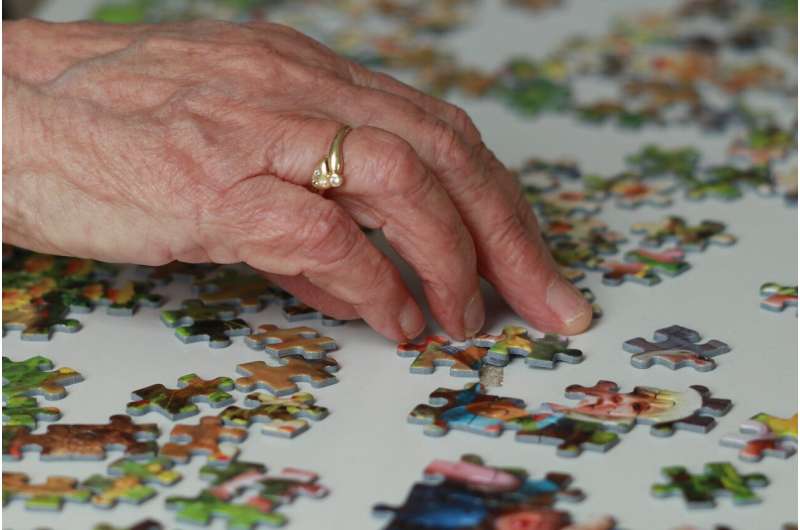
A daily fiber supplement improved brain function in people over 60 in just 12 weeks. The study, published recently in Nature Communications by researchers from the School of Life Course & Population Sciences showed that this simple and cheap addition to diet can improve performance in memory tests associated with early signs of Alzheimer's disease.
11 april 2024--However, the prebiotic supplements inulin and FOS were found to have no effect on muscle strength over this period.
"We are excited to see these changes in just 12 weeks. This holds huge promise for enhancing brain health and memory in our aging population. Unlocking the secrets of the gut-brain axis could offer new approaches for living more healthily for longer," says first author Dr. Mary Ni Lochlainn from the Department of Twin Research.
As populations age globally, the prevalence of age-related conditions such as cognitive decline and muscle loss is on the rise. Researchers at TwinsUK, the U.K.'s largest adult twin registry based at King's College London, sought to understand how targeting the microbiota, the diverse community of microorganisms residing in our intestines, using two cheap, commercially available plant fiber supplements inulin and FOS, could impact both muscle health and brain function.
Researchers assigned 36 twin pairs—72 individuals—over 60 years old to receive either a placebo or the supplement every day for 12 weeks. Neither the analysis team, nor the participants knew which they received until the analysis was complete (double-blind). Alongside this, all study participants did resistance exercises and ate a protein supplement which was aimed at improving muscle function.
Researchers monitored participants remotely via video, online questionnaires and cognitive tests. They found the fiber supplement led to significant changes in the participants' gut microbiome composition, particularly an increase in the numbers of beneficial bacteria such as Bifidobacterium.
While there was no significant difference in muscle strength between the groups, the group receiving the fiber supplement performed better in tests assessing brain function, including the Paired Associates Learning test which is an early marker for Alzheimer's disease, together with tests of reaction time and processing speed. These measures are important for daily living—for example reacting to traffic or stopping a simple trip-up turning into a fall.
"These plant fibers, which are cheap and available over the counter, could benefit a wide group of people in these cash-strapped times. They are safe and acceptable too. Our next task is to see whether these effects are sustained over longer periods and in larger groups of people," says senior author Professor Claire Steves, professor of aging and health.
Another novel aspect of the study was its remote design which demonstrated the feasibility of conducting trials in older adults without the need for extensive travel or hospital visits, which could be delivered in many settings globally. Challenges such as digital literacy and access to the necessary technology were acknowledged and will be addressed in future larger scale projects with the aim to enhance the quality of life for aging populations worldwide.
More information: Mary Ni Lochlainn et al, Effect of gut microbiome modulation on muscle function and cognition: the PROMOTe randomised controlled trial, Nature Communications (2024). DOI: 10.1038/s41467-024-46116-y
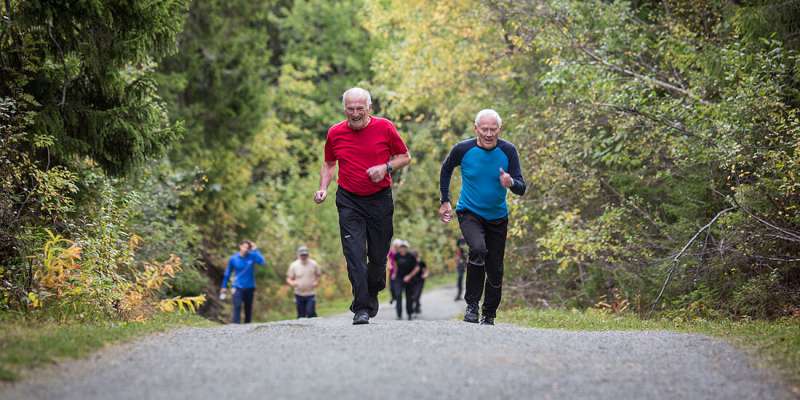
How should older people train to get in better shape? What’s most important, according to the researchers, is that you find an activity that you enjoy and can continue doing over time. Credit: Erlend Lånke Solbu / NRK
Seventy- to eighty-year-olds who train for better fitness are better at solving cognitive tasks and are less likely to suffer cognitive impairment.
20 feb 2022--"Our findings suggest that being fit can protect against mild cognitive impairment in older people," says Ekaterina Zotcheva.
Just before Christmas, Zotcheva defended her doctoral dissertation on exercise and brain health at NTNU. The day before the defense, the last study for her doctoral degree was published in the Sports Medicine journal.
The article is just one of three recent research articles from NTNU that show how important it is for the brain to stay in good physical shape as you get older. Common to all three articles is that they are based on data from the world's largest training study for older adults, the Generation 100 study from the Cardiac Exercise Research Group.
Dementia risk
"The Generation 100 study has been going on for almost ten years now. After the study participants had been exercising for five years, we tested the cognitive function of almost 1,000 of them."
"The men and women who had maintained or increased their physical fitness during the study had better brain health than those whose fitness had declined over the five years," says Zotcheva.
The cognitive test that the participants took is the same one that is often used to check whether people are at risk of developing dementia.
The test assesses short-term memory, execution function and the ability to orient oneself in time and space. Scoring below a certain number indicates a risk of mild cognitive impairment.
"We know that mild cognitive impairment can lead to dementia for some individuals. The greater the increase in a participant's fitness level during the five years of the study, the lower their probability was of developing mild cognitive impairment," says Zotcheva.
Better at problem solving
Good conditioning appears to be an important prerequisite for good brain function in the elderly in the other two research articles as well. In both of these studies, the researchers tested the brain health of more than 100 of the participants in the Generation 100 study at start-up and after one, three and five years of training.
"Participants who were in good shape, both when the study started and later in the study, had a faster reaction time. The ones who improved their fitness level gained a somewhat better working memory," says NTNU professor Asta Håberg.
The ability to solve cognitive problems was tested using the web-based Memoro platform, which Håberg developed in collaboration with neuropsychologist Tor Ivar Hansen.
Less brain atrophy
Håberg has been involved in the work with all three recent research articles. In the third study, the researchers performed MRI scans of the participants' brains to see how the brain volume and thickness of the cerebral cortex changed throughout the study. Here, too, the most energetic participants came out best.
"Participants who were in good shape when the study started had a thicker cerebral cortex after one, three and five years, as compared with those who had lower maximum oxygen uptake. But we didn't find any effect from increasing fitness during the study," says Håberg.
The cerebral cortex is the outermost layer of the brain and is important for several important brain functions, such as attention, ability to make choices, working memory, abstract thinking and memory. This part of the brain becomes thinner with age, and thinning of the cerebral cortex in different areas is linked to different types of dementia, such as Alzheimer's disease and frontotemporal dementia.
Fitness more important than type of exercise
All 70- to 77-year-olds in Trondheim were invited to the Generation 100 study in 2012. Those who agreed to participate were randomly assigned to five years of exercise of various kinds. One group would primarily do high intensity intervals, a second group would mainly go for walks or do other exercise with moderate intensity, and the last group would try to follow the activity recommendations of the health authorities to be physically active for at least 150 minutes each week.
The first two groups were followed up most closely by the researchers, and were offered two organized training sessions each week. The NTNU researchers looked beyond the connection between fitness and brain health and also investigated whether the type of training follow-up that participants received made a difference.
"Our results show that organized training follow-up may have given older men, but not older women, better cognitive function and lowered the probability of mild cognitive impairments. But all in all, it seems that the most important thing is that you actually train in a way that increases your fitness, regardless of whether you get organized help to be physically active or not," says Zotcheva.
Less brain atrophy than expected
"In the groups that received follow-up with high-intensity training and training with moderate intensity, respectively, we found somewhat greater loss of brain volume in deep areas of the brain than among those who trained themselves. But we have to emphasize that everyone in the Generation 100 study—regardless of the form of exercise they did—had less brain loss than expected for people in their 70s. The group that trained on their own without organized follow-up had the least shrinkage in the hippocampus and thalamus," Håberg says.
The training follow-up in Generation 100 was not decisive for the participants' ability to solve cognitive tasks.
"The groups that were able to attend organized training didn't perform any better than the group that trained on their own on various tasks, such as remembering where an object is located, memorizing words, processing information quickly or planning," says Håberg.
Maintained good cognitive function
"It's still worth noting that the 70- to 77-year-old participants on average had the same cognitive abilities after five years as at start-up, and that during the study period they even improved on some of the tests. The results show that being in good shape like the Generation 100 participants were, is important for maintaining good brain function," Håberg says.
The training effect thus seems to be greatest for people who enter retirement age in good shape, and exercise that improves fitness can provide further benefits. So how should the elderly train to get in better shape?
"Several paths can lead to that goal, and the most important factor is to find an activity you enjoy and can continue with over time. In order to maintain or increase your fitness, you should in any case exercise regularly in a way that gets you out of breath and sweaty," says Zotcheva.
More information: Ekaterina Zotcheva et al, Effects of 5 Years Aerobic Exercise on Cognition in Older Adults: The Generation 100 Study: A Randomized Controlled Trial, Sports Medicine (2021). DOI: 10.1007/s40279-021-01608-5
Daniel R. Sokołowski et al, 5 Years of Exercise Intervention Did Not Benefit Cognition Compared to the Physical Activity Guidelines in Older Adults, but Higher Cardiorespiratory Fitness Did. A Generation 100 Substudy, Frontiers in Aging Neuroscience (2021). DOI: 10.3389/fnagi.2021.742587
Jasmine Pani et al, Effect of 5 Years of Exercise Intervention at Different Intensities on Brain Structure in Older Adults from the General Population: A Generation 100 Substudy, Clinical Interventions in Aging (2021). DOI: 10.2147/CIA.S318679
Provided by Norwegian University of Science and Technology
Saturday, January 29, 2022
Keeping the aging brain connected with words and music
by Vibhav Nandagiri, Duke Research Blog
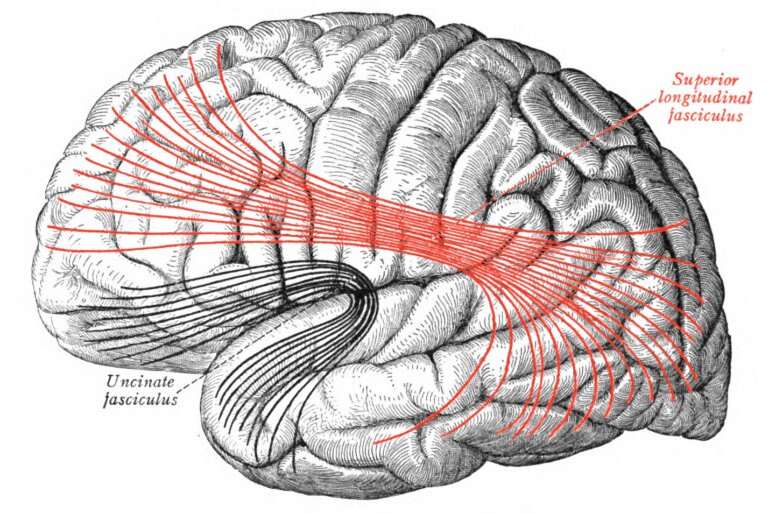
Relative location of subcortical white matter fiber tracts (lateral view). Credit: Wikipedia
In an era of seemingly endless panaceas for age-based mental decline, navigating through the clutter can be a considerable challenge.
29 jan 2022--However, a team of Duke researchers, led by cognitive neuroscientist Edna Andrews, Ph.D., think they may have found a robust and long-term solution to countering this decline and preventing pathologies in an agingbrain. Their approach does not require an invasive procedure or some pharmacological intervention, just a good ear, some sheet music, and maybe an instrument or two.
In early 2021, Andrews and her team published one of the first studies to look at musicianship's impact in building cognitive brain reserve. Cognitive brain reserve, simply put, is a way to qualify the resilience of the brain in the face of various pathologies. High levels of cognitive reserve can help stave off dementia, Parkinson's disease or multiple sclerosis for years on end. These levels are quantified through structural measurements of gray matter and white matter in the brain. The white matter may be thought of as the insulated wiring that helps different areas of the brain communicate.
In this particular study, Andrews' team focused on measurements of white matter integrity through an advanced MRI technique known as diffusion tensor imaging, to see what shape it is in.
Previous neuroimaging studies have revealed that normal aging leads to a decrease in white matter integrity across the brain. Over the past fifteen years, however, researchers have found that complex sensory-motor activities may be able to slow down and even reverse the loss of white matter integrity. The two most robust examples of complex sensory-motor activities are multilingualism and musicianship.
Andrews has long been fascinated by the brain and languages. In 2014, she published one of the seminal texts in the field of cognitive neurolinguistics where she laid the groundwork for a new neuroscience model of language. Around the same time, she published the first and to-date only longitudinal fMRI study of second language acquisition. Her findings, built upon decades of research in cognitive neuroscience and linguistics, served as the foundation for her popular FOCUS course: Neuroscience/Human Language.
In more recent years, she has shifted her research focus to understanding the impact of musicianship on cognitive brain reserve. Invigorated by her lived experience as a professional musician and composer, she wanted to see whether lifelong musicianship could increase white matter integrity as one ages. She and her team hypothesized that musicianship would increase white matter integrity in certain fiber tracts related to the act of music-making
To accomplish this goal, she and her team scanned the brains of eight different musicians ranging in age from 20 years to 67 years old. These musicians dedicated an average of three hours per day to practice and had gained years' worth of performance experience. After participants were placed into the MRI machine, the researchers used diffusion tensor imaging to calculate fractional antisotropy (FA) values for certain white matter fiber tracts. A higher FA value meant higher integrity and, consequently, higher cognitive brain reserve. Andrews and her team chose to observe FA values in two fiber tracts, the superior longitudinal fasciculus (SLF) and the uncinate fasciculus (UF), based on their relevance to musicianship in previous studies.
Previous studies of the two fiber tracts in non-musicians found that their integrity decreased with age. In other words, the older the participants, the lower their white matter integrity in these regions. After analyzing the anisotropy values via linear regression, they observed a clear positive correlation between age and fractional anisotropy in both fiber tracts. These trends were visible in both tracts of both the left and right hemispheres of the brain. Such an observation substantiated their hypothesis, suggesting that highly proficient musicianship can increase cognitive brain reserve as one ages.
These findings expand the existing literature of lifestyle changes that can improve brain health beyond diet and exercise. Though more demanding, neurological changes resulting from the acquisition and maintenance of language and music capabilities have the potential to endure longer into the life cycle.
Andrews is one of the strongest advocates of lifelong learning, not solely for the satisfaction it brings about, but also for the tangible impact it can have on cognitive brain reserve. Picking up a new language or a new instrument should not be pursuits confined to the young child.
It appears, then, that the kindest way to treat the brain is to throw something new at it. A little bit of practice couldn't hurt either.
More information: Edna Andrews et al, Effects of Lifelong Musicianship on White Matter Integrity and Cognitive Brain Reserve, Brain Sciences (2021). DOI: 10.3390/brainsci11010067
Tuesday, April 28, 2015
The art of maintaining cognitive health as our brains age
Brains age, just like the rest of the body, even for those don't get neurological disease, according to an Institute of Medicine report released on April 14.
28 april 2015--"Some of the changes that one observes doesn't mean that it's all over, gloom and doom," the committee's vice chair, Kristine Yaffe, MD, told the Washington Post.
While aging does more damage to some than others, most people can take steps to improve their health, according to Yaffe, the Roy and Marie Scola Endowed Chair and professor of psychiatry, neurology, and epidemiology at UCSF and chief of geriatric psychiatry and director of the Memory Disorders Clinic at the San Francisco VA Medical Center.
The committee proposed three actions to help maintain cognitive function with age: staying physically active; managing blood pressure and diabetes; and stopping smoking. Aging adults should also pay careful attention to health conditions and medications that could influence their cognitive health.
Having an active social and intellectual life can also promote cognitive health, as can getting good sleep. Aging individuals should treat any sleep disorders that develop and be aware of the delirium that can be caused by medications and hospitalization.
The committee advised caution when evaluating claims that brain training and nutritional supplements can improve cognition.
The scientific literature has shown that older adults can get better at trained abilities, although often more slowly than younger adults, and that they can maintain these skills. But it's less clear whether these benefits transfer to real-world activities like driving or remembering an appointment.
As for nutritional supplements, the report says the medical literature does not offer convincing support that any of them can prevent cognitive decline.
The committee urged more protections for older adults, who lose an estimated $2.9 billion a year, directly and indirectly, because of financial fraud. The report said government and the financial services industry should take steps to protectolder adults from exploitation and help preserve their independence.
Provided by University of California, San Francisco
Thursday, May 10, 2012
Researchers say genes and vascular risk modify effects of aging on brain and cognition
Efforts to understand how the aging process affects the brain
and cognition have expanded beyond simply comparing younger and older
adults.
10 may 2012--"Everybody ages differently. By looking at genetic variations and
individual differences in markers of vascular health, we begin to
understand that preventable factors may affect our chances for
successful aging," said Wayne State University psychology doctoral
student Andrew Bender, lead author of a study supported by the National
Institute on Aging of the National Institutes of Health and now in press
in the journal Neuropsychologia.
The report, "Age-related Differences in Memory
and Executive Functions in Healthy APOE ε4 Carriers: The Contribution
of Individual Differences in Prefrontal Volumes and Systolic Blood Pressure,"
focuses on carriers of the ε4 variant of the apolipoprotein (APOE)
gene, present in roughly 25 percent of the population. Compared to those
who possess other forms of the APOE gene, carriers of the ε4 allele are
at significantly greater risk for Alzheimer's, dementia and
cardiovascular disease.
Many studies also have shown that nondemented carriers of the APOE ε4
variant have smaller brain volumes and perform less well on cognitive
tests than carriers of other gene variants. Those findings, however, are
not consistent, and a possible explanation may come from examining
interactions between the risky genes and other factors, such as markers
of cardiovascular health. Prior research in typical samples of older adults
has shown that indeed other vascular risk factors — such as elevated
cholesterol, hypertension or diabetes — can exacerbate the impact of the
APOE ε4 variant on brain and cognition, but it is unclear if such
synergy of risks is present in healthy adults.
Thus, Wayne State researchers evaluated a group of volunteers from 19
to 77 years of age who self-reported as exceptionally healthy on a
questionnaire that screened for a number of conditions, representing a
"best case scenario" of healthy aging. The research project, led by
Naftali Raz, Ph.D., professor of psychology and director of the Lifespan
Cognitive Neuroscience Research Program at WSU's Institute of
Gerontology, tested different cognitive abilities known for their
sensitivity to aging and the effects of the APOE ε4 variant. Those
abilities include speed of information processing, working memory
(holding and manipulating information in one's mind) and episodic memory
(memory for events).
Researchers also measured participants' blood pressure, performed
genetic testing to determine which APOE variant participants carried,
and measured the volumes of several critical brain regions using a
high-resolution structural magnetic resonance imaging brain scan. Bender
and Raz showed that for older APOE ε4 carriers, even minor increases in
systolic blood pressure (the higher of the two numbers that are
reported in blood pressure measures) were linked with smaller volumes of
the prefrontal cortex and prefrontal white matter, slower speed of
information processing, reduced working memory capacity and worse verbal
memory. Notably, they said, that pattern was not evident in those who
lacked the ε4 gene variant.
The study concludes that the APOE ε4 gene may make its carriers
sensitive to negative effects of relatively subtle elevations in
systolic blood pressure, and that the interplay between two risk
factors, genetic and physiological, is detrimental to the key brain
structures and associated cognitive functions.
"Although genes play a significant role in shaping the effects of age
and vascular risk on the brain and cognition, the impact of single
genetic variants is relatively small, and there are quite a few of them.
Thus, one's aging should not be seen through the lens of one's genetic
profile," cautioned the study's authors. They continued, "The negative
impact of many genetic variations needs help from other risk factors,
and while there isn't much one can do about genes, a lot can be done
about vascular risk factors such as blood pressure or cholesterol."
"Everybody should try to keep those in check, although people with
certain genetic variants more so than others." Raz said. "Practically
speaking, even with the best deck of genetic cards dealt to you, it
still makes sense to reduce risk through whatever works: exercise, diet
or, if those fail, medication."
Because the study is part of a longitudinal project, he and Bender
said the immediate future task now is to determine how the interaction
between risky genes and vascular risk factors affect the trajectory of age-related changes — not differences, as in this cross-sectional study — in brain and cognition.
Provided by Wayne State University
Tuesday, July 17, 2007
VAS-COG: Exercise in Midlife May Protect the Aging Brain
SAN ANTONIO, July 16 -- Regular physical activity during midlife is linked to a reduced risk of brain infarcts years later, particularly in men, study shows. Older men who had exercised or played sports in their 40s and 50s had more than a 50% reduction in the risk of cortical and subcortical brain infarcts, according to data presented here at the International Society for Vascular Behavioral and Cognitive Disorders meeting. Older women also tended to benefit from midlife physical activity, but not significantly so, said Satu Pajala, Ph.D., of the National Institue on Aging, and colleagues. Their findings came from the longitudinal, population-based Reykjavik Study begun in Iceland 40 years ago, with a follow-up investigation in 2002. In the earlier study, participants (whose mean age was about 50 at the time) were asked whether they had engaged in sports or exercised regularly since age 20. The follow-up study included a full-brain MRI evaluation. For the current analysis men and women who reported one or more hours of physical activity a week in the 1967 study were classified as exercisers, and those who were less active were classified as non-exercisers. Complete data from both studies were available for 1,956 participants, whose mean age was about 76. Overall, 33% of the 818 men and 22.1% of the 1,138 women had MRI evidence of infarct-like brain lesions. Among men, 26% of infarcts were subcortical, 26% were cortical, and 48% were cerebellar. In women the distribution of infarcts was 21% subcortical, 19% cortical, and 60% cerebellar. Men who had been physically active earlier in life had about a 50% reduction in the risk of subcortical infarcts and a 60% to 70% reduction in the risk of cortical infarcts compared with men who had been inactive. Physically active women had about a 20% to 25% reduction in risk for subcortical infarcts and a 50% risk reduction for cortical infarcts. Physical activity had no apparent effect on late-life white-matter lesions in men or women. After adjustment for multiple clinical and demographic variables, physically active men had an odds ratio of 0.67 (95%CI 0.40- 0.99) for subcortical infarcts and 0.71 (95% CI 0.50-1.00 for all infarcts)for all infarcts compared with men who reported a sedentary history. Among women, the odds ratios for subcortical (OR 1.07, 95% CI 0.64-1.78) and total infarcts (OR 0.97, CI .70-1.34) did not differ between active and inactive study participants. "On the basis of these findings, we hypothesize that exercise in earlier life may be important in maintaining brain health in old age and that exercise's effect on the brain is rather focal than diffuse," Dr. Pajala concluded. The study was funded by the National Institute on Aging, the Icelandic Heart Association, and the Government of Iceland. The authors had no disclosures.Primary source: International Society for Vascular Behavioral and Cognitive DisordersSource reference: Pajala S et al. "Association between midlife physical activity and late-life brain changes on MRI." International Society for Vascular Behavioral and Cognitive Disorders Meeting. July 11-14, San Antonio. Final Program. Abstract P-24.