Showing posts with label antipsychotic drugs. Show all posts

Tuesday, January 14, 2020

Antipsychotic medications linked to brain injuries in individuals with Alzheimer's disease

Alzheimer's disease
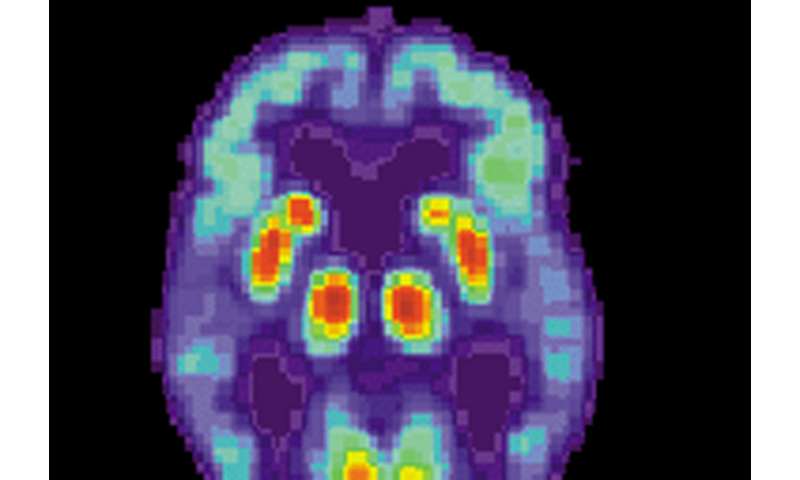
PET scan of a human brain with Alzheimer's disease. Credit: public domain
Use of antipsychotic medications was associated with an increased risk of head injuries in a study of individuals with Alzheimer's disease. The findings are published in the Journal of the American Geriatrics Society.
14 jan 2020--The nationwide study of individuals in Finland who were diagnosed with Alzheimer's disease from 2005 to 2011 included 21,795 patients who started taking antipsychotic medications and 21,795 patients who did not. Use of antipsychotic medications was linked with a 29% higher risk of head injuries—the "event rate" was 1.65 vs. 1.26 per 100 person-years in users vs. non-users. (This means there would be an average of 1.65 vs. 1.26 injuries among 100 people over one year. This translates to 165 vs. 126 injuries per 10,000 people.) Also, use of antipsychotic medications was linked with a 22% higher risk of traumatic brain injuries—0.90 vs. 0.72 per 100 person-years.
When comparing antipsychotic medications, quetiapine users had 60% higher risk of traumatic brain injuries compared with risperidone users.
"Persons with Alzheimer's disease have a higher risk of falling, head injuries, and traumatic brain injuries and worse prognosis after these events in comparison to those without Alzheimer's disease.Therefore, it is important to avoid further increasing risk with antipsychotics in this vulnerable population, if possible," said lead author Vesa Tapiainen, MD, of the University of Eastern Finland.

More information: Vesa Tapiainen et al, The Risk of Head Injuries Associated With Antipsychotic Use Among Persons With Alzheimer's disease, Journal of the American Geriatrics Society (2020). DOI: 10.1111/jgs.16275
Journal information: Journal of the American Geriatrics Society 
Provided by Wiley 

Saturday, November 10, 2018

Common use of antipsychotics shown ineffective for delirium in intensive care patients


Critically ill patients in intensive care units (ICUs) did not benefit from two antipsychotic drugs used to treat delirium, according to a large clinical trial funded by the National Institute on Aging, part of the National Institutes of Health. The multi-site team that conducted the trial found no evidence that treatment with antipsychotic medicines—haloperidol or ziprasidone—affected delirium, survival, length of ICU or hospital stay or safety. The findings from the Modifying the Incidence of Delirium USA (MIND USA) study were published online Oct. 22, 2018 in the New England Journal of Medicine.

10 nov 2018--"This is strong evidence from what we consider a 'gold standard' clinical trial showing that these two antipsychotics don't work to treat delirium during a critical illness," said NIA Deputy Director Marie A. Bernard, M.D. "Antipsychotics have often been used to treat delirium. The evidence from this study suggests the need to reexamine that practice." Bernard is also NIA's senior geriatrician.
Delirium is an acute disturbance in attention and awareness with symptoms that can include disorganized thinking and agitation. More than 7 million hospitalized Americans per year experience delirium. It can affect patients of any age but is more common among older adults who experience major illness—especially involving an ICU stay—or have major surgery. Delirium is also associated with higher ICU costs and multiple adverse outcomes, such as longer hospital stays, long-term cognitive impairment and death.
Antipsychotic medications have been used to treat delirium in ICU patients for 40 years without definitive understanding of their effectiveness. To address the question of benefit versus risk of the use of antipsychotics for delirium, the MIND USA investigators, led by E. Wesley Ely, M.D., M.P.H., professor of medicine at Vanderbilt University Medical Center, Nashville, Tennessee, associate director of Research for the VA Geriatric Research Education Clinical Center, and co-director of the CIBS (Critical Illness, Brain dysfunction, and Survivorship) Center, screened nearly 21,000 patients at 16 U.S. medical centers. Of the 1,183 patients on mechanical ventilation or in shock enrolled, 566 became delirious and were randomized into three groups: those who received intravenous haloperidol, ziprasidone or placebo (saline). The researchers then measured for endpoints including delirium and coma duration, time on mechanical ventilation, successful discharge from ICU and hospital, as well as 30- and 90-day mortality.
Researchers found no significant difference in duration of delirium or coma among those participants on haloperidol or ziprasidone compared to placebo. Similarly, there were no significant differences among participants on either antipsychotic medication compared to placebo in 30-day and 90-day mortality or time on the ventilator, or in the ICU and hospital.
The study population included participants with a wide range of ages, conditions and admission diagnoses. Overall, they had a 73-percent 30-day survival rate and 64-percent 90-day survival rate, which reflects the severe nature of their illnesses. The research team also found no evidence of major harm from the antipsychotics but did note other research suggesting safety concerns—including increased mortality—associated with antipsychotic use in non-ICU geriatric populations.
"This research joins other important studies on delirium showing that there clearly is need for improvement in treating and managing this complicated condition," said Molly Wagster, Ph.D. chief of the Behavioral and Systems Neuroscience Branch in the NIA's Division of Neuroscience. "Large randomized trials like this can inform clinicians and help guide care."

More information: Gerard et al. Haloperidol and Ziprasidone for Treatment of Delirium in Critical Illness. NEJM. 2018 Oct. 22. DOI: 10.1056/NEJMoa1808217


Provided by National Institutes of Health

Thursday, August 09, 2018

Most antipsychotics prescribed in nursing homes initiated there

Most antipsychotics prescribed in nursing homes initiated there
Antipsychotic therapy prescribed to nursing home residents is mostly initiated in nursing homes rather than hospitals or outpatient settings, according to a study published in the June issue of the Journal of the American Geriatrics Society.

09 aug 2018--Yan Zhang, from the University of Iowa in Iowa City, and colleagues used a linked dataset of Chronic Condition Data Warehouse Medicare claims and Long-Term Care Minimum Data Set (MDS) 3.0 to determine care settings of antipsychotic initiations among 7,496 fee-for-service Medicare beneficiaries who had nursing home stays between Jan. 1, 2011, and Dec. 31, 2014.
The researchers found that 64 percent of study participants had new antipsychotic use initiated in nursing homes, 18.6 percent had initiation in hospitals, and 17.5 percent had initiation in outpatient settings. Antipsychotics were often prescribed early in nursing home stays, with 40.4 percent of the entire sample receiving antipsychotic therapy within the first seven days of nursing home admission. Just over half of antipsychotic initiations (58 percent) were potentially appropriate based on indications captured in MDS records.
"Most residents initiated antipsychotic therapy in nursing homes, confirming that nursing home providers are [an] appropriate primary target of interventions to reduce antipsychotic initiation in their residents," the authors write. "Many antipsychotics were continued from other settings, indicating a need to evaluate the necessity of continued antipsychotic treatment after such transitions of care."

More information:

Abstract/Full Text (subscription or payment may be required)

Editorial (subscription or payment may be required)

Tuesday, March 27, 2012

Antipsychotic medication associated with modest heart attack risk in older patients with dementia

Antipsychotic medication was associated with a modest and time-limited increased risk of myocardial infarction (heart attack) among older patients treated with cholinesterase inhibitors for dementia, according to a study published Online First by Archives of Internal Medicine.

27 march 2012--Antipsychotic medications are commonly prescribed for older patients to manage the symptoms of dementia, which can include physical aggression, agitation and hallucinations. For this indication, previous studies have suggested the use of antipsychotic agents (APs) was linked to an increased risk of stroke and safety warnings were issued in several countries. Studies focusing on the risk of death from all causes led to similar conclusions. However, the effect of AP use on the risk of acute myocardial infarction (MI) in patients with treated dementia "remains poorly examined," the authors write in their study background. .

Antoine Pariente, M.D., Ph.D., then of the Université de Montreal, Canada, now of Université Bordeaux Ségalen, France, and colleagues investigated the risk of MI associated with the use of APs in patients with dementia treated with cholinesterase inhibitors (ChIs). Using the Quebec, Canada, prescription claims database, the authors identified 37,138 patients during the study period (January 2000 through December 2009) who were 66 years or older and had ChI treatment. Of them, 10,969 (29.5 percent) started AP treatment during the study period. They were matched with 10,969 non-AP users.

"Our study results indicate that the use of APs is associated with a modest increase in the risk of MI among community-dwelling older patients with treated dementia," the authors note. "The increased risk seems to be highest at the beginning of treatment and seems to decrease thereafter, with the first month of treatment accounting for the highest period of risk."

The results indicate that within one year of starting AP treatment, 1.3 percent of the patients had an incident MI. Hazard ratios for the risk of MI after initiating AP treatment were 2.19 for the first 30 days; 1.62 for the first 60 days; 1.36 for the first 90 days and 1.15 for the first 365 days.

Researchers also performed a self-controlled case series (SCCS) study among 804 new AP users who had an incident MI. The results indicate incidence rate ratios of 1.78 for the one- to 30-day period; 1.67 for the 31- to 60-day period; 1.37 for the 61-to 90-day period; 1.18 for the remaining exposure period; and 0.80 for the withdrawal period.

"Because AP use is frequent in patients with dementia (29.5 percent in our study population), the increased risk of MI may have a major public health effect, which highlights the need for communicating such risk and for close monitoring of patients during the first weeks of treatment," the authors conclude.

In an invited commentary, Sudeep S. Gill, M.D., M.Sc., and Dallas P. Seitz, M.D., of Queen's University, Kingston, Ontario, Canada, write: "The increased risk for death associated with antipsychotic use has raised several important questions, and among them is the question of how exposure to these drugs leads to death."

"Important lessons about the pathogenesis of cardiovascular disease may underlie the observed association between antipsychotic drug use and AMI (acute myocardial infarction) that is described by Pariente et al, but we must await further research to clarify the mechanisms contributing to this association," they comment.

"Meanwhile, physicians should limit prescribing of antipsychotic drugs to patients with dementia and instead use other techniques when available, such as environmental and behavioral strategies, to keep these patients safe and engaged."

More information: Arch Intern Med. Published online March 26, 2012. doi:10.1001/archinternmend.2012.28
Arch Intern Med. Published online March 26, 2012. doi:10.1001/archinternmed.2012.682
Friday, August 29, 2008


All types of antipsychotic drugs increase the risk of stroke

29 aug 2008--All drugs used to treat psychosis are linked to an increased risk of stroke, and dementia sufferers are at double the risk, according to a study published on bmj.com today.
Previous research has shown that second generation (atypical) antipsychotic drugs can increase the chances of patients having a stroke. But the risk of stroke associated with first generation (typical) antipsychotics, and whether the risk differs in people with and without dementia, is not known.
Concerns about an increased risk of stroke among people taking atypical antipsychotic drugs were first raised in 2002, particularly in people with dementia. In 2004, the UK's Committee on Safety of Medicines recommended that these drugs should not be used in people with dementia, despite a lack of clear evidence.
A team of researchers from the London School of Hygiene and Tropical Medicine, examined data from the General Practice Research Database (GPRD), which contains the clinical information of more than six million patients registered at over 400 general practices in the UK.
They assessed the effect of exposure to antipsychotic medication on the incidence of stroke in 6 790 patients with a recorded incident of stroke and at least one prescription of any antipsychotic between January 1988 and the end of 2002.
The authors found that during periods when patients were receiving an antispychotic drug they were 1.7 times more likely to have a stroke, whereas people with dementia were 3.5 times more likely to have a stroke whilst taking any antipsychotic.
The likelihood of having a stroke was slightly higher for people taking atypical antipsychotics than people taking typical antipsychotics.
The study did not look at the specific mechanisms linking antipsychotics and stroke or why the risk is greater with atypical antipsycotics.
Previously, the risk of stroke associated with typical antipsychotics was unclear, say the researchers, but "we have established that all types of antipsychotics carry an increased risk, although the risk might be somewhat higher with the atypical drugs."
They conclude: "We reaffirm that the risks associated with antipsychotic use in patients with dementia generally outweigh the potential benefits, and in this patient group, use of antipsychotic drugs should be avoided wherever possible."

Tuesday, February 27, 2007

Older antipsychotic drugs may be at least as risky as newer ones for seniors

Older antipsychotic drugs may be at least as risky for elderly dementia patients as newer medications, a study says.
The authors of the study suggest until further evidence is available, doctors should proceed with caution when prescribing either type of antipsychotic drug to elderly patients.
The work, by researchers from Harvard Medical School and the University of British Columbia, backs up a previous study the same group published last year in the New England Journal of Medicine. The new study was published in this week's Canadian Medical Association Journal.
In mid-2005, health regulators in Canada and the United States warned that second generation antipsychotic drugs - called atypical antipsychotics - seemed to raise the risk of death when taken by seniors suffering from dementia. Studies had shown that elderly patients newly prescribed these drugs had a 1.6 greater death rate than patients taking a placebo.
Drugs included in these studies were risperidone (Risperdal), quetiapine (Seroquel) and olanzapine (Zyprexa). A fourth in this class, clozapine (Clozaril), was not studied. But because it is in the same family, Health Canada included it in its warning about the potential risks of atypical antipsychotics.

http://www.topix.net/content/cp/3233266442421641731403027975071041850630