Showing posts with label polypill. Show all posts

Saturday, September 03, 2022


'Polypill' reduces cardiovascular mortality by 33% in patients treated after a heart attack
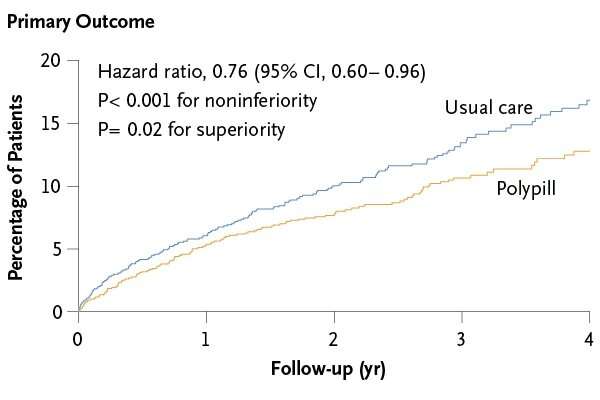
“Polypill” reduces cardiovascular mortality by 33% in patients treated after a heart attack
Credit: The New England Journal of Medicine DOI: 10.1056/NEJMoa2208275

A three-drug medication known as a "polypill," developed by the Spanish National Center for Cardiovascular Research (CNIC) and Ferrer, is effective in preventing secondary adverse cardiovascular events in people who have previously had a heart attack, reducing cardiovascular mortality by 33 percent in this patient population. These are findings from the SECURE trial led by Valentin Fuster, MD, Ph.D., Director of Mount Sinai Heart and Physician-in-Chief of The Mount Sinai Hospital, and General Director of CNIC.The study results were announced Friday, August 26, in a Hot Line session at the European Society of Cardiology Congress (ESC 2022) in Barcelona, Spain, and published in The New England Journal of Medicine.

03 sept 2022--"The results of the SECURE study show that for the first time that the polypill, which contains aspirin, ramipril, and atorvastatin, achieves clinically relevant reductions in the recurrent cardiovascular events among people who have recovered from a previous heart attack because of better adherence to this simplified approach with a simple polypill, rather than taking them separately as conventional," says Dr. Fuster.

Patients recovering from a heart attack—also known as myocardial infarction—are prescribed specific treatments to prevent subsequent cardiovascular events. Standard therapy includes three different drugs: an antiplatelet agent (like aspirin); ramipril or a similar drug to control blood pressure; and a lipid-reducing drug, such as a statin. However, fewer than 50 percent of patients consistently adhere to their medication regimen.

"Although most patients initially adhere to treatment after an acute event such as an infarction, adherence drops off after the first few months. Our goal was to have an impact right from the start, and most of the patients in the study began taking a simple polypill in the first week after having a heart attack," Dr. Fuster explains.

"Adherence to treatment after an acute myocardial infarction is essential for effective secondary prevention," said José María Castellano, MD, study first author and Scientific Director of Fundación de Investigación HM Hospitales.

CNIC scientists first demonstrated that prescription of their polypill significantly improved treatment adherence among patients recovering after a myocardial infarction, in the FOCUS study, previously published in the Journal of the American College of Cardiology (JACC).

The CNIC team launched the SECURE study, an international randomized clinical trial, to determine whether the improved treatment adherence with the polypill translated into a reduction in cardiovascular events. The polypill analyzed in the study, commercialized under the name Trinomia, contains aspirin (100 mg), the angiotensin-converting enzyme inhibitor ramipril (2.5, 5, or 10 mg), and atorvastatin (20 or 40 mg).

"The polypill, being a very simple strategy that combines three essential treatments for this type of patient, has proved its worth because the improved adherence means that these patients are receiving better treatment and therefore have a lower risk of recurrent cardiovascular events," added Dr. Castellano.

SECURE included 2,499 patients from seven European countries (Spain, Italy, Germany, the Czech Republic, France, Poland, and Hungary) recovering after a heart attack. Study participants were randomly assigned to receive standard therapy or the CNIC polypill. The average age of the participants was 76 years, and 31 percent were women. The study population included 77.9 percent with hypertension, 57.4 percent with diabetes, and 51.3 percent with a history of smoking tobacco.

Researchers analyzed the incidence of four major cardiovascular events: death from cardiovascular causes, non-fatal myocardial infarction, non-fatal stroke, and need for emergency coronary revascularization (the restoration of blood flow through a blocked coronary artery). The study followed patients for an average of three years and produced conclusive results: patients taking the CNIC polypills had a 24 percent lower risk of these four events than patients taking the three separate drugs.

The standout finding of the study is the effect of the polypill on the key outcome of cardiovascular-related death, which showed a relative reduction of 33 percent, from 71 patients in the group receiving standard treatment to just 48 in the polypill group. Importantly, the study found that patients in the polypill group had a higher level of treatment adherence than those in the control group, thus confirming the findings of the earlier FOCUS study, and in part such good adherence appears to explain the benefits of the simple polypill.

"The 33 percent reduction in cardiovascular mortality demonstrates the efficacy of treatment with Trinomia compared to standard treatment. These results ratify our purpose of making a positive impact in society and represent an important step in our mission to provide significant and differential value to people who suffer from serious health conditions," explains Oscar Pérez, Chief Marketing, Market Access and Business Development Officer at Ferrer.

"The SECURE study findings suggest that the polypill could become an integral element of strategies to prevent recurrent cardiovascular events in patients who have had a heart attack. By simplifying treatment and improving adherence, this approach has the potential to reduce the risk of recurrent cardiovascular disease and death on a global scale," adds Dr. Fuster.


More information: Jose M. Castellano et al, Polypill Strategy in Secondary Cardiovascular Prevention, The New England Journal of Medicine (2022). DOI: 10.1056/NEJMoa2208275
Provided by The Mount Sinai Hospital 

Sunday, September 16, 2018

Single, fixed-dose combo pills improve hypertension outcomes

Single, fixed-dose combo pills improve hypertension outcomes
Single-pill, fixed-dose combination (FDC) treatment may be more effective for improving blood pressure control in older patients, according to a study recently published in PLOS Medicine.

16 sept 2018--Amol A. Verma, M.D., from St. Michael's Hospital in Toronto, and colleagues used linked clinical and administrative databases to compare clinical outcomes and medication adherence for patients prescribed one angiotensin-converting enzyme inhibitor or angiotensin II-receptor blocker plus one thiazide diuretic, either as a single-pill FDC or as a multi-pill combination. The authors performed a retrospective cohort study, with five year follow-up, of 13,350 patients aged 66 years or older.

The researchers observed no significant difference in outcomes between groups while patients were on treatment (hazard ratio, 1.06; 95 percent confidence interval, 0.86 to 1.31; P = 0.60). The proportion of total follow-up days covered with medications was significantly greater in the FDC group (70 percent) versus the multi-pill group (42 percent; P < 0.01), and a composite of death or hospitalization for acute myocardial infarction, heart failure, or stroke was less frequent in FDC recipients (3.4 versus 3.9 events per 100 person-years; hazard ratio, 0.89; 95 percent confidence interval, 0.81 to 0.97; P < 0.01).
"Among older adults initiating combination antihypertensive treatment, FDC therapy was associated with a significantly lower risk of composite clinical outcomes, which may be related to better medication adherence," the authors write.
One author disclosed financial ties to the pharmaceutical industry.

More information: Abstract/Full Text

Friday, July 08, 2016

Combination therapy best combats heart disease

Combination therapy best combats heart disease
Combination pills could be the future of heart disease treatment.
Using combination drugs or 'polypills', may hold the key to reducing heart disease in Western Australia.
This is the finding of Curtin University researchers who took part in the global Heart Outcomes Prevention Evaluation-3, or 'HOPE-3' study, which involved more than 12,000 participants in 21 countries.

08 july 2016--The study targeted people at a moderate risk of cardiovascular disease, and investigated what impact a combination of inexpensive drugs might have on reducing the risk of heart attack and stroke.
"More than a decade ago, researchers from the UK put forward a proposal that if we had a combination pill, which included cholesterol lowering and blood pressure lowering medications, that a significant improvement may result," says Curtin University's Professor Christopher Reid.
"They estimated around an 80 per cent reduction in heart attacks and strokes. Over the last decade there's been a number of studies that have looked at this concept of a polypill or a combined approach to cardiovascular prevention.
"We provided study participants with anti-hypertensives alone to lower blood pressure, statins alone to lower cholesterol, a combination of the two, and lastly placebos which provided no treatment at all," Prof Reid says.
"Most importantly, we saw a near 40 per cent reduction in heart attacks and strokes in the groups that were receiving combinations, lipid lowering and cholesterol lowering therapies."
"It's really painting a picture that combination therapy may well be one of the best ways in which we can reduce the burden of cardiovascular disease."
Researchers found that anti-hypertensives alone were effective for lowering blood pressure among participants with significantly elevated blood pressures. But those with normal blood pressures, anti-hypertensives had no major impact on heart attacks and strokes.
With cholesterol lowering therapy, overall the test group showed a 25 to 30 per cent reduction in heart attack and stroke rate after the five-year follow-up period.
"What the Hope-3 study did in quite a clever design was randomise participants to receive either blood pressure lowering or lipid lowering or the combination treatments in comparison to placebo treatments in each of those three study groups," Prof Reid says.
He says people at moderate-risk could still fall victim to heart attack and stroke, and says further research is needed into the effectiveness of 'polypills'.
"Hope-3 is a very important part of piecing together the puzzle, and clearly our results demonstrate that in a moderate risk group, the combination of lipid lowering and blood pressure lowering is very effective in reducing heart attacks and strokes."

This article first appeared on ScienceNetwork Western Australia a science news website based at Scitech.

Provided by Science Network WA

Wednesday, September 03, 2014

Polypill increases adherence to post MI treatment


Polypill increases adherence to post MI treatment
Percentage of post MI patients adhering to treatment with the FDC polypill vs. control (conventional treatment with 3 drugs separately) (A) using Morisky Green Adherence Questionnaire; (B) using pill count.

A new polypill increases adherence to treatment following a myocardial infarction (MI), according to results from the FOCUS Study presented for the first time at ESC Congress 2014 today by principal investigator Dr Valentin Fuster, director of Mount Sinai Heart in New York, US. The novel treatment regime has the potential to prevent more patients having a second heart attack.
03 sept 2014--Dr Fuster said: "Despite continuous advances in all areas of cardiovascular (CV) medicine, cardiovascular disease (CVD) has steadily increased in prevalence to become the number one cause of death worldwide. It is estimated that half of the overall reduction in CVD mortality observed over the past 20 years in western countries could be attributed to appropriate use of CV medications for secondary prevention. But lack of adherence to treatment impedes adequate secondary prevention and contributes to the CVD pandemic."
He continued: "The most important factors responsible for a lack of adherence to treatment are the complexity of treatment and the daily number of prescribed pills. The idea of using a polypill for CVD prevention has gained increasing momentum because it could increase adherence and therefore contain the progression of CVD. A polypill could simplify healthcare delivery, improve cost-effectiveness, support the comprehensive prescription of evidence-based cardioprotective drugs, and reach underdeveloped regions of the world."
The Fixed-dose Combination Drug for Secondary Cardiovascular Prevention (FOCUS) study was established to investigate adherence to secondary prevention medication and test a new polypill. The study was conducted in two subsequent phases. FOCUS 1 included post MI patients in a multi-country comprehensive analysis of socioeconomic, comorbidity, and other factors that determine adherence to CV medications. FOCUS 2 was a randomised controlled clinical trial testing the effect of a fixed-dose combination (FDC), the CNIC-FS-FERRER polypill, containing acetylsalicylic acid (ASA) 100 mg, simvastatin 40 mg and ramipril 2.5, 5 or 10 mg, on adherence and control of CV risk factors in post MI patients.
FOCUS 1 included 2 118 patients with a history of MI from five different countries (Spain, Italy, Argentina, Brazil and Paraguay). The degree of adherence to prescribed medications was calculated using the Morisky Green Adherence Questionnaire, a self-reported method with four questions on adherence behaviour. The researchers found an average baseline adherence level of 45.5%.
The researchers also conducted a descriptive analysis of variables that impede adequate adherence. They found that patients below 50 years of age, those taking more than 10 pills, following a complex regimen (i.e. those taking medications other than orally), current smokers and those with sedentary lifestyles were significantly more non-adherent.
Dr Fuster said: "Importantly, there was a significant trend towards more non-adherence with a higher score of depression (as measured by the PHQ-9 questionnaire). Of the socio-demographic variables, illiteracy level, lower social support and lower percentage of insurance cover showed significantly lower levels of adherence as well as those patients being treated by general practitioners (as opposed to cardiologists) and being treated in a private centre (as opposed to a public health centre)."
In a stepwise forward regression model, FOCUS 1 found that the risk of being non-adherent was independently associated with younger age (under 50 years old), scoring high on the depression scale, and following a complex (administrations other than oral) treatment. On the other hand, the odds of being adherent increased with higher percentage of health insurance coverage, and with optimal levels of social support.
In FOCUS 2, a total of 695 patients were enrolled from four countries and followed for a period of nine months. Patients were randomised to receive either the polypill or the three drugs separately. Adherence was measured with two methods: self-reported adherence using the Morisky Green Adherence Questionnaire as well as a direct method, the pill count. The results after nine months of follow up are shown in figure 1.
Dr Fuster said: "Patients were more likely to take their medication to prevent a heart attack when it was given as a polypill, rather than as three separate pills. We found this using two methods. With the self-reported questionnaire, 68% of patients in the polypill group took their drugs compared to just 59% of patients in the group assigned to three drugs. With the pill count, we found that 92% of patients in the polypill group were adherent compared to only 84% in the group assigned to separate drugs."
He added: "FOCUS 1 has identified the reasons that impede appropriate adherence to CV medications in a post MI population from five different countries. FOCUS 2 has shown that, compared with the three drugs given separately, the use of a polypill strategy significantly increases self-reported and directly measured medication adherence for secondary prevention following an acute MI. FOCUS 2 is ongoing and will assess whether there are any differences between the two treatment arms in blood pressure, blood cholesterol, safety or costs."
Dr Fuster concluded: "Our results suggest that the polypill has the potential to prevent more patients having a second heart attack. A randomised trial is needed to test whether the improved adherence with the polypill found in FOCUS results in fewer post MI patients having another MI."
Provided by European Society of Cardiology

Tuesday, August 05, 2014

A polypill strategy to improve global secondary cardiovascular prevention


A polypill strategy to improve global secondary cardiovascular prevention
This Central Illustration for the article shows adherence to the polypill compared to usual care with multiple pills extracted from published research studies, and identifies reasons patients fail to take medications prescribed for secondary prevention of heart disease. Credit:Journal of the American College of Cardiology. 2014;64(6):613-621

05 aug 2014--The polypill, a combination pill taken just once a day that includes key medications for secondary prevention of heart disease, may be an effective low-cost strategy to improve adherence to medication recommendations and reduce costs, according to researchers from Spain and New York, who reviewed research on the polypill.
The review article, A Polypill Strategy to Improve Global Secondary Cardiovascular Prevention, was published online today in the Journal of the American College of Cardiology and will appear in the August 12, 2014 print issue.
Cardiovascular disease is the leading global cause of death, accounting for 17.3 million deaths per year. As the population ages and patients with heart disease survive longer, a growing pool of patients could benefit from secondary prevention of heart disease.
Secondary prevention includes lifestyle changes and the use of medications—including statins, medications to reduce blood pressure, and antithrombotic agents. Use of these medications, which are generally low cost and safe, is thought to be responsible for half of the overall 50 percent reduction in mortality from heart disease in the past 20 years in some Western countries.
According to the researchers, there is room for improvement in secondary prevention, especially in nations with limited resources. The polypill, a combination pill taken just once a day that includes key medications for secondary prevention of heart disease, has been proposed as a low-cost strategy to improve adherence and reduce costs.
More information: Journal of the American College of Cardiologydx.doi.org/10.1016/j.jacc.2014.06.009
Provided by American College of Cardiology

Wednesday, May 07, 2014

Largest ever analysis on the use of a polypill in cardiovascular disease

New data presented for the first time at the World Heart Federation's World Congress of Cardiology 2014 shows a significant improvement in both patient adherence and risk factor control when patients at high risk of heart attack or stroke receive a polypill, compared to usual care. A polypill is a fixed dose combination of commonly-used blood pressure and cholesterol lowering medications, along with aspirin, which helps prevent cardiovascular disease (CVD).
07 may 2014--The Single Pill to Avert Cardiovascular Events (SPACE) project, led by researchers from The George Institute for Global Health, analysed data from 3140 patients with established CVD or at high risk of CVD in Europe, India and Australasia. The results showed a 43 per cent increase in patient adherence to medication at 12 months with the polypill, in addition to corresponding improvements in systolic blood pressure and LDL-cholesterol that were highly statistically significant. The largest benefits were seen among patients not receiving all recommended medications at baseline, which corresponds to mostcardiovascular disease patients globally.
"These results are an important step forward in the polypill journey and management of cardiovascular disease", commented Ruth Webster of the George Institute for Global Health, Sydney. "Most patients globally either don't start or don't continue taking all the medications they need, which can lead to untimely death or further CVD events. An important finding from our analyses is that the greatest benefits from a polypill were for currently untreated individuals. Although the idea of a polypill has always been appealing, we now have the most comprehensive real-world analysis to date of this treatment strategy in high risk CVD patients. Given the potential affordability, even in low income countries, there is considerable potential to improve global health."
CVD is the number one cause of death globally, killing 17.3 million people each year and it is expected to remain the world's leading cause of death in the near future. Access to effective treatment like polypills can play a key part in achieving the bold World Health Organization (WHO) target of at least a 25 per cent reduction in premature mortality from NCDs by 2025, especially as a polypill can be cheaper than several individual drugs.
Professor Salim Yusuf, President-elect of the World Heart Federation said: "These results emphasize the importance of the polypill as a foundation for a global strategy on cardiovascular disease prevention. It will improve patient access to essential medications at an affordable cost and wide use of the polypill can avoid several millions of premature CVD events. The polypill is however not a replacement for a healthy lifestyle and should be combined with tobacco avoidance, a healthy diet and enhanced physical activity. This broad strategy, if adopted widely, can reduce cardiovascular disease to a large extent."
SPACE combined results from three clinical studies which took place from 2009 – 2013: UMPIRE (Europe and India), Kanyini-GAP (Australia) and IMPACT (New Zealand). Importantly, in the Australasian trials, half the patients were indigenous. Further analysis of this unique data source is underway to investigate the effect of the polypill on major patient groups and the results of this are expected over the coming year.
Provided by World Heart Federation

Sunday, April 05, 2009

Polypill can 'halve' heart risk

A single pill containing a combination of drugs could lower heart risk

05 april 2009--Most national newspapers have reported on a study of a ‘polypill’ that can “halve” the risk of heart disease and stroke. The Daily Telegraph said the new “five-in-one pill can significantly reduce the risk of heart disease and stroke in even healthy patients, and could save tens of thousands of lives a year”. The Independent says that the pill “costs pennies”.

The study was carried out in India as a twelve-week trial in 2,053 people (aged 45 to 80 years old) who had no known cardiovascular disease, but had at least one risk factor, such as diabetes or smoking. Some of the participants were given one “Polycap” daily, while others took different combinations of the polypill’s constituent drugs (including cholesterol-lowering drugs, aspirin, and blood pressure drugs).

The trial was well-conducted, and its findings are promising. It indicates that the formulation of this particular polypill is at least as effective as the drugs given separately (other than its effect on lipids). Whether or not it actually reduces mortality from strokes and heart disease will need to be demonstrated by larger trials.

Where did the story come from?

The trial was conducted by doctors from The Indian Polycap Study (TIPS) and funded by the makers of the Polycap, Cadila Pharmaceuticals. The study was published in the peer-reviewed medical journal The Lancet.

What kind of scientific study was this? This was a phase II randomised controlled trial of the Polycap, a new capsule pill that combines several existing drugs that are known to reduce the risk of coronary heart disease and stroke by improving lipid profiles, blood pressure and clotting factors in the blood.

The Polycap contains

  • thiazide (12.5mg)
  • atenolol (50mg)
  • ramipril (5mg)
  • simvastatin (20mg) to lower cholesterol
  • aspirin for thinning the blood (100mg)

These include aspirin, a statin, three blood pressure-lowering drugs, and folic acid.

It was, in part, a ‘non-inferiority’ trial, which means that it firstly tested whether the Polycap was no worse at improving risk factors than each drug given separately. Once the non-inferiority of the Polycap combination was confirmed, it was compared with pills containing one drug, two drugs and three drugs to observe the effect of different polypills.

The researchers recruited 2,053 people without cardiovascular disease from 50 health centres across India. The participants were aged 45 to 80 years old, and each of them had one risk factor, which included either type 2 diabetes, high blood pressure (more than 140mm Hg systolic or 90mm Hg diastolic), being a smoker within the past five years, having a large waist-to-hip ratio (a measure of abdominal obesity), or having abnormal lipids (LDL-cholesterol more than 3.1mmol/L or HDL-cholesterol less than 1.04mmol/L).

The participants were also not taking any of the study drugs, or they had more extreme levels of risk factors, abnormal liver function, asthma or were pregnant.

The participants were randomly split into nine groups, and each group were given a different treatment for 12 weeks. Of these, 412 were randomised to one Polycap daily. The other eight groups took other combinations of the constituent drugs in a similar capsule, to allow comparison. These other groups took identical-looking capsules containing one of the following:

  • Aspirin
  • Hydrochlorothiazide
  • Hydrochlorothiazide and ramipril
  • Hydrochlorothiazide and atenolol
  • Ramipril and atenolol
  • Hydrochlorothiazide, ramipril and atenolol
  • Hydrochlorothiazide, ramipril, atenolol and aspirin simvastatin

After obtaining written informed consent, there was a three-week lead-in period while the participants’ condition at the beginning of the trial was recorded. The researchers then recorded the participants’ blood pressure and heart rate to test for the effects of medication to lower blood pressure. The participants also had blood tests for LDL-cholesterol, and a urine test for the antiplatelet effects of aspirin.

Records were made at four, eight, twelve and sixteen weeks. The rates of discontinuation of drugs was also recorded as a safety measure.

The researchers analysed the nine groups according to the groups that they had been originally allocated.

What were the results of the study?

The results were reported for the nine different formulations. The main result was that groups taking the Polycap had a reduction in systolic blood pressure of 7.4mmHg and diastolic blood pressure of 5.6mmHg. The blood pressures achieved were lower than in groups that did not receive drugs to lower blood pressure.

The blood pressure reduction was the same whether aspirin was included in the Polycap or not. The more blood pressure drugs were used, the greater the reductions in blood pressure (2.2/1.3mm Hg with one drug, 4.7/3.6mm Hg with two drugs, and 6.3/4.5mm Hg with three drugs).

The Polycap reduced LDL cholesterol by 0.70mmol/L, which was less than taking simvastatin on its own (0.83mmol/L, 0.72–0.93; p=0.04). Both these reductions were greater than that in the groups that were not given simvastatin.

The Polycap was no worse than the other combinations that contained aspirin in terms of showing the antiplatelet (blood thinning) effects of aspirin.

Tolerability of the Polycap was similar to that of other treatments, and there was no evidence that increasing the number of active components in one pill increased intolerability.

What interpretations did the researchers draw from these results? The researchers simply say that the Polycap formulation “could be conveniently used to reduce multiple risk factors and cardiovascular risk”. They also say that they are unable to clarify why the Polycap was less effective at lowering LDL-cholesterol than when the statin, simvastatin, was used alone.

What does the NHS Knowledge Service make of this study? This important study has been widely reported because it is the first to have tested the multiple effects of a combination pill for reducing heart and stroke risk factors in people without known cardiovascular disease. The researchers emphasise that it cannot be assumed that the effects of any type of polypill are equal to the effects of its individual components, and that each polypill needs testing individually.

This study has demonstrated that combination pills can reduce risk factors for heart disease and stroke to a similar extent as the component medications. Whether or not these pills fulfil the potential to reduce mortality from strokes and heart disease will need to be clarified with further research.

There are a few other points to note:

  • Other groups of researchers around the world are investigating polypills with different formulations. Each formulation would need to be tested individually to assess its pharmacological properties.
  • The researchers say that because this formulation containing 20mg of simvastatin did not reduce cholesterol as well as simvastatin on its own, it may lead to combination pills that contain alternative doses or alternative statins.
  • As the study was carried out in India, it is not known whether the drugs studied would have a similar effect on other ethnic groups.

The researchers calculate the expected reduction in risk of stroke and heart attack based on the improvement in risk factors (cholesterol, blood pressure and platelet function) shown in their trial by multiplying the risk ratios together. This gives an expected reduction of 62% in the rate of coronary heart disease and 48% in the rate of stroke, over five years. However, it is not yet known if this reduction can be achieved in practice.

Wednesday, April 01, 2009

ACC: Polypill May Reduce Cardiovascular Risk

Combo treatment with anti-hypertensive drugs, a statin and aspirin suggests favorable results

01 april 2009-- A polypill -- a combination of three blood-pressure-lowering drugs at low doses, with a statin, aspirin and folic acid -- could significantly reduce cardiovascular events in otherwise healthy patients, according to an article published online March 30 in The Lancet to coincide with the American College of Cardiology's 58th Annual Scientific Session held March 29 to 31 in Orlando, Fla.

Salim Yusuf, M.D., of McMaster University in Hamilton, Ontario, Canada, and colleagues randomly assigned 2,053 Indian patients aged 45 to 80 who were free of heart disease but had one risk factor to receive either a polypill containing low doses of thiazide, atenolol, ramipril, simvastatin and aspirin or aspirin alone, simvastatin alone, hydrochlorthiazide alone, three combinations of the two blood-pressure-lowering drugs, three blood-pressure-lowering drugs alone, or three blood-pressure-lowering drugs plus aspirin.

The researchers found that the polypill reduced systolic blood pressure by 7.4 mm Hg and diastolic blood pressure by 5.6 mm Hg, which was similar when three blood-pressure-lowering drugs were used, with or without aspirin, compared with groups not receiving blood-pressure-lowering drugs. They also found that the polypill reduced low-density lipoprotein (LDL) cholesterol by 0.70 mmol/L, which was less than that with simvastatin alone.

"Our findings emphasize that the effects of the polypill cannot be assumed to equal the combined effects of its individual components," the authors write. "Every preparation of a combination pill needs to be tested to assess its pharmacokinetic and pharmacodynamic effects, before it is used in larger studies examining clinical outcomes. The substantial preservation of the lowering of blood pressure, heart rate, LDL cholesterol, and 11-dehydrothromboxane B2 with the Polycap suggests that it has the potential to greatly reduce cardiovascular disease."

The study was supported by Cadila Pharmaceuticals, Ahmedabad, India; one of the authors disclosed a financial relationship with Cadila.

Abstract
Full Text (subscription or payment may be required)