Showing posts with label heart disease risk. Show all posts

Sunday, February 20, 2022


Social isolation and loneliness increase heart disease risk in senior women
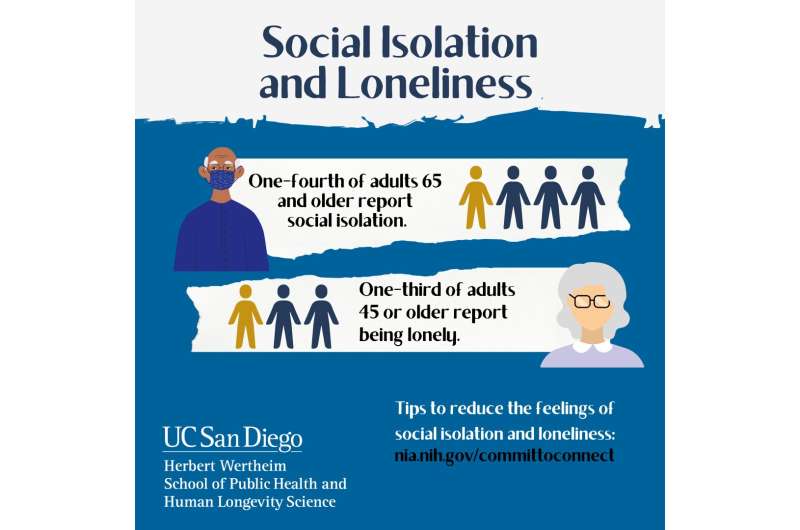
Social isolation and loneliness increase heart disease risk in senior women
As social networks shrink, older adults are more at risk for social isolation and loneliness. Credit: Herbert Wertheim School of Public Health and Human Longevity Science at University of California San Diego

During the current pandemic, social distancing has been one tool used to reduce the spread of COVID-19. But data from a new study point to as much as a 27% increase in heart disease risk in postmenopausal women who experience both high levels of social isolation and loneliness.

20 feb 2022--The findings of the prospective study, published in the February 2, 2022 online issue of JAMA Network Open, reveal that social isolation and loneliness independently increased cardiovascular disease risk by 8% and 5% respectively. If women experienced high levels of both, their risk rose 13% to 27% compared to women who reported low levels of social isolation and low levels of loneliness.

"We are social beings. In this time of COVID-19, many people are experiencing social isolation and loneliness, which may spiral into chronic states," said first author Natalie Golaszewski, Ph.D., a postdoctoral scholar at the Herbert Wertheim School of Public Health and Human Longevity Science at University of California San Diego. "It is important to further understand the acute and long-term effects these experiences have on cardiovascular health and overall well-being."

Importantly, social isolation and loneliness are mildly correlated and can occur at the same time, but they are not mutually exclusive. A socially isolated person is not always lonely and conversely a person experiencing loneliness is not necessarily socially isolated.

"Social isolation is about physically being away from people, like not touching or seeing or talking to other people. Loneliness is a feeling, one that can be experienced even by people who are regularly in contact with others," said senior author John Bellettiere, Ph.D., M.P.H., assistant professor of epidemiology at the Herbert Wertheim School of Public Health.

Social isolation and loneliness are a growing public health concern as they are associated with health conditions that increase the risk of cardiovascular disease including obesity, smoking, physical inactivity, poor diet, high blood pressure and high cholesterol.

When researchers included all of these health behaviors and conditions in their study and adjusted for diabetes and depression, high social isolation and loneliness remained strongly linked with increased risk for heart disease, supporting the importance of studying these social conditions.

According to the Centers for Disease Control and Prevention, heart disease is the leading cause of death for women in the United States, responsible for 1 in every 5 deaths.

As social networks shrink, older adults are more at risk for social isolation and loneliness, wrote the authors. One-fourth of adults 65 and older report social isolation and one-third of adults 45 or older report being lonely.

"We do not yet know whether the increased risk of cardiovascular disease is due to acute exposure to social isolation and loneliness or whether prolonged exposure accumulated over a lifetime is the culprit. Further studies are needed to better understand that," said Bellettiere.

Previous research indicates women experience more social isolation than men.

For this study, 57,825 postmenopausal women living in the United States who had previously participated in the Women's Health Initiative study responded to questionnaires assessing social  from 2011 to 2012. They were sent a second questionnaire assessing loneliness and social support in 2014 to 2015.

Participants were followed from the time of the questionnaire completion through 2019 or when they were diagnosed with cardiovascular disease. A total of 1,599 women experienced cardiovascular disease.

"Measures of social isolation and loneliness—even with brief questions as was done in our study—should be incorporated into standard care," said Golaszewski. "We monitor our patients' blood pressure, weight and temperature, and it might also be beneficial to capture the social needs that individuals may be lacking to better understand cardiovascular risk and develop solutions."

Individuals who feel lonely or socially isolated can find information about steps to help reduce these feelings from the National Institute on Aging.


More information: Evaluation of Social Isolation, Loneliness, and Cardiovascular Disease Among Older Women in the US, JAMA Network Open (2022). DOI: 10.1001/jamanetworkopen.2021.46461
Provided by University of California - San Diego 

Sunday, March 13, 2016

Latin dancing may have health benefits for older adults

A four-month dance program helped older Latino adults walk faster and improved their physical fitness, which may reduce their risk for heart disease, according to research presented at the American Heart Association's Epidemiology/Lifestyle 2016 Scientific Sessions.

13 mar 2016--Researchers at the University of Illinois at Chicago tested whether a community-based intervention focused on Latin dancing could benefit 54 Spanish-speaking adults (about 65 years old, 80 percent Mexican female) who were not very physically active. Participants were randomly assigned to either participate in a dance program twice a week for four months or to attend a health education program. All participants completed questionnaires about their leisure time physical activity and a 400-meter walk test at the start and end of the study.
After four months of twice-weekly Latin dancing, researchers found:
  • Dancers walked faster and were more physically active during their leisure time than before they started dancing.
  • Dancers completed a 400-meter walk in just under 392 seconds compared with almost 430 seconds at the start of the study.
  • Leisure physical activity rose from 650 minutes to nearly a total of 818 minutes per week.
Those in the health education classes had a smaller improvements in their fitness—they finished the 400-meter walk in about 409 seconds at the end of the study compared with 419 seconds four months earlier; total time spent on weekly leisure physical activity increased from 522 minutes to 628 minutes over the course of the study.
The dance program is a program called BAILAMOS©, a culturally-tailored, community-based lifestyle intervention developed at the University of Illinois at Chicago by David X. Marquez and Miguel Mendez, included four different dance styles—merengue, bachata, cha cha cha and salsa—led by the dance instructor, with more complex choreography as the program progressed.
Increasing physical activity is one of the key 2020 Impact Goals of the American Heart Association, which calls for all adults to get a minimum of 150 minutes of moderate physical activity or at least 75 minutes of vigorous physical activity(or a combination of both) each week. Regular physical activity has been shown to reduce the risk of heart disease, stroke, type 2 diabetes and complications associated with advancing age as well as improve balance, mobility and reduce stress.
Scaling up such a culturally-attuned, and what appears to be a fun intervention could have significant public health effects, said Priscilla Vásquez, M.P.H., lead study author at the University of Illinois at Chicago.
'There are many barriers older Latino adults face, and they are busy with caregiving and other responsibilities, so often physical activity takes a back seat and many times the opportunities are unavailable," Vásquez said. "This program engaged them on many levels, physically, culturally and emotionally. Anecdotally, I've heard participants say attending dance class is their stress relief. They also interact with others and build community. This impacts their physical as well as emotional health and wellbeing."
Dancing could have wider health implications, too. Vásquez said the research team is interested in testing whether BAILAMOS© can help older Latinos already experiencing mild cognitive impairment. "We are interested in using magnetic resonance imaging to see if dancing positively affects their brains," she said.


Provided by American Heart Association

Tuesday, January 31, 2012

Two-arm blood pressure check indicator for risk from heart disease or death

A systematic review and meta-analysis carried out by researchers at the University of Exeter Peninsula College of Medicine and Dentistry (PCMD) has found that differences in systolic blood pressure between arms could be a useful indicator of the likelihood of vascular risk and death.

31 jan 2012--The findings add support to the calls for both-arm blood pressure checks to be performed as standard.

The review is published in The Lancet online today and the study is supported by the Royal College of General Practitioners, the South West GP Trust and the National Institute for Health Research Peninsula Collaboration for Leadership in Applied Health Research and Care.

The study reviewed 28 papers covering difference in systolic blood pressure between arms. It found significant evidence to suggest that a difference of 15mm Hg or more was associated with increased risk of: peripheral vascular disease (the narrowing and hardening of the arteries that supply blood to the legs and feet); pre-existing cerebrovascular disease (affecting the blood supply to the brain and often associated with cognitive issues such as dementia); and mortality, both as a result of cardiovascular problems and generally.

The risk of peripheral vascular disease was also increased at a difference of 10mm Hg or more.

The findings further support the need for both-arm blood pressure checks to be the norm – not least because most cases are 'clinically silent' and such checks would better identify those at risk.

Dr. Christopher Clark, Clinical Academic Fellow at PCMD and a GP in Witheridge, Devon, led the study. He said: "We set out to investigate whether there was an association between differences in systolic blood pressure between arms and vascular disease and mortality. Our findings indicate a strong association, and that differences of 10mm Hg or 15mm Hg or more might help to identify patients who are at risk and who need further vascular assessment. More research is Linkrequired in order to transfer our findings to clinical practice, but in the meanwhile we will be flagging the results of our review to the UK Vascular Check programme."

More information: Paper online: http://www.thelancet.com/journals/lancet/article/PIIS0140-6736(11)61710-8/abstract

Provided by The Peninsula College of Medicine and Dentistry

Sunday, January 29, 2012

Food fried in olive or sunflower oil is not linked to heart disease

Eating food fried in olive or sunflower oil is not linked to heart disease or premature death, finds a paper published in the British Medical Journal today.

29 jan 2012--The authors stress, however, that their study took place in Spain, a Mediterranean country where olive or sunflower oil is used for frying and their results would probably not be the same in another country where solid and re-used oils were used for frying.

In Western countries, frying is one of the most common methods of cooking. When food is fried it becomes more calorific because the food absorbs the fat of the oils.

While eating lots of fried food can increase some heart disease risk factors such as high blood pressure, high cholesterol and obesity, a link between fried food and heart disease has not been fully investigated.

So the authors, led by Professor Pilar Guallar-Castillón from Autonomous University of Madrid, surveyed the cooking methods of 40,757 adults aged 29 to 69 over an 11-year period. None of the participants had heart disease when the study began.

Trained interviewers asked participants about their diet and cooking methods. Fried food was defined as food for which frying was the only cooking method used. Questions were also asked about whether food was fried, battered, crumbed or sautéed.

The participants' diet was divided into ranges of fried food consumption, the first quartile related to the lowest amount of fried food consumed and the fourth indicated the highest amount.

During the follow-up there were 606 events linked to heart disease and 1,134 deaths.

The authors conclude: "In a Mediterranean country where olive and sunflower oils are the most commonly used fats for frying, and where large amounts of fried foods are consumed both at and away from home, no association was observed between fried food consumption and the risk of coronary heart disease or death."

In an accompanying editorial, Professor Michael Leitzmann from the University of Regensburg in Germany, says the study explodes the myth that "frying food is generally bad for the heart" but stresses that this "does not mean that frequent meals of fish and chips will have no health consequences." He adds that specific aspects of frying food are relevant, such as the type of oil used.

Provided by British Medical Journal

Tuesday, April 29, 2008

Overweight warning: More than exercise needed

29april 2008--Exercise will not cut the risk of heart disease in those who are overweight unless they also slim down, according to a study of thousands of U.S. women published on Monday.
"Even high quantities of physical activity are unlikely to fully reverse the risk of coronary heart disease in overweight and obese women without concurrent weight loss," Dr. Amy Weinstein and colleagues at Boston's Beth Israel Deaconess Medical Center reported.
"Regardless of body weight, (the findings) highlight the importance of counseling all women to participate in increasing amounts of regular physical activity and maintaining a healthy weight to reduce the risk of coronary heart disease," they concluded.
The study, appearing in the Archives of Internal Medicine, was based on information from a study of nearly 39,000 women that began in 1992 and traced a number of health issues.
The researchers said 34 percent of the women in the study were physically active based on government guidelines, 31 percent were overweight and 18 percent were obese.
In the end, 948 women were diagnosed with heart disease. Active women with normal weight had the lowest risk of developing heart problems while there was a slightly higher risk for those with normal weight who were not active.
The risk was next highest for active women who were either overweight or obese, and highest for similar women who were inactive.
Fat cells produce chemicals that can speed up hardening of the arteries and increase inflammation, the researchers said, harming blood vessels, while physical activity makes for healthier blood vessels and reduces the risk of blood clots.

Monday, March 26, 2007

Place more than race tied to heart disease risk

Results presented at American College of Cardiology and American Heart Association’s Cardiovascular Disease and Epidemiology meetings
Where you live might play a bigger role in your risk for heart disease than your ethnicity or race. New research reveals that rural residents were more knowledgeable about healthy eating and heart disease risk than urban residents, but that urban residents were more motivated and optimistic about getting healthy. And further, these differences persisted when the researchers compared rural Caucasians to urban Caucasians. The findings could help healthcare professionals better target heart disease prevention programs.
Carol Homko, Ph.D., researcher and assistant professor at Temple University School of Medicine, suggests that the differences are partly due to lifestyle. Fresh fruits and vegetables are more plentiful and less costly in rural areas, where it's also easier and safer to exercise outside. Urban areas often lack good grocery stores, forcing residents to rely on corner stores that don't have many fresh food selections at reasonable prices.